Feature Photo: Anthony22 at en.wikipedia, CC BY-SA 3.0 <https://creativecommons.org/licenses/by-sa/3.0>, via Wikimedia Commons
It is no exaggeration to say that the Bronx Zoo is one of the most famous zoos in the United States. As someone raised in the Bronx not far from the Zoo, I take much joy in writing a history of this magical oasis of escape from city life. The Bronx Zoo is a legendary American institution, but to understand its scale, you have to look at the numbers. Sprawling across 265 acres of woods, wetlands, and parkland, it reigns as the largest metropolitan zoo in the United States. This massive footprint allows the zoo to achieve something spectacular: housing more than 4,000 animals representing upwards of 650 species right in the middle of a bustling urban environment. Since opening its gates in 1899, the Bronx Zoo has done more than just showcase wildlife; it has actively rewritten the playbook for global animal conservation and exhibit design.
Origins: From Royal Menageries to Public Parks
Humans have always been fascinated by exotic animals, but for centuries, collecting them was a game of power. Ancient rulers built private menageries to flaunt their wealth and conquests. The modern zoo, however, was born from a different impulse in the 18th and 19th centuries. As European cities ballooned during the Industrial Revolution, two distinct trends collided: a desperate need for public entertainment and a rising scientific curiosity about the natural world.
The United States quickly followed suit. While the Philadelphia Zoo is widely recognized as the country’s first official zoo, opening in 1874, New Yorkers had already been flirting with the concept. P.T. Barnum’s American Museum drew massive crowds with its traveling exotic animals, and the Central Park Menagerie offered a small escape in Manhattan. But as American cities grew, civic leaders wanted something grander.
In 1895, a group of forward-thinking New Yorkers, spearheaded by naturalists, wealthy philanthropists, and members of the Boone and Crockett Club, formed the New York Zoological Society (known today as the Wildlife Conservation Society). They established three core pillars: found a world-class zoo, protect wildlife, and advance science.
To realize this dream, the city struck a deal with the Society, transferring 261 acres of land from Bronx Park to their care for just one dollar, on the condition that the park remain free to the public on most days. On November 8, 1899, the zoo officially opened its doors, debuting 22 exhibits and welcoming a massive wave of eager city residents.
The Taxidermist-Turned-Conservationist and a Complicated Legacy
The man chosen to lead this new experiment was William Temple Hornaday. By trade, Hornaday was a taxidermist, an occupation that seems at odds with modern conservationists. Yet, it was precisely his work with the dead that inspired him to save the living. While collecting specimens for the Smithsonian in the American West, Hornaday witnessed the near-total annihilation of the American bison. Horrified by the destruction, he dedicated his life to ensuring future generations wouldn’t just know these creatures as stuffed museum displays.
Hornaday helped launch the National Zoo in Washington, D.C., in 1889, but after clashing with his superiors, he brought his fierce, uncompromising energy to New York, directing the Bronx Zoo for over thirty years.
However, Hornaday’s legacy is deeply complicated and marred by systemic prejudice. In September 1906, he made the abhorrent decision to exhibit Ota Benga, a young Mbuti Congolese man, inside the zoo’s Monkey House. Ota Benga had been brought to the US by an explorer to be displayed at the World’s Fair, but placing him in a cage with primates at the Bronx Zoo sparked immediate, justifiable outrage. New York’s Black community, led by a coalition of local Baptist clergymen like the Reverend James H. Gordon, fiercely protested the exhibition. While Hornaday stubbornly defended the display as a “scientific exhibit,” the intense pressure and threat of legal action forced the zoo to quietly release Ota Benga from the cage by the end of that same month. It remains a dark, cautionary chapter in the institution’s history.
Architectural Grandeur: Astor Court
As the zoo expanded into the 20th century, it anchored its visual identity in Astor Court. Designed by the famous architects Heins & LaFarge, this central cluster of buildings was constructed in the grand Beaux-Arts style. It featured massive, ornate brick-and-limestone structures arranged around a circular sea lion pool.
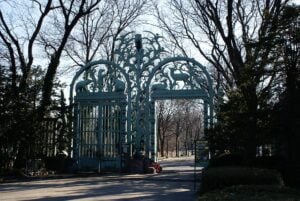
The buildings themselves were works of art, adorned with intricate stone carvings of the animals housed within them, sculpted by artists such as Eli Harvey and Charles R. Knight. In 1934, the zoo added the Rainey Memorial Gates at its Concourse entrance. Sculpted by Paul Manship in the Art Deco style, these monumental bronze gates feature more than 20 stylized wildlife figures and are now listed on the National Register of Historic Places.
Breaking the Bars: The Mid-Century Revolution
In its infancy, the Bronx Zoo looked very different from what it is today. Early zoos were essentially museums of living things, keeping animals in small, stark iron cages. While this looks cruel by today’s standards, early zookeepers were operating out of fear and ignorance; they struggled constantly with deadly diseases, and small concrete cages were simply easier to scrub clean.
But the Bronx Zoo quickly became a global pioneer in changing this philosophy. The real turning point came in 1941 with the opening of the African Plains exhibit. Under the leadership of Allyn Jennings, the zoo bypassed traditional bars and cages entirely. Instead, they utilized deep, hidden dry moats to separate predators from prey and animals from visitors. For the first time in a major American city, lions appeared to roam the same open, grassy savanna as the antelopes they hunted.
This shift wasn’t just aesthetic; it fundamentally transformed animal welfare and pioneered modern, immersive zoo environments, including World of Darkness (1969), the indoor ecosystem of JungleWorld (1985), and the award-winning Congo Gorilla Forest (1999).
A Lifeline for Endangered Species
Because the Wildlife Conservation Society was built on a foundation of preservation, the Bronx Zoo has always doubled as a survival bunker. Its most famous triumph began at the turn of the 20th century, when Hornaday and the Society founded the American Bison Society to take a stand against extinction. By breeding a core herd within the safety of the Bronx and shipping them back out West to protected reserves like the Wichita National Forest, the zoo helped pull the species back from the brink of oblivion.
That legacy of hands-on rescue continues to ripple across the globe. Over the decades, the zoo successfully pioneered captive breeding and reintroduction programs for a staggering variety of wildlife, transforming the park into a critical nursery for species on the brink of extinction. Following its historic success in saving the American bison in the early 1900s, the zoo stepped up again in the 1970s to breed and release peregrine falcons after their populations were decimated by DDT pesticides. In recent years, this conservation engine has expanded internationally, partnering with global agencies to reintroduce the critically endangered Chinese alligator to its native wetlands along the Yangtze River and to successfully breed a massive colony of Kihansi spray toads to be flown back to Tanzania after the species had completely vanished from the wild.
The Modern Era and Happy the Elephant
For the most part, the recent history of the Bronx Zoo has been defined by quiet success, punctuated only by occasional, harmless stories of an animal temporarily escaping or an overzealous tourist jumping a barrier.
The most enduring emotional and legal lightning rod of recent decades involves Happy, an Asian elephant who arrived at the zoo in 1877. Happy became the center of an intense national debate regarding elephant captivity and animal rights after the zoo chose to house her without another elephant companion. The zoo’s reasoning was rooted in a tragic past: a previous attempt to introduce Happy and her companion, Grumpy, to other resident elephants went so violently wrong that Grumpy had to be euthanized from her injuries. Fearing another deadly conflict, keepers kept Happy separated for her own safety.
The animal advocacy group The Nonhuman Rights Project filed lawsuits on Happy’s behalf, arguing that she was a cognitively complex individual who possessed legal “personhood” and deserved to be released to a sanctuary. In 2022, the New York Court of Appeals ultimately ruled against the petition, declaring that while elephants are intelligent beings deserving of care, they do not hold legal human rights. Tragically, in May 2026, the Bronx Zoo announced that Happy had been euthanized due to rapidly declining health, a devastating loss for the keepers who had cared for her for over three decades.
As a kid and teenager who grew up in the Bronx not far from the Zoo, this was always a place to escape to a world of fantasy. I always remember that as I walked along the concrete paths between the exhibits, if I looked up at the trees, I could also see the tops of the Bronx apartment buildings, serving as a reminder of where I really was, even though I was pretending to be somewhere else.