Photo by Brian Kachejian
One of the most common questions I get from people visiting New York for the first time is a simple one: What exactly is a bodega, and how many of them are there?
The first part is easy. I can answer that off the top of my head because, if you grew up here the way I did, the bodega is simply part of the furniture of daily life.
The second part stopped me for a second. I had a rough idea, but I wanted a real number, so I went and did the research.
This article answers both questions. We will start with what a bodega actually is, then get to the count, and along the way I will make the case for why these little corner stores are the beating heart of New York City.
Walk down almost any block in the five boroughs at two in the morning, and you will probably see a warm glow spilling onto the sidewalk. Under a humming sign advertising cold beer, lottery tickets, and hot coffee, the local bodega stands open, a brightly lit sanctuary anchoring the block.
It is much more than a convenience store. The bodega is where neighbors catch up on local news, where commuters grab a bacon, egg, and cheese on a roll, where late-night workers pick up milk, and where the neighborhood cat keeps watch from atop a stack of paper towels.
Direct Answer: How Many Bodegas Are in NYC?
The most defensible short answer is approximately 13,000 bodegas across New York City’s five boroughs.
That is an estimate, not an official census. Some broader counts have placed the number as high as 16,000, while other sources use lower totals because they count only stores that meet a particular definition. There is no single city license labeled “bodega,” and the word can overlap with deli, corner store, convenience store, grocery, and neighborhood market.
Stores also open, close, change owners, and change the way they operate. A shop that begins as a small grocery may add a grill and deli counter. Another may remove most of its groceries and become primarily a sandwich shop. That is why the number can never be as precise as the count of subway stations or public schools.
So, when somebody asks how many bodegas there are in New York City, the honest answer is this: about 13,000, with some reasonable estimates extending higher.
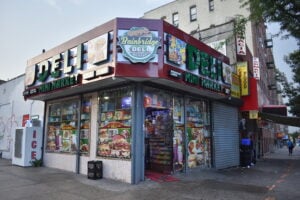
One reason bodegas are so difficult to count is that many of them do not actually have the word “bodega” anywhere on the storefront. Walk through the Bronx, Queens, Brooklyn, or Upper Manhattan, and you may see signs identifying them as a deli, mini market, grocery, candy store, luncheonette, or some combination of those names. Some still display signs left behind by businesses that occupied the space years earlier.
A neighborhood store may call itself a deli because it serves sandwiches, even though it bears little resemblance to a traditional New York delicatessen with a full counter of sliced meats, salads, and prepared foods. That leaves us with another question: Where does a deli end and a bodega begin? There is no clean dividing line. The New York bodega is often part grocery store, part deli, part convenience store, part luncheonette, and part neighborhood gathering place. You may not recognize one by its sign, but most New Yorkers recognize one the moment they step through the door.
What Officially Defines a New York City Bodega?
The word bodega comes from Spanish, where it can mean a storeroom, wine cellar, warehouse, or small grocery. It is linguistically related to words such as boutique and apothecary, all of which trace back to an older word connected to storage.
New York’s use of the word developed primarily through Puerto Rican and other Spanish-speaking communities, where it described the small neighborhood grocery that carried familiar foods and everyday necessities.
The official definitions remain slippery. In a recent New York City Health Department study, bodegas were defined as small convenience stores with no more than two cash registers that sell a variety of mostly nonperishable grocery items. Earlier city programs have also used a size limit of less than 4,000 square feet.
A City Council bill introduced in 2026 proposed an even more specific definition: a store smaller than 4,000 square feet, with no more than two cash registers, where food for off-site consumption accounts for at least half of total sales. That proposal remains legislation rather than a universal legal definition, but it shows how the city is trying to put boundaries around a word New Yorkers have always understood instinctively.
Ask a born-and-raised New Yorker, and you will get a better answer. A true bodega is defined by its soul, not its square footage.
The Five Hallmarks of an Authentic NYC Bodega
1. The flat-top grill. A busy grill cook turns out bacon, egg, and cheese sandwiches, chopped cheeses, burgers, and hot heroes wrapped tightly in foil.
2. The hours. Many bodegas stay open late, open early, or operate around the clock. Even when everything else on the block is closed, the bodega light is often still on.
3. The neighborhood relationship. Owners and workers recognize regular customers, know who lives nearby, accept packages, share local news, and sometimes extend informal credit to people they trust.
4. The all-in-one inventory. Tightly packed shelves hold everything from plantain chips, canned beans, coffee, and cold medicine to toilet paper, umbrellas, batteries, and phone chargers.
5. The bodega cat. The resident cat has become one of the most beloved symbols of New York corner-store culture, even though live animals are prohibited in retail food-store operational areas under current state rules.
The History of the New York City Bodega
The story of the New York City bodega is really the story of the city’s immigrant communities across the twentieth and twenty-first centuries. Each generation of owners adapted the corner store to the neighborhood around it.
1. The Puerto Rican Pioneer Era
Puerto Rican migration to New York increased after United States citizenship was extended to island residents in 1917 and grew dramatically during and after the Second World War. Many newcomers settled in East Harlem, which became known as El Barrio, as well as in Brooklyn and the South Bronx.
Mainstream supermarkets did not always carry the ingredients these communities wanted. Puerto Rican merchants opened small neighborhood groceries stocked with plantains, yuca, yautía, beans, spices, tropical produce, coffee, and other familiar products. They called the stores bodegas, and some were named after towns and regions back on the island.
These shops did more than sell food. They extended credit, carried messages, displayed community notices, and gave newly arrived families a place where Spanish was spoken and the products on the shelves felt familiar.
2. Dominican, Cuban, and Other Latino Ownership
As migration from the Caribbean and Latin America continued, Dominican, Cuban, and other Latino families entered the bodega business in large numbers. The stores changed with their owners and customers, adding new foods, brands, music, newspapers, and neighborhood traditions.
A bodega could function as a community bulletin board, an informal bank, a job-referral network, and a place to hear news from home. For a newcomer trying to find a foothold in New York, the corner store was often the first familiar place in an unfamiliar city.
3. The Rise of Yemeni-American Bodega Ownership
Beginning in the late twentieth century and accelerating through the 1990s and 2000s, Yemeni immigrants became a major force in New York’s corner-store economy. Today, Yemeni-American families own and operate several thousand bodegas across the five boroughs.
There is no official count of Yemeni-owned stores. Community and trade-group estimates have generally ranged from about 4,000 to 6,000. Whatever the precise total, the bodega has become one of the Yemeni-American community’s most important engines of entrepreneurship, family employment, and economic mobility.
These stores are often family operations, with relatives working different shifts to keep the doors open for long hours. Their role became impossible for the wider city to overlook during the historic bodega strike of 2017.
Why the Bodega Is New York City’s Heartbeat
In a metropolis of millions of people, the bodega offers something genuinely rare: intimate, human-scale connection in one of the largest cities in the world.
Eyes on the Street
The urban writer Jane Jacobs famously described the importance of “eyes on the street,” the idea that shopkeepers, residents, and regular foot traffic create a natural form of neighborhood watchfulness.
The bodega is that idea brought to life. The owner knows the local kids, notices when an older customer has not come in for several days, recognizes the delivery workers, and watches the block during hours when almost nothing else is open.
That does not make every bodega or every block safe, but the constant presence of a familiar business can make a neighborhood feel less anonymous.
Bodega Food and the Chopped Cheese
Bodegas are central to New York’s everyday food culture. The bacon, egg, and cheese on a roll may be the city’s unofficial breakfast, while hot heroes, burgers, halal platters, and sandwiches feed people at almost every hour of the day.
The crown jewel of the bodega grill may be the chopped cheese. Ground beef and onions are chopped together on the flat top, covered with melted American cheese, and served on a hero with lettuce, tomato, and condiments.
The sandwich is commonly traced to Blue Sky Deli, better known as Hajji’s, at First Avenue and East 110th Street in East Harlem. Most versions of the story credit longtime cook Carlos Soto, who worked there for more than two decades and died in 2014, although workers have told different stories about exactly how the sandwich began.
Some accounts also connect the chopped meat and onions to Yemeni cooking traditions, giving the sandwich a fitting mixture of Dominican, Yemeni, Black, Latino, and New York bodega influences. What began as an inexpensive neighborhood sandwich became a pop-culture phenomenon celebrated in hip-hop, restaurants, food videos, and television.
The Legend of the Bodega Cat
The bodega cat may be almost as famous as the chopped cheese. These cats are treated by many store owners as companions and traditional mousers, and customers often consider them part of the neighborhood.
The legal situation is less charming. New York State retail food-store rules require live animals to be kept out of operational areas, with limited exceptions for service animals and certain other circumstances. A New York City Council bill introduced in 2026 seeks to remove the city’s prohibition and create vaccination and spay-and-neuter programs for store cats, but the proposal would not by itself override the state’s restrictions.
For now, the bodega cat remains both a New York cultural icon and a violation waiting to happen.
Bodegas and Access to Food
In neighborhoods with few full-service supermarkets, bodegas are not merely convenient. They may be the closest place where residents can buy milk, eggs, bread, canned goods, produce, and prepared food.
That importance comes with complications. Bodegas generally have less space, less buying power, and fewer fresh-food options than supermarkets. A New York City Health Department study of the South Bronx found one supermarket for every six bodegas in the areas examined between 2019 and 2024. An earlier 2012 study of Crotona-Tremont found a ratio of one supermarket to ten bodegas.
The newer South Bronx study also found that most bodegas carried some fresh produce, but many lacked fresh vegetables or fruit, and healthier packaged foods were less common than in supermarkets.
That is why Shop Healthy NYC works with bodegas, supermarkets, suppliers, and community organizations to increase access to fruits, vegetables, whole-grain bread, low-sodium products, and other healthier choices. Nearly 2,000 stores participate in the program across the city.
Modern Challenges Facing NYC Bodegas
Rising rents. Commercial rent increases can wipe out a family business when its lease expires, especially when a store operates on the narrow margins typical of food retail.
Chains and delivery apps. Pharmacies, convenience-store chains, online grocery services, and rapid-delivery companies compete for many of the same purchases that once automatically went to the corner store.
Food costs. Small stores cannot buy at the same volume as major supermarket chains. That makes it difficult to keep prices down while still paying rent, utilities, insurance, payroll, and wholesale costs.
The demand for healthier products. Owners are under pressure to stock more fresh produce and healthier food, but those products can spoil quickly and require refrigeration, storage space, and a dependable level of customer demand.
Crime and worker safety. Bodega employees work long hours, often late at night, while surrounded by cash, cigarettes, lottery products, and other items that can attract robbery.
Bodega Safety Programs and Legislation
In 2025, New York City announced a $1.6 million SilentShield initiative intended to equip an estimated 500 bodegas in high-crime areas with panic buttons connected to store cameras and the NYPD. The locations were not publicly identified for security reasons.
On the federal level, Bronx Congressman Ritchie Torres reintroduced the Bodega Owner Defense Enhancement Grant Assistance Act, known as the BODEGA Act, in 2025. The proposal would allow certain federal Byrne-JAG grant funds to pay for panic buttons and surveillance equipment in qualifying private businesses.
The bill was introduced as proposed legislation, not enacted law. Still, both efforts show that bodega safety has become a serious public-policy issue rather than something owners are expected to handle entirely on their own.
The 2017 Yemeni-American Bodega Strike
One event demonstrated the importance of the bodega better than any statistic ever could.
On February 2, 2017, more than 1,000 Yemeni-owned bodegas and other businesses across New York City closed from noon until 8 p.m. to protest the federal travel ban affecting several Muslim-majority countries, including Yemen. Thousands of people gathered that evening outside Brooklyn Borough Hall.
For eight hours, blocks that almost always had a light on suddenly went dark. New Yorkers who rarely thought about who owned the corner store or how many hours that family worked could suddenly see the scale of the Yemeni-American community’s contribution.
The strike did not merely make a political statement. It showed the whole city what New York feels like when the bodegas are gone.
A Final Word
The exact number of New York City bodegas may remain impossible to settle. About 13,000 is the figure most often used, but the definition changes depending on who is counting and what type of store they include.
The cultural answer is much easier. There are enough bodegas that nearly every New Yorker has one they think of as their own.
It is the place where somebody knows how you take your coffee, where you can buy aspirin at midnight, where the grill cook remembers your sandwich, and where the owner may know more about what is happening on the block than anyone else.
The bodega is not a footnote to New York City. It is the city, open late, waiting on the corner.
NYC Bodegas by the Numbers
| Measure | Best Available Figure | Important Context |
|---|---|---|
| Estimated number of NYC bodegas | Approximately 13,000 | No official census exists; broader estimates have reached about 16,000 |
| Estimated Yemeni-American ownership | Several thousand, often estimated at 4,000 to 6,000 | Community estimate rather than an official count |
| South Bronx bodega-to-supermarket ratio | Six bodegas for every supermarket | Based on selected South Bronx ZIP codes studied from 2019 to 2024 |
| Earlier Crotona-Tremont ratio | Ten bodegas for every supermarket | Based on a 2012 neighborhood study |
| NYC Health study definition | No more than two cash registers | Small convenience store selling mostly nonperishable grocery items |
| Shop Healthy NYC participation | Nearly 2,000 stores | Includes participating bodegas and other food retailers |
| SilentShield target | Approximately 500 bodegas | Program announced in 2025 for stores in high-crime areas |
More New York City Food and Neighborhood History
For more on the businesses, foods, and neighborhoods that shaped everyday life in New York, explore our history of New York pizza, our history and memories of A&P supermarkets, our look at the history of Bohack grocery stores, and our personal remembrance of life along Bainbridge Avenue and 204th Street in the Bronx.
How Many Bodegas Are in NYC? History, Definition, and Cultural Impact article published on ClassicNewYorkHistory.com © 2026