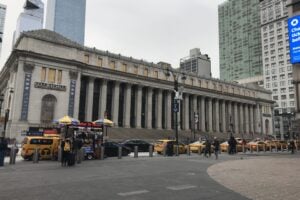

Feature Photo: Alena Veasey / Shutterstock.com
Founded by James Christie in London, England, in 1766, Christie’s International PLC started off as a British-based auction firm that specialized in the buying and selling of art. Now as one of the world’s leading auction houses there’s a Christie’s Auction House located in several major cities such as Rome, Italy, Geneva, Switzerland, Tokyo, Japan, and New York, U.S.A. Aside from London’s headquarters, Christie’s Auction House also has one set up at the Rockefeller Center in New York City. It also has one at Hong Kong’s Alexandra House.
About James Christie
James Christie befriended several notable artists and craftsmen which enabled him to gather an impressive collection of auctionable items for collectors, dealers, and fashionable members of society to view and bid on at his site. Furthermore, his knowledge of valuable art was reflected in the various transactions he handled, including a 1778 sale of Sir Robert Walpole’s collection to Russia’s empress, Catherine the Great. It was Christie’s that handled major auction events such as selling the contents of Sir Joshua Reynold’s studio in 1794, as well as Madame du Barry’s jewels in 1795.
According to Christie’s company records, the first auction James Christie held was on December 5, 1766, in London, England. However, there have been accounts the man rented auction rooms as far back as 1759, based on old newspaper advertisements that were discovered.
Christie’s Family Legacy
After Christie’s death in 1803, his son, James Christie the Younger assumed management of London’s auction house. Already an expert on ancient Greek and Italian sculptures and vases, he moved shop to 8 King’s Street, St. James’s Square in 1823. With him, the family tradition of hosting historical auction sales continued until the day of his death in 1831. Through him, the family business continued to grow as it still hosted historical auctioneering events. This tradition continued through his son, James, who managed the forty-day sale of the second duke of Buckingham Palace and Chandos’s Stowe House collection in 1848.
After he passed away, his two sons, James Stirling and George Henry took in the brothers, William and Edward Manson. In 1859, Thomas J. Woods teamed up with the Christies and the Mansons. This was the same team who handled the sale of Hamilton Palace’s pictures in 1882, which was a seventeen-day event. 1919’s sell-off of pictures from Sir George Drummond’s collection was also conducted by them.
As Christie, Manson & Woods it was reorganized as a private limited company in 1940. This was a necessary step in order to compete against their rival auctioneers, Sotheby’s. It would also be at this time Christie’s expanded the firm beyond the borders of the United Kingdom. The first office they opened was in Rome in 1958. Then it was Geneva in 1968. A year later it was Tokyo.
Coming to America
From 1973 until 1999, Christie International Inc. was a public company that was listed on the London Stock Exchange. From 1974 until 1988, Jo Floyd served as the chairman until handing the reigns over to Lord Carrington. It was through Floyd Christie’s held its first sale in the United States, which was in 1977.
1977 marked the year Christie’s Auction house opened its first international branch in the Delmonico Hotel grand ballroom’s second floor. Located on Park Avenue, New York City, it held auctions there until 1997 after taking on a thirty-year lease in Rockefeller Center. For $40 million, Christie gained access to the site’s 310,000-square-foot space to hold its prestigious auctions.
In 1996, Christie’s purchased a townhouse on East 59th Street in Manhattan, which served as a separate gallery that allowed experts to show clients art privately. Through this method, private treaty sales would be conducted. There was also Christie’s East, a division belonging to Christie’s Auction House that sold lower-priced art from its 219 East 67th Street location until 2001.
In 1997, Christie’s Auction House also opened its doors for business in Beverly Hills.
In 1998, Francois Pinault bought enough shares to take full ownership of Christie’s. Shortly after France’s government removed its traditional controls over auctioneering in its nation, the French Investor held Christie’s first auction in Paris in 2001. Today, Francois-Henri Pinault and its holding company, Groupe Artemis carry the proud heritage of Christie’s Auction House as one of the elite auctioneers in the industry.
Making History in New York
From New York’s Christie’s Auction House, some notable sales were made that made history. In 1994, Leonardo da Vinci’s Codex Leicester was sold to Bill Gates on November 11, 1994, for $30,802,500.00 USD. As soon as Gates got his hands on the Codex, he had the pages scanned into digital image files. Some of them were later distributed as screensavers and wallpaper files that became part of the Microsoft Plus! for Windows 95 desktop theme. It was also incorporated into Windows 98 and Windows ME.
In 1998, the New York location sold the infamous Archimedes Palimpsest manuscript, which was in the hands of Marie Louis Sirieix’s daughter. Before turning to Christie’s to auction it off, she tried to sell it privately. However, this move immediately brought forth a lawsuit from the Greek Orthodox Patriarchate of Jerusalem. Going up against Christie, Inc., the plaintiff pointed out the palimpsest was stolen from its Constantinople library in the 1920s. At the time, there was extreme persecution that also included the confiscation of several artifacts and artworks. Despite the church’s protest, the court ruled in favor of Christie’s Auction House on laches grounds. The palimpsest was sold to an anonymous American buyer for two million dollars.
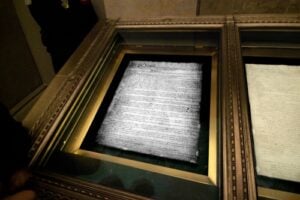
On June 22, 2012, New York’s Christie’s Auction House continued to make history after selling George Washington’s personal annotated copy of the Acts Passed at a Congress of the United States of America. This 1789 document included The Constitution of the United States, along with a draft of the Bill of Rights. The Mount Vernon Ladies’ Association forked out $9,826,500.00 USD, plus fees, in order to call this document their own. It set a new record for a document sold at an auction.
Three Studies of Lucian Freud was a triptych that was sold on November 12, 2013, for $142.4 million to Elaine Wynn from Christie’s New York location. At the time, it became the most expensive work of art ever sold at an auction. The 1969 oil-on-canvas piece depicting Lucian Freud was done by Irish-born British painter Francis Bacon. It wasn’t until May 11, 2015, this record would be beaten by the $179.3 million purchase price of Pablo Picasso’s Les Femmes d’Alger (“Version O”) painting. It was also in November 2015 Amedeo Modigliani’s Nu Couche was also sold in New York for $170.4 million.
Leonardi da Vinci’s Salvator Mundi was a painting that was exhibited in Hong Kong, London, New York, and San Francisco in 2017. It was at the New York location on November 15th that made the sale for $450,312,500.00. This was a new record price for an art piece. The buyer was Saudi Arabian Prince Badr bin, Abdullah, who acted on behalf of Abu Dhabi’s Department of Culture and Tourism. The intent was to have the painting displayed at the Louvre Abu Dhabi. However, this was postponed indefinitely. As of June 2019, it was reported to be on a luxury yacht belonging to Saudi Arabian Crown Prince Mohammed bin Salman.
On October 6, 2020, the Stan the T-Rex exhibit was sold for $31.8 million to an anonymous buyer. It was the most amount of money ever spent on a fossil at the time. At one point, there was a rumor Dwayne “The Rock” Johnson was the buyer after a T-Rex skull was in the background while he was being interviewed by Eli Manning’s Manningcast broadcast for the National Football League. However, it was merely a replica. The current story has Stan slated to be the centerpiece of the Natural History Museum Abu Dhabi. Stan was first found in the Hell Creek Formation in South Dakota, just outside Buffalo in 1987 and was excavated in 1992. Stan Sacrison was the amateur paleontologist who found the bone fragments and it was after him the artifact was named.
Going into the twenty-first century, Christie’s became increasingly involved in high-profile private transactions. This included a twenty-one million dollar guarantee to the Donald Judd Foundation as it displayed its artworks for five weeks at an exhibition that won the AICA Award for Best Installation in an Alternative Space.
New York Influence
In New York, Christie’s Auction House has been calling 20 Rockefeller Plaza it’s home since 1997. According to the forty-year lease agreement, there it will stay until 2037. Within the 310,000 square feet of architectural splendor, this site continues to hold public auctions and private sales on-site. It’s also engaged in using the internet and cryptocurrency when it comes to making transactions between buyers and sellers. Visiting Christie’s Auction House while at Rockefeller Plaza is a must. The grand limestone and bronze exterior with post-industrial steel and glass canopy complements the existing mosaics, murals, and sculptures that grace the Rockefeller Center.
One of the highlights of Christie’s Auction House in New York is the many departments it has that cover more than just a collection of fine art. There are also musical instruments and various collectibles. Considering the rich history of New York City which also includes the influence of pop culture and sports, it’s doubtful the legacy of Christie’s will fade away anytime soon.
History Of Christie’s Auction House In New York – ClassicNewYorkHistory.com ©2022
ClassicNewYorkHistory.com claims ownership of all its original content and Intellectual property under United States Copyright laws and those of all other foreign countries. No one person, business, or any organization is allowed to republish any of our original content anywhere on the web or in print without our permission.