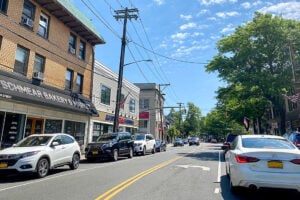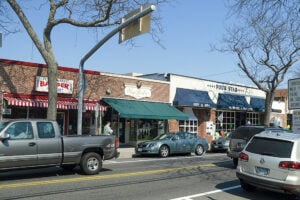
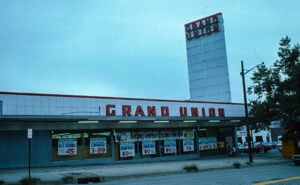
Grand Union Market in Little Neck, Queens, New York, 1976. Photo by John Margolies, Library of Congress, via Wikimedia Commons.
If you grew up in New York, the supermarket you remember can tell you almost as much about where you lived as your ZIP code. On Long Island, it might have been King Kullen, Waldbaum’s, Pathmark, or Bohack. In Syracuse and Central New York, generations shopped at P&C, Victory Markets, and Loblaws. Buffalo and Western New York had Bells, Quality Markets, and Super Duper. Rochester had Hart’s, Star Super Markets, Wegmans, and Loblaws. In the Capital Region, Central Market evolved into Price Chopper, while Albany Public Markets once stood among the region’s most important grocery chains.
New York also played an enormous role in the development of the American supermarket itself. A&P began in Manhattan and grew into what was once the largest retailer in the world. Michael J. Cullen opened the first King Kullen in Queens in 1930, creating a store widely recognized as the first modern American supermarket. Wegmans grew out of Rochester. Tops emerged from Western New York. Price Chopper grew from the Capital Region. At the same time, hundreds of neighborhood chains and independent supermarket banners served individual boroughs, counties, cities, and small towns.
This is not a ranking of the best supermarkets in New York. It is a statewide directory of supermarket names, past and present, that have been part of New York life. The list includes traditional chains, retailer cooperatives, important independent banners, revived historic names, and regional companies that may have been famous in one part of the state while barely known in another. Because supermarket ownership and store banners change constantly, some historic names have also returned in new forms.
New York City and Long Island Supermarkets Still Operating
Associated Supermarkets and Associated Fresh. Associated has been part of New York neighborhood grocery shopping for decades. Today, Associated Supermarket Group supports independently owned stores operating under Associated, Associated Fresh, and several related banners, allowing local owners to retain neighborhood identities while sharing purchasing, distribution, marketing, and other services.
Brooklyn Fare. Brooklyn Fare began as a neighborhood grocery operation in Brooklyn and developed into an upscale New York City market known for high-quality produce, specialty foods, prepared meals, and compact urban stores.
Bravo Supermarkets. Bravo is an independently operated supermarket banner found throughout the New York metropolitan area. Its stores are especially associated with neighborhoods where shoppers expect extensive Caribbean, Latin American, and international grocery selections.
C-Town Supermarkets. C-Town is one of the most familiar independent supermarket banners in New York City. Individual stores are locally operated, and the banner has long been associated with neighborhood-sized supermarkets in the Bronx, Brooklyn, Queens, and other densely populated communities.
Citarella. Citarella grew from a New York seafood business into an upscale specialty supermarket operation with stores in Manhattan and the Hamptons. Its fish counters, meat, produce, prepared foods, bakery products, and gourmet groceries place it somewhere between a traditional supermarket and a specialty food market.
Compare Foods and Compare Fresh. Compare stores are independently operated neighborhood supermarkets serving New York City and Long Island communities. The banner is particularly associated with international grocery products and neighborhoods with large Caribbean and Latin American populations.
D’Agostino Supermarkets. Founded in 1932, D’Agostino became one of Manhattan’s classic neighborhood supermarket names. The chain is much smaller than it was during its peak years, but the D’Agostino name remains part of New York grocery history and continues in the city.
Fairway Market. Fairway began on the Upper West Side in 1933 and became famous for the crowded, high-energy shopping experience that New Yorkers either loved or learned to survive. The original company entered bankruptcy in 2020, but Fairway did not disappear. Village Super Market acquired several stores and the Fairway name, and the banner continues as part of the Wakefern supermarket family.
Food Bazaar. Food Bazaar traces its history to the first supermarket opened by founder Francis An in Queens in 1988. Operated by Bogopa Service Corp., the company built its reputation by carrying an unusually broad range of foods for New York’s immigrant communities, including extensive international grocery, meat, seafood, and produce selections.
Food Dynasty. Food Dynasty remains a neighborhood supermarket name in New York City. Like many urban grocery banners, its stores have focused on fitting full grocery operations into the smaller footprints found in dense residential neighborhoods.
The Food Emporium. The Food Emporium name grew from the old Daitch-Shopwell organization and became one of Manhattan’s best-known upscale supermarket banners. The original corporate lineage changed repeatedly over the decades, but the Food Emporium name still survives at Manhattan stores.
Foodtown. Foodtown is not one centrally owned supermarket chain in the traditional sense. It is a cooperative of independently owned neighborhood stores that share purchasing, marketing, and other resources. The banner has had a long presence in metropolitan New York and remains one of the region’s recognizable supermarket names.
Food Universe Marketplace. Food Universe is another neighborhood supermarket banner operating in the New York metropolitan market. Its stores are generally independently owned and tailored to the communities they serve.
Gala Fresh Farms. Gala Fresh Farms operates neighborhood supermarkets in New York City and Long Island. The banner emphasizes produce, meat, prepared foods, and international products suited to individual local markets.
Giunta’s Meat Farms. Giunta’s Meat Farms grew into a well-known Long Island supermarket company with a strong emphasis on meat, produce, and value. In October 2026, Giunta’s completed its acquisition of King Kullen, bringing together two Long Island supermarket companies with very different histories.
Gourmet Garage. Gourmet Garage became known in Manhattan for specialty groceries, produce, cheese, meats, seafood, and prepared foods. The brand became part of the Wakefern family in 2019 and continues as a New York specialty supermarket banner.
Gristedes. Gristedes is one of the oldest supermarket names still associated with Manhattan. Its modern history is closely tied to John Catsimatidis and the Red Apple Group, which assembled a large New York City supermarket operation through Red Apple, Gristedes, Sloan’s, and other acquisitions.
Holiday Farms. Holiday Farms is a neighborhood supermarket operator on Long Island’s North Shore, with stores serving Nassau County communities including Roslyn Heights, Glen Head, and Franklin Square.
Ideal Food Basket and Ideal Fresh Market. Ideal Food Basket and Ideal Fresh Market stores serve neighborhoods across New York City, Long Island, Westchester, and the lower Hudson Valley. Their locations are independently operated and reflect the varied grocery needs of the communities around them.
Key Food and Key Food Marketplace. Key Food was founded in Brooklyn in 1937 and developed as a retailer cooperative. The system allows independent supermarket owners to operate under Key Food and related banners while taking advantage of collective purchasing and distribution. It remains one of the most important neighborhood grocery systems in metropolitan New York.
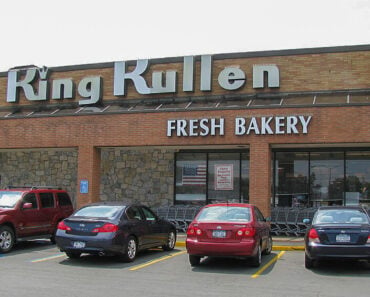
King Kullen. Michael J. Cullen opened the first King Kullen in Queens on August 4, 1930. The store combined self-service, separate departments, discount pricing, chain marketing, and high-volume selling in a format widely recognized as the first modern American supermarket. King Kullen later became a Long Island institution. Giunta’s Meat Farms completed its acquisition of King Kullen in October 2026, although the King Kullen name remains an important part of Long Island supermarket history.
Lincoln Market. Lincoln Market is a family-operated New York City supermarket company serving Brooklyn and other city neighborhoods. Its stores combine conventional groceries with prepared foods, bakery items, produce, meat, and specialty products.
Met Foodmarkets and Met Fresh. Met Foodmarkets has been a familiar independent supermarket banner across New York City and Long Island for decades. Met Fresh represents a newer variation of the neighborhood-market concept. Both banners are supported through Associated Supermarket Group.
Morton Williams. Morton Williams grew from the Sloan family’s New York grocery business into a familiar Manhattan supermarket name. Wakefern completed its acquisition of the 17-store Morton Williams operation in 2025, while preserving the Morton Williams banner and its neighborhood identity.
NetCost Market. NetCost Market operates international supermarkets in New York City and Long Island, with a particularly strong selection of Eastern European, Russian, Ukrainian, Central Asian, and other imported foods.
North Shore Farms. North Shore Farms began on Long Island and developed into a regional supermarket company serving communities in Nassau and Suffolk Counties as well as Queens and Westchester. The stores are known for produce, butcher departments, prepared foods, bakery items, and specialty groceries.
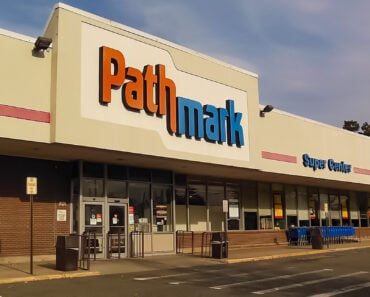
Pathmark. Pathmark was once one of the dominant supermarket names in metropolitan New York. The original chain disappeared during the A&P liquidation in 2015, but the name did not stay dead. Allegiance Retail Services acquired the Pathmark intellectual property and relaunched the banner in Brooklyn in 2019.
Pioneer Supermarkets. Pioneer is a neighborhood supermarket banner with deep roots in New York City. Today it operates through independent retailers supported by Associated Supermarket Group, with stores particularly suited to the smaller urban footprints found throughout the five boroughs.
Trade Fair Supermarket. Trade Fair is strongly associated with Queens, where its stores have served some of the most culturally diverse neighborhoods in New York. International foods and products tailored to local communities have long been central to the chain’s identity.
Uncle Giuseppe’s Marketplace. Uncle Giuseppe’s began on Long Island and grew into a specialty supermarket company centered on Italian food, fresh mozzarella, prepared meals, bakery goods, meat, seafood, and produce. The company has expanded beyond its original Long Island base while retaining a strong local identity.
Western Beef. Western Beef developed a distinctive warehouse-style supermarket format in New York City, with large meat departments and stores designed to serve densely populated urban neighborhoods. The company continues to operate in New York as well as Florida.
Westside Market NYC. Westside Market has served Manhattan since 1965. Its family-owned stores combine the compact footprint of a New York neighborhood market with extensive produce, groceries, prepared foods, and specialty products.
Wild by Nature. Wild by Nature was developed as King Kullen’s natural and organic foods banner on Long Island. The four Wild by Nature stores were included in Giunta’s 2026 acquisition of King Kullen.
Hudson Valley and Upstate New York Supermarkets Still Operating
Adams Fairacre Farms. Adams Fairacre Farms began in the Hudson Valley and developed into a distinctive regional market combining a full grocery operation with produce, meat, bakery products, prepared foods, garden departments, and a strong emphasis on local products. The company operates stores in Poughkeepsie, Kingston, Newburgh, Wappinger, and the Middletown area.
Big M Supermarkets. Big M is an independent supermarket banner with a long Upstate New York presence. Its stores have appeared in communities from Central New York to the North Country and continue to serve smaller towns that are often overlooked by larger supermarket chains.
Dash’s Market. Dash’s is a family-owned Western New York supermarket company with roots in the Buffalo area. It represents the kind of local grocery operation that survived while many larger regional competitors disappeared through consolidation.
DeCicco & Sons. DeCicco & Sons has become one of the Hudson Valley’s better-known family supermarket companies. Its stores serve communities including Ardsley, Armonk, Bedford, Brewster, Eastchester, Harrison, Larchmont, Millwood, Pelham, Sleepy Hollow, and Somers.
DeCicco Family Markets. DeCicco Family Markets represents another branch of the DeCicco supermarket tradition in the lower Hudson Valley. The two DeCicco operations share family roots but operate as separate businesses.
Grand Union. For generations, Grand Union was one of the great supermarket names of New York and the Northeast. The original company eventually collapsed, but the banner was revived. Grand Union stores currently operate in Peru and Saranac Lake, giving one of New York’s oldest supermarket names another life.
Market 32 and Price Chopper. The company behind Price Chopper traces its supermarket history to the Capital Region in 1932, when the Golub organization operated stores under the Central Market name. Central Market became Price Chopper in 1973. Beginning in the 2010s, the company introduced the Market 32 banner, named for its 1932 roots. Price Chopper/Market 32 and Tops now share the parent company Northeast Grocery while retaining their separate identities.
Market in the Square. Market in the Square is a Western New York supermarket company associated with the Buffalo-Niagara region. Its history also became connected with the beloved Budwey’s supermarket in North Tonawanda when the Budwey operation was sold to Market in the Square ownership.
Tops Friendly Markets. Tops grew directly out of Western New York grocery history. The Castellani family’s Great Bear stores helped lead to the development of Tops, and the first modern Tops supermarket opened in Niagara Falls in 1962. Tops expanded across Western and Central New York and later absorbed many former P&C and Quality Markets locations.
Wegmans. Wegmans began in Rochester in 1916 and developed into one of America’s most admired supermarket companies. Its New York roots remain especially visible around Rochester, Buffalo, Syracuse, and other Upstate communities, even as the company has expanded far beyond the state. Wegmans opened its first New York City location at the Brooklyn Navy Yard in 2019.
Major Regional and National Supermarkets Operating in New York
ALDI. The German discount supermarket company has expanded throughout New York, with locations in New York City, the Hudson Valley, Central New York, Western New York, and other regions.
Hannaford. Hannaford has a substantial Upstate New York presence, particularly in the Capital Region and Hudson Valley. Although the company is rooted in Maine, it became an important competitor in eastern and northern New York grocery markets.
H Mart. H Mart is a Korean-American supermarket company with a strong New York metropolitan presence. Its stores carry extensive Korean, Japanese, Chinese, and other Asian groceries along with produce, seafood, meat, prepared foods, and household products.
Lidl. Lidl accelerated its New York expansion by acquiring Best Market in 2018. The deal gave the German discount chain an immediate Long Island footprint, and former Best Market stores were gradually converted to Lidl.
Piggly Wiggly. The pioneering American self-service grocery banner is rarely associated with New York today, but it still has a New York presence. A Piggly Wiggly supermarket currently operates on Washington Street in Watertown.
Price Rite Marketplace. Price Rite is Wakefern’s discount supermarket banner and operates in selected New York markets. It emphasizes a streamlined assortment and value pricing.
Save A Lot. Save A Lot is a discount supermarket banner with locations in portions of Upstate New York. Its smaller-format stores have often served communities where conventional supermarket options are limited.
ShopRite. ShopRite is one of the Northeast’s largest supermarket banners and is organized through the Wakefern retailer cooperative. In New York, ShopRite has been especially important in the Hudson Valley and metropolitan suburbs, while also maintaining a presence in New York City and on Long Island.
Stew Leonard’s. Stew Leonard’s began in Connecticut but became a major New York supermarket attraction through its Yonkers and Long Island stores. The company is famous for fresh foods, dairy products, prepared meals, a one-way shopping route, and the animated characters that made its stores a destination for families.
Stop & Shop. Stop & Shop has been a major supermarket presence on Long Island and in the lower Hudson Valley for decades. The New England-based company also inherited a number of locations tied to earlier supermarket chains through years of consolidation.
The Fresh Grocer. The Fresh Grocer is a Wakefern supermarket banner with New York-area locations. The brand joined the Wakefern system in 2013.
Trader Joe’s. Trader Joe’s has become an important part of the New York grocery landscape through stores in New York City, Long Island, and Upstate communities. Its smaller footprints and private-label-heavy inventory make it very different from traditional full-line supermarkets.
Whole Foods Market. Whole Foods became a major force in New York’s natural and organic grocery market, particularly in New York City and the surrounding suburbs. The company is now owned by Amazon.
Historic New York City and Long Island Supermarkets We Lost
A&P. The Great Atlantic & Pacific Tea Company began in New York in the 19th century and eventually became the largest retailer in the world. At its height, A&P operated thousands of stores and transformed grocery distribution through enormous purchasing power, private labels, warehouses, and manufacturing. The company declined over many decades and finally liquidated in 2015.
Best Market. Best Market became a familiar supermarket name on Long Island before Lidl agreed to acquire 27 Best Market stores in New York and New Jersey in 2018. Most of the acquired Long Island locations were subsequently converted to Lidl, ending the Best Market name while giving Lidl a major foothold in the region.
Bohack. H.C. Bohack began in Brooklyn in 1887 and grew into one of the great neighborhood grocery names of Brooklyn, Queens, Long Island, and the surrounding region. Bohack stores were once woven into daily life across the outer boroughs, but the company struggled financially and disappeared in 1977.
Daitch. The Daitch grocery story began with Louis Daitch’s dairy business in 1919. Daitch expanded into supermarkets and became an important New York grocery chain before merging with Shopwell Foods in the 1950s.
Daitch-Shopwell. The merger of Daitch and Shopwell created a major metropolitan supermarket company with stores in New York City, Long Island, Westchester, and surrounding areas. The company eventually moved away from the Daitch name, developed the Food Emporium concept, and was later acquired by A&P.
Edwards Food Warehouse and Edwards Super Food Stores. Edwards was a discount-oriented supermarket operation with stores in metropolitan New York and the Hudson Valley. Through later corporate consolidation, its stores became connected to Ahold and other supermarket banners.
Finast and First National Stores. First National Stores, later widely known through the Finast name, operated throughout the Northeast and maintained a significant New York presence. The chain became part of the corporate lineage that eventually fed into Ahold’s supermarket operations.
Food Basics USA. A&P used the Food Basics banner for discount grocery stores in selected markets. The American Food Basics operation disappeared along with A&P’s final collapse.
Food Fair. Food Fair was a major East Coast supermarket company that operated throughout metropolitan New York and the Hudson Valley. The company later emphasized the Pantry Pride name, beginning another chapter in a corporate history that ultimately ended in decline and bankruptcy.
Hills Supermarkets. Hills was a major New York-area supermarket chain with a particularly strong presence on Long Island. The chain was acquired by Pantry Pride in the 1970s, and the Hills name eventually vanished.
James Butler Grocery Company. Long before the suburban supermarket era, James Butler operated a vast network of grocery stores across New York City and nearby communities. The company belonged to the generation of chains that helped turn grocery retailing from independent neighborhood shops into large coordinated systems.
Pantry Pride. Pantry Pride grew from the Food Fair organization and became a recognizable supermarket name in New York and other East Coast markets. Financial problems and corporate restructuring eventually erased the banner.
Red Apple Supermarkets. Red Apple was the supermarket company through which John Catsimatidis built a growing Manhattan grocery operation. By the 1970s he had multiple Red Apple stores along Broadway, and later acquisitions brought Red Apple together with Gristedes and former Sloan’s supermarkets.
Safeway. Safeway once operated supermarkets in the New York metropolitan market before withdrawing from the region. Its former New York operations became part of the shifting supermarket landscape that included First National and Finast.
Shopwell. Shopwell began as a separate Westchester supermarket operation before merging with Daitch. The Shopwell name later became more prominent as the combined company evolved, eventually giving rise to The Food Emporium.
Sloan’s Supermarkets. Sloan’s became a powerful Manhattan supermarket chain with stores positioned throughout dense residential neighborhoods. Red Apple acquired 21 Sloan’s stores in the early 1990s and later acquired additional locations, tying the Sloan’s story directly to the growth of the modern Gristedes organization.
Waldbaum’s. Waldbaum’s began as a Brooklyn grocery business and became one of the supermarket names most closely associated with Long Island. A&P acquired the company in the 1980s, and Waldbaum’s finally disappeared during A&P’s 2015 liquidation.
Historic Hudson Valley and Capital Region Supermarkets
Albany Public Markets. Albany Public Market grew from the Nigro family’s grocery business into one of the Capital Region’s landmark supermarket companies. The business expanded during the mid-20th century and was acquired by Weis Markets in 1967. The Albany Public Markets name disappeared in the 1980s.
Central Market. Central Market is one of the most important names in Capital Region supermarket history because it became Price Chopper. The Golub organization built the Central Market chain beginning in the 1930s and changed the stores to the Price Chopper name in 1973.
Empire Super Markets. Empire operated supermarkets in eastern New York and became closely connected with Schaffer Stores. In 1958, Grand Union took over operation of dozens of Empire Super Markets, placing the regional company inside the much larger Grand Union system.
Great Bull Markets. The Great Bull Market in Kingston opened in 1933 and became one of the Hudson Valley’s early large supermarkets. Its Smith Avenue store was remembered as an all-in-one food shopping destination long before the supermarket format became universal.
Schaffer Stores. Schaffer was a substantial grocery and supermarket operator in eastern New York, with stores appearing in Albany, Poughkeepsie, and other Hudson Valley and Capital Region communities. The company also operated the Empire Super Markets system before Grand Union took over those stores.
Shoor Stores. Shoor Stores appears repeatedly in early Capital Region grocery records, particularly in Albany during the 1920s. It belongs to an earlier generation of chain grocers that preceded the large postwar supermarket.
Trading Port. Trading Port was a Capital Region grocery and supermarket operator with a surprisingly long history. Records place the name in Albany as early as the 1930s, and Trading Port remained a recognized local grocery name many decades later.
Historic Central and Northern New York Supermarkets
Acme Markets. Acme, best known today as a Mid-Atlantic supermarket banner, once operated in Central and Upstate New York. The company purchased Syracuse’s Market Basket chain in the 1950s and remained in the Syracuse market into the 1970s before withdrawing.
American Stores. American Stores was an important national grocery organization whose banners and stores appeared in New York markets during the first half of the 20th century. Its history overlaps with Acme and several other regional grocery systems.
Chicago Markets. Chicago Markets was a Central New York supermarket name associated with Syracuse and the Mohawk Valley. Historical store records show the banner operating in the region during an era when Central New York had many more competing supermarket names than it does today.
Community Stores. Community Stores operated grocery locations across portions of Central and Northern New York during the early and mid-20th century. The name survives mostly in old city directories, advertisements, and memories of neighborhood grocery shopping.
Grandway Supermarkets. Grandway was associated with Grand Union and appeared in portions of Central New York during the 1970s. It should not be confused with Grand Union itself, although the two histories are closely connected.
Great American and Victory Markets. Victory Chain, later Victory Markets, became an important Central and Upstate New York supermarket company. The Great American name became closely associated with the same organization, and the banner remained familiar in many smaller Upstate communities long after larger chains had concentrated on metropolitan markets.
Johnson’s. Johnson’s operated in Central New York before being acquired by Victory Chain in the 1950s. In places such as Syracuse, old store locations can be traced from Johnson’s to Victory and later Great American.
Loblaws. Long before many New Yorkers associated Loblaws only with Canada, the company operated an extensive network of supermarkets across Western and Central New York. Loblaws was a major competitor in cities including Rochester, Buffalo, and Syracuse before retreating from most of Upstate New York during the 1970s.
Market Basket. Central New York had its own Market Basket supermarket chain, unrelated to the famous New England company that uses the same name today. Acme acquired the Central New York Market Basket operation in the 1950s.
Mohican Markets. Mohican was a regional grocery and supermarket name found in several Upstate New York markets, including the Capital Region and Central New York. Its stores were part of the competitive pre- and postwar grocery landscape that existed before a smaller number of large chains came to dominate.
National Economy Stores. National Economy Stores appeared in Central and Upstate New York grocery records during the early chain-store era. Like many regional operators from that period, the name eventually disappeared as supermarket retailing consolidated.
One Way Stores. One Way Stores was a Northern New York grocery chain documented in communities such as Watertown during the first half of the 20th century.
P&C Food Markets. P&C was one of the defining supermarket names of Syracuse and Central New York. The company began with cooperative roots and later became part of Penn Traffic. After Penn Traffic’s collapse, many P&C stores were acquired and converted to Tops in 2010.
Par-Super Market. Par-Super Market was one of the regional supermarket names that appeared in Syracuse and Central New York. It belongs to a large group of local grocery companies that once competed alongside A&P, Loblaws, P&C, Acme, Victory, and Grand Union.
Red & White. Red & White was an independent grocery banner used by local retailers throughout New York State. Because stores were independently operated, the banner could appear in small towns and city neighborhoods that were too small for the largest chains.
Super Duper. Super Duper was once a familiar independent supermarket banner across Western, Central, and Northern New York. Many stores were locally owned, which allowed the name to spread widely without operating as one conventional centrally owned chain.
Weston’s. Weston’s was a North Country grocery and supermarket name that appeared in the region’s historical retail landscape before the modern consolidation of Upstate supermarket chains.
Historic Western New York Supermarkets
B-Kwik. B-Kwik was a smaller-format grocery banner associated with Tops. It represented an effort to operate stores between the traditional neighborhood grocery and the larger full-size supermarket.
Bells Markets. Bells was one of Western New York’s great supermarket names. The chain was a major competitor in the Buffalo region for decades before collapsing in the early 1990s. Many former Bells locations became Quality Markets stores.
Budwey’s Supermarket. Budwey’s was a North Tonawanda institution whose family grocery history dated to 1925. After more than 90 years of family operation, the supermarket was sold in 2017 to Brian Kusmierski, owner of Market in the Square, linking two Western New York grocery traditions.
Danahy-Faxon. Danahy-Faxon was part of Buffalo’s earlier chain-grocery landscape and became connected with the American Stores and Acme corporate lineage. Its name belongs to the generation of grocery chains that preceded the modern Western New York supermarket wars.
Flickinger. The Flickinger name was deeply connected with Western New York’s grocery business and wholesale distribution. Its influence extended through stores and independent grocery systems that helped supply and shape the region’s supermarket trade.
Great Bear Market. Great Bear is especially important because it sits near the beginning of the Tops story. Ferrante Castellani’s sons expanded the family’s grocery business through Great Bear stores before the group that became Tops opened its first modern supermarket in Niagara Falls in 1962.
Hart’s. Hart’s was once a major Rochester grocery chain with well over 100 neighborhood stores. As supermarket shopping replaced the small grocery model, the company opened larger Star Super Markets and gradually closed the old Hart’s stores.
Larkin Economy Stores. Larkin Economy Stores belonged to Buffalo’s early chain-grocery era. The name reflected a period when grocery companies were experimenting with standardized stores, centralized purchasing, and increasingly aggressive price competition.
Nu-Way Markets. Nu-Way was another Buffalo-area grocery chain that became tied to the larger American Stores and Acme organization. Its history illustrates how many local supermarket names vanished not because grocery shopping disappeared, but because ownership and banners changed.
Park Edge Supermarkets. Park Edge operated supermarkets in Western New York before locations passed into other regional systems, including Bells. The name is one of several remembered locally despite having largely vanished from modern supermarket histories.
Quality Markets. Quality Markets began in Jamestown in 1913 and grew across Western New York and northwestern Pennsylvania. The chain became part of Penn Traffic and survived into the 21st century. After Tops acquired Penn Traffic assets, Quality Markets stores were converted to Tops in 2010.
Star Discount Foods. Star Discount Foods was a Western New York discount supermarket banner that appeared during the intense price competition of the postwar supermarket era.
Star Super Markets. Rochester’s Star Super Markets grew from the old Hart’s organization beginning around 1940. As larger supermarkets replaced Hart’s neighborhood grocery stores, Star became the company’s modern supermarket format. It was unrelated to the better-known Star Market chain of New England.
Super Saver. Super Saver was a discount supermarket banner that appeared in Rochester and Western New York. It was part of a period when conventional chains experimented aggressively with lower-frills, price-driven supermarket formats.
Thrift Grocery Stores. Thrift Grocery Stores was part of Buffalo’s historic grocery-chain landscape. The name appears in records from the era when dozens of regional and neighborhood chains competed for Western New York shoppers.
Why New York Supermarket History Matters
The supermarket is such an ordinary part of modern life that it is easy to overlook how much history is hiding behind the weekly grocery trip. Supermarkets followed New Yorkers from crowded city neighborhoods into the postwar suburbs. They moved into shopping centers beside new highways. They changed as immigration changed neighborhoods. They grew larger, stayed open later, introduced pharmacies and prepared-food departments, experimented with discount formats, and eventually faced competition from warehouse clubs, specialty markets, delivery services, and online shopping.
The names also tell a regional story. A shopper growing up on Long Island may have strong memories of Waldbaum’s, Bohack, Pathmark, King Kullen, or Hills while knowing almost nothing about Bells or P&C. Someone from Buffalo might remember Bells, Quality Markets, Loblaws, Super Duper, and Tops. A Rochester family could have shopped at Hart’s, Star, Loblaws, or Wegmans. Around Albany, Central Market, Albany Public Markets, Grand Union, and Price Chopper belonged to a different grocery landscape entirely.
That regional character is one of the reasons so many old supermarket names remain emotionally powerful. These were not simply places where people bought milk and bread. They were where families cashed coupons, collected stamps, saw neighbors, got their first jobs, waited at butcher counters, pushed overloaded carts before holidays, and watched familiar stores change names after another merger or bankruptcy. The signs may be gone, but the memories remain remarkably durable.
Read more about New York supermarket history in our stories on A&P supermarket history and memories, Bohack’s grocery stores, the history of King Kullen, the rise, fall, and return of Pathmark, and the story of Waldbaum’s.