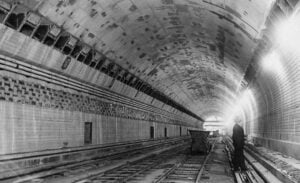
The Lincoln Tunnel under construction in 1936, showing the unfinished interior of the tube beneath the Hudson River. Associated Press, public domain, via Wikimedia Commons.
The Holland Tunnel, connecting Canal Street in Lower Manhattan with Jersey City, New Jersey, stands as one of the great engineering achievements of the early automobile age. Construction began on October 12, 1920, and the tunnel formally opened in November 1927. At the time, travelers crossing the Hudson River depended heavily on ferries, while automobile ownership was rising rapidly. Engineers now faced a new problem: how to build a long underwater tunnel that could safely carry thousands of gasoline-powered vehicles without filling with deadly exhaust.
The result was a pair of large, shield-driven tubes built beneath the Hudson River and equipped with the world’s first full-scale transverse ventilation system for a long underwater motor-vehicle tunnel. The project was led successively by Clifford M. Holland, Milton H. Freeman, and Ole Singstad. The tunnel ultimately took Holland’s name after his death during construction.
When Was the Holland Tunnel Built?
Ground was broken for the Holland Tunnel on October 12, 1920. Construction continued for seven years as crews worked from both the New York and New Jersey sides of the Hudson. The tunnel was formally opened on November 12, 1927, with President Calvin Coolidge participating remotely by telegraph. Vehicular traffic began just after midnight on November 13.
On the first full day of operation, 52,285 vehicles passed through the tunnel. The crossing immediately became one of the most important fixed transportation links between New York City and New Jersey.
The Carbon Monoxide Problem and the Ventilation Breakthrough
The most difficult problem was not simply digging beneath the Hudson River. Engineers already had experience building underwater railroad tunnels, but trains could be electrically powered. Thousands of automobiles and trucks burning gasoline inside an enclosed tube created a potentially lethal carbon monoxide problem.
To determine how much ventilation would be required, engineers worked with the U.S. Bureau of Mines and researchers including Yale physiologist Yandell Henderson. Human and animal tests were used to study the effects of different concentrations of carbon monoxide. The research helped establish the maximum concentration the tunnel’s ventilation system would be designed to tolerate.
Ole Singstad developed the revolutionary transverse ventilation system that solved the problem. Instead of trying to blow air from one portal all the way through the tunnel, fresh air was distributed continuously along the entire length of each tube. Four ventilation buildings, two in New York and two in New Jersey, housed 42 supply fans and 42 exhaust fans.
Fresh air was forced into ducts beneath the roadway and entered the traffic area through openings near road level. As that air mixed with automobile exhaust, contaminated air rose toward the ceiling, where it was drawn through separate exhaust openings and carried away through ducts above the roadway. The system could replace the tunnel’s air approximately every 90 seconds. This became the model for later long vehicular tunnels around the world.
How the Holland Tunnel Was Dug Beneath the Hudson
The twin tubes were excavated using the pneumatic shield method. Large steel tunneling shields protected the working face while crews excavated the material ahead. Hydraulic machinery pushed the shields forward as the tunnel advanced beneath the river.
The work took place through extremely difficult river-bottom conditions. Sandhogs encountered soft silt as well as more resistant material, and compressed air was used to help prevent water and saturated soil from rushing into the excavation. Airlocks separated the high-pressure work areas from normal atmospheric pressure outside the active tunnel headings.
As each shield advanced, workers immediately built the permanent tunnel lining behind it. Curved cast-iron and steel segments were bolted together to form circular rings. The outside diameter of the tubes was approximately 29.5 feet, and historical tunnel data lists about 114,000 tons of cast iron and steel in the tunnel lining. Concrete was added inside the structural shell before the roadway, ventilation ducts, walls, lighting, and other systems were installed.
The Sandhogs and Compressed-Air Construction
The underground workers who carried out much of this dangerous work became known as sandhogs. They excavated soil, handled tunnel-lining segments, worked around heavy machinery, and performed their jobs inside a compressed-air environment beneath the Hudson River.
Compressed air helped keep water out of the active excavation, but it created serious risks for the men. Workers had to pass through airlocks and undergo controlled decompression before returning to normal atmospheric pressure. Moving too quickly from high pressure to ordinary air could cause decompression sickness, commonly called the bends.
At the highest working pressures, time underground had to be sharply limited. The Port Authority’s historical account describes periods when more than 1,000 men were employed because workers under the greatest pressure could remain at the face for only about an hour and a half at a time. The dangers also included equipment accidents, flooding, and sudden losses of pressure. One major blowout during construction forced dozens of men to run from the tunnel and temporarily shut down work.
Clifford Holland, Milton Freeman, and Ole Singstad
The Holland Tunnel’s history is inseparable from the three engineers who successively led the project. Clifford M. Holland was appointed chief engineer in 1919 and became intensely involved in the tunnel’s design and construction. By October 1924, he was suffering from what contemporary accounts called nervous exhaustion. Holland died of heart failure at age 41, shortly before the New York and New Jersey tunnel headings were joined beneath the river.
Milton H. Freeman, who had served as engineer of construction, succeeded Holland as chief engineer. Freeman died of acute pneumonia in 1925, less than a year after taking charge. The New York entrance plaza was later named in his honor.
Ole Singstad then became chief engineer and carried the project through its final construction and mechanical work. Singstad had already been central to the development of the ventilation system, the feature that ultimately made the Holland Tunnel an international engineering landmark.
Why the Holland Tunnel Changed Tunnel Engineering
The Holland Tunnel was not the first underwater tunnel ever built, but it represented a major step forward in the design of tunnels specifically for automobiles and trucks. Its twin tubes were among the largest and longest underwater vehicular tunnels of their era, while the ventilation system solved a problem that had previously limited the practicality of long enclosed automobile tunnels.
The American Society of Civil Engineers and the American Society of Mechanical Engineers jointly recognized the Holland Tunnel as a National Historic Civil and Mechanical Engineering Landmark in 1984. In 1993, it was designated a National Historic Landmark. The engineering principles demonstrated there, particularly the transverse ventilation system, influenced the design of later tunnels including the Lincoln Tunnel and other major vehicular crossings around the world.
Readers interested in more New York engineering and transportation history can also explore our History of the George Washington Bridge, History of the Bayonne Bridge, History of the Second Avenue Subway Project, and Grand Central Terminal, A Postmodern Cathedral.
Sources
- Port Authority of New York and New Jersey: The Holland Tunnel, Did You Know?
- Port Authority of New York and New Jersey: The Holland at 90
- Port Authority of New York and New Jersey: The Holland Tunnel Takes a Breather
- American Society of Mechanical Engineers: Holland Tunnel Ventilation System
- American Society of Civil Engineers: Holland Tunnel
- National Park Service: Holland Tunnel National Historic Landmark Nomination
- Library of Congress Historic American Engineering Record: Holland Tunnel, HAER NY-161