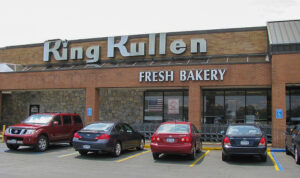
King Kullen supermarket on Long Island, New York. Photo by Thrawn, CC BY-SA 3.0, via Wikimedia Commons.
King Kullen occupies a unique place in American retail history. When Michael J. Cullen opened his first store on Jamaica Avenue in Queens on August 4, 1930, he combined ideas that had existed separately in earlier grocery stores into a new kind of operation: a large store with multiple departments, extensive self-service, aggressive discount pricing, high sales volume, and room for customers arriving by automobile. That formula became the foundation of the modern American supermarket.
For generations of New Yorkers, however, King Kullen was more than a milestone in retail history. After beginning in Queens, the chain became deeply associated with Long Island, where the Cullen family continued operating the company for decades. That family-owned era finally ended in 2026, when Giunta’s Meat Farms completed its acquisition of King Kullen and its Wild by Nature stores.
Michael J. Cullen and the Idea That Changed Grocery Shopping
Michael J. Cullen was born in 1884 to Irish immigrant parents and entered the grocery business at age 18 with The Great Atlantic & Pacific Tea Company, better known as A&P. He spent 17 years with the company, eventually rising to division superintendent, before moving on to other grocery companies in the Midwest and ultimately Kroger.
By 1929, Cullen was managing dozens of Kroger stores in Illinois and had developed a radically different idea for selling groceries. In a letter to Kroger president William Albers, he proposed enormous stores located outside high-rent shopping districts, with plenty of parking, extensive self-service, low operating costs, and dramatically reduced prices. Cullen believed enormous sales volume could compensate for smaller profit margins on individual items.
The proposal went nowhere. Convinced that the idea would work, Cullen left Kroger and returned east to put it into practice himself.
The First King Kullen Opens in Queens
On August 4, 1930, Cullen opened the first King Kullen Grocery Company store in a converted garage at 171-06 Jamaica Avenue, near 171st Street in Jamaica, Queens. The store measured roughly 6,000 square feet and carried about 1,000 products, including groceries as well as household, hardware, and automotive merchandise.
King Kullen was not the first grocery store to experiment with self-service. Piggly Wiggly had introduced self-service grocery shopping years earlier. What made Cullen’s operation different was the way it combined self-service with a much larger store, separate departments, low prices, aggressive advertising, high-volume sales, and a location designed to draw customers from beyond the immediate neighborhood. The Smithsonian’s Lemelson Center has identified those characteristics as central to the supermarket model that followed.
Cullen promoted the new business aggressively as the “World’s Greatest Price Wrecker.” The timing could hardly have been more significant. The Great Depression had begun, and families were searching for ways to stretch every dollar. King Kullen’s low-price, high-volume approach quickly attracted large crowds and forced established grocery chains to pay attention.
From One Store to a Growing New York Chain
King Kullen expanded rapidly. Within two years, the company operated eight stores. By 1936, it had grown to 17 locations in New York City and Long Island and was generating approximately $6 million in annual sales.
Michael Cullen did not live to see how completely his supermarket concept would transform American shopping. He died in April 1936 at age 52 from peritonitis following an appendectomy. His widow, Nan Cullen, took control of the company with assistance from other members of the family and continued the business rather than selling it.
That decision established one of the defining characteristics of King Kullen for the next 90 years. While the American supermarket industry consolidated around increasingly large regional and national corporations, King Kullen remained controlled by generations of the Cullen family.
King Kullen Becomes a Long Island Institution
As Long Island’s population exploded after World War II, King Kullen followed the suburban growth eastward through Nassau and Suffolk counties. The combination of automobile ownership, new housing developments, shopping centers, and growing suburban communities was particularly well suited to the supermarket model Cullen had imagined decades earlier.
Over time, the company adapted to changing expectations inside the supermarket itself. King Kullen added new departments and services, including in-store bakeries, while remaining a familiar neighborhood grocery name throughout Long Island.
In 1995, the company entered the growing natural and organic food market by opening the first Wild by Nature store in East Setauket. The full-service natural foods concept later expanded to additional Long Island locations and remained part of the King Kullen organization through the company’s 2026 sale.
The Failed Stop & Shop Acquisition
After decades of independent family ownership, King Kullen appeared headed for a major change in late 2018 when the company reached an agreement to be acquired by Stop & Shop, part of Ahold Delhaize USA. The proposed transaction included King Kullen supermarkets and Wild by Nature stores.
The acquisition never happened. In June 2020, the companies announced that they had mutually terminated the agreement, citing significant unforeseen changes in the marketplace, largely connected to the COVID-19 pandemic. King Kullen remained independent and continued operating as a Cullen family-controlled business.
Giunta’s Meat Farms Acquires King Kullen in 2026
On July 30, 2026, King Kullen announced that it had reached an agreement to be acquired by Giunta’s Meat Farms, another family-owned Long Island supermarket company. The transaction included all 24 remaining King Kullen supermarkets and four Wild by Nature natural food markets across Nassau and Suffolk counties.
On October 3, 2026, the companies announced that the acquisition had been completed. The transaction brought an end to nearly a century of Cullen family ownership while keeping the business in the hands of another Long Island grocery family.
The immediate future of the King Kullen name has not yet been completely decided. The companies said they would decide over the following months which locations would retain the King Kullen name and which would be converted to Giunta’s Meat Farms. When the acquisition was completed, no plans to close stores had been announced, layoffs were not anticipated, and existing union contracts were to be honored.
The Legacy of America’s First Modern Supermarket
King Kullen’s importance extends far beyond the number of stores that ultimately carried its name. Michael Cullen recognized that shoppers would travel farther for lower prices, serve themselves if the store was designed properly, and buy more when a wide range of products was brought together under one roof. High volume rather than high margins became the heart of his business model.
Other grocers adopted the same principles, and the supermarket became a defining institution of American consumer life. What began in a converted garage on Jamaica Avenue in Queens in 1930 eventually became the standard way millions of Americans bought their food.
The 2026 acquisition changed King Kullen’s ownership, but it did not change the historical importance of what Michael J. Cullen created. Nearly a century after the first store opened, the name remains tied to one of the most consequential transformations in the history of American retail.
Readers interested in more New York supermarket history can also explore our A&P Supermarket History and Memories, History and Memories of Bohack’s Grocery Stores, and The Story of Waldbaum’s: From a Brooklyn Butter Shop to a Long Island Supermarket Icon.
Sources
- King Kullen: Company History
- Smithsonian Lemelson Center: The Development of the Modern Supermarket
- American Heritage: The Rise of the Supermarket
- Supermarket News: Michael J. Cullen, 2009 Hall of Fame
- Supermarket News: King Kullen, An American Original
- Supermarket News: King Kullen to Open Wild by Nature
- Supermarket News: Stop & Shop and King Kullen End Acquisition Agreement
- Store Brands: Giunta’s Meat Farms Agreement to Acquire King Kullen
- News 12 Long Island: Giunta’s Meat Farms Finalizes King Kullen Acquisition
- Patch: King Kullen Officially Acquired by Giunta’s Meat Farms