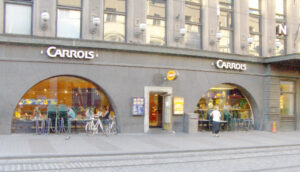
Feature Photo: No machine-readable author provided. Skorpion87 assumed (based on copyright claims)., Public domain, via Wikimedia Commons
Long before the fast-food wars were fought through national advertising campaigns and sprawling drive-through chains, families across Upstate New York, Pennsylvania, and other parts of the Northeast were ordering hamburgers, fries, and thick milkshakes at Carrols Drive-In. For a generation of customers, the name meant inexpensive food, an unmistakable roadside restaurant, and the chance to enjoy a meal without spending much money.
Carrols was especially important in Central New York because its most successful American operation grew out of Syracuse. At its height, the chain had more than 150 restaurants, with locations across New York and beyond. Its best-remembered sandwich was the Club Burger, a double-decker hamburger with its own special dressing. People who grew up eating at Carrols still remember the taste, the prices, and the promotional drinking glasses almost as vividly as the restaurants themselves.
So whatever happened to Carrols Hamburgers? The answer is more surprising than the familiar story of a chain that ran out of money and closed. Beginning in 1975, Carrols made an agreement to operate Burger King restaurants. Its original locations were gradually converted or closed, but the Syracuse company behind them continued to grow. Decades later, that business became Burger King’s largest franchisee in the United States before Burger King’s parent company acquired it in 2024.
In other words, the Carrols name disappeared from American hamburger stands, but the company did not disappear along with it. And there was another twist: the old Carrols restaurant name continued in Finland for decades after it had largely vanished from New York.
1. How Carrols Hamburgers Started in Syracuse
The American Carrols story began in 1960, when Herbert N. Slotnick obtained the rights to develop Carrols Drive-In restaurants in New York State. The concept grew out of a Midwestern company connected with Tastee-Freez, the soft-serve ice cream business. Historical accounts trace the Carrols name to Carol, the daughter of Tastee-Freez co-founder Leo Maranz. Slotnick’s contribution was to turn that restaurant concept into a fast-growing regional business with Syracuse as its center.
The first Syracuse-area locations included a restaurant on Erie Boulevard in DeWitt and another along Route 11 in the Mattydale and North Syracuse area. They offered a relatively new kind of dining experience for many local families: customers could stop for a quick, inexpensive meal served in a standardized, recognizable setting. The restaurants were designed around speed, value, and the appeal of hamburgers, french fries, and milkshakes.
Slotnick already understood the importance of entertainment and attracting families. His business background included movie theaters, and he recognized how popular a reliable fast-food restaurant could become in communities where the national hamburger chains had not yet established a dominant presence. His family later recalled that the first restaurants were particularly successful and that he eventually acquired the broader Carrols chain.
This distinction is important. Carrols did not begin as a national restaurant corporation created entirely in Syracuse, but Slotnick’s New York franchise operation became the driving force behind its expansion. The success of that Syracuse-based business made Carrols a recognizable name throughout much of the Northeast.
2. The Rise of a Regional Fast-Food Giant
By the early 1960s, Carrols was appearing in communities well beyond Syracuse. Its restaurants spread through New York State, including Western New York, the Rochester region, and the Hudson Valley, and the wider chain also developed locations in Pennsylvania and other markets. The expanding network brought a familiar menu and image to neighborhoods that were just beginning to experience the arrival of large fast-food operators.
Old advertisements capture how inexpensive the restaurants once seemed. A Buffalo-area Carrols advertisement from 1962 promoted hamburgers for 15 cents and shakes for 20 cents. A later Niagara Falls opening in 1965 was described as the chain’s 36th New York State location. These details help explain how quickly the restaurants had become part of the region’s everyday landscape.
Carrols’ own corporate history says the system had grown to more than 150 restaurants by the middle of the 1970s. Slotnick’s family obituary gives a peak figure of 167. The precise count depends on the year and which operations are included, but there is no question that Carrols grew into a substantial regional competitor in an increasingly crowded hamburger business.
For many customers, Carrols became associated with ordinary family routines: something to eat after a school event, a stop during a shopping trip, or a hamburger with friends. The company also used the promotions familiar to anyone who remembers fast-food advertising of the period. Collectible drinking glasses featuring cartoon characters, including Looney Tunes promotions, became part of the chain’s appeal. Long after the restaurants disappeared, some of those glasses and other giveaways survived in kitchen cabinets and collections.
3. The Club Burger: The Sandwich People Still Remember
If there is one menu item that keeps the Carrols name alive, it is the Club Burger. The sandwich was a substantial alternative to the plain, inexpensive hamburgers that made early drive-ins popular. It featured two beef patties and a layered bun, together with cheese, lettuce, pickles, onions, and a dressing that former customers often recall as Royal Dressing or a tangy special sauce.
The Club Burger is regularly compared with McDonald’s Big Mac, and it is easy to understand why. Both offered a larger, double-decker hamburger with a distinctive sauce. McDonald’s dates the Big Mac’s introduction to 1967 and its national rollout to 1968. Carrols was already firmly established by then, although the surviving evidence does not establish a sufficiently precise introduction date for the Club Burger to claim with certainty that the sandwich preceded the Big Mac.
What matters to people who ate at Carrols is that the Club Burger had an identity of its own. Former customers still remember the dressing, the combination of toppings, and the particular taste of a sandwich that was not simply another chain’s hamburger. Carrols also served fish sandwiches, chicken items in later years, french fries, shakes, and other familiar fast-food choices. The Club Burger, however, was the item many customers continued talking about long after the signs came down.
4. Why Carrols Restaurants Became Burger King
As Carrols expanded, so did the competition. McDonald’s and Burger King were building nationally recognized brands, backed by advertising campaigns, standardized operations, and resources that could be difficult for regional chains to match. Carrols had been successful in markets where it had arrived early, but the economics of fast food were changing rapidly.
Rather than attempt to defeat those larger companies at every new intersection, the Syracuse leadership changed direction. In late 1975, Carrols entered into a franchise agreement with Burger King. The arrangement called for suitable Carrols restaurants to be converted into Burger King locations over approximately five years, while restaurants that could not be converted would be phased out.
That makes the original chain’s disappearance different from a bankruptcy liquidation. A converted Carrols restaurant could remain in business, employ workers, and continue selling hamburgers, but it would no longer serve the Club Burger or display the familiar Carrols name. From the customer’s point of view, a beloved neighborhood restaurant had vanished. From the company’s point of view, the business had changed brands and moved into a new chapter.
It also did not happen everywhere on a single night. Some areas lost their Carrols locations quite rapidly during the mid-1970s; other restaurants retained the name longer. Carrols’ own account describes a conversion program extending over several years. Remembering the change as an overnight disappearance may capture how sudden it felt to diners, but it is not the complete corporate history.
5. The Last Carrols Hamburger Restaurant in America
Although the larger company moved into Burger King operations, at least one independently operated Carrols continued selling the old menu well after the main conversion program began. That restaurant was on East Main Street in Batavia, in Genesee County. Former manager Philip Tooze later recalled customers who visited because they wanted another Club Burger while they still had the chance.
Accounts place the end of the Batavia Carrols at about 1981. It has been widely remembered as the last operating American restaurant carrying the original Carrols name. Its unusually long survival explains why the statement that every Carrols was gone by 1977 is misleading. The company’s branded presence disappeared from most communities during the 1970s, but the final American holdout lasted into the next decade.
The restaurant eventually operated under a different name, another example of the way old fast-food properties could remain part of a town even after the original business was gone. For anyone who made a special trip to Batavia for a Club Burger, however, the closing meant the loss of something that a newly installed sign could not replace.
6. What Happened to the Syracuse Company After the Restaurants Closed?
For customers, the disappearance of the Carrols menu seemed like the end of the business. Behind the scenes, Carrols continued operating and expanding as a Burger King franchisee. The company retained its Syracuse identity even as its restaurants served food under a different national brand.
Its corporate history was not limited to Burger King. Carrols expanded into other businesses over the years, including movie theaters associated with CinemaNational. In the late 1990s and early 2000s, it acquired the restaurant chains Pollo Tropical and Taco Cabana. Those businesses were later separated from Carrols in 2012, allowing it to concentrate again on expanding its Burger King operations.
During the following years, Carrols acquired additional Burger King restaurants and became the largest Burger King franchisee in the United States. It also entered the Popeyes business in 2019. By the time its ownership changed in 2024, Carrols operated a restaurant network vastly larger than the original collection of drive-ins that Syracuse residents had known in the 1960s.
7. Burger King’s Parent Company Bought Carrols in 2024
On January 16, 2024, Restaurant Brands International, the parent company of Burger King, announced an agreement to purchase Carrols Restaurant Group. The transaction was completed on May 16, 2024, with an enterprise value of approximately $1 billion. This was an acquisition of the company, not a purchase of the long-discontinued Carrols hamburger menu or a billion-dollar payment to its original founder.
At the time of the announcement, Carrols operated 1,022 Burger King restaurants across 23 states, along with 60 Popeyes locations in six states. Its Burger King restaurants generated approximately $1.8 billion in systemwide sales during the twelve months ending September 30, 2023. These figures make the scale of the transformation clear: a regional hamburger chain had become one of the most significant restaurant operators in the Burger King system.
Restaurant Brands International said it intended to invest in remodeling more than 600 of the acquired restaurants and eventually transfer many of them to smaller franchise operators. Those were announced plans, not an indication that every property would be sold immediately. The acquisition made Carrols a subsidiary within the larger restaurant group.
There is an important difference between the disappearance of the Carrols hamburger chain and the continued existence of the Carrols business name. Even after the 2024 acquisition, the company maintained a corporate website identifying Carrols as a Syracuse-based Burger King operator. The familiar Carrols Drive-In signs were gone, but the organizational legacy was still there.
8. The Surprising Survival of Carrols in Finland
Perhaps the strangest part of this story happened thousands of miles from Syracuse. While American Carrols restaurants were beginning their transition to Burger King, a Carrols hamburger chain opened in Finland in 1975. It became one of the country’s recognizable early fast-food brands, with a customer following of its own.
The Finnish chain’s history developed separately from the Syracuse company’s later American Burger King franchise operation. Carrols became a familiar name in Helsinki, and Finnish customers associated it with hamburgers such as the Carolina. The brand remained visible there long after Americans had stopped seeing Carrols restaurants on their local roads.
In 2002, Burger-In, the company behind Finland’s Hesburger chain, acquired the Finnish Carrols operation. Hesburger absorbed most locations over time, but the old name survived at several restaurants. Finnish news reports confirm that the five remaining Carrols-branded restaurants converted to Hesburger locations in 2012. The Finnish name disappeared roughly three decades after the last American holdouts.
It is a wonderful coincidence in fast-food history. A restaurant name closely associated with Syracuse in the 1960s and 1970s continued to mean something to customers in Helsinki well into the twenty-first century.
9. Why Upstate New Yorkers Still Remember Carrols
The old restaurants occupy a particular place in Upstate New York memory because they belong to a time before the national chains seemed to be everywhere. Carrols had its own signs, its own advertising, its own promotions, and, most importantly, its own food. Families had favorite locations, children collected drinking glasses, and people developed strong opinions about which hamburger they liked best.
The prices are part of that memory. The advertisements for 15-cent hamburgers and inexpensive shakes seem almost unbelievable today, although they reflected a different economy and a very different fast-food business. The restaurants also represented something distinctly regional: a company whose greatest American success was organized from Syracuse rather than one of the country’s established national corporate centers.
And then there was the Club Burger. People who remember its sauce and layered bun are not necessarily asking for an entire chain to return. Often, they simply want to taste something they associate with a particular time in their lives. That is why a discussion of Carrols can turn so quickly from corporate history to stories about childhood, school, family outings, and the restaurants that used to stand along familiar roads.
So Whatever Happened to Carrols Hamburgers?
Carrols Hamburgers disappeared because its Syracuse-based operators chose to become Burger King franchisees in the mid-1970s. Most of the original restaurants were converted or closed over the next several years, and the last American location survived until about 1981. The Carrols name lasted longer in Finland, where the final branded restaurants became Hesburger locations in 2012.
The company behind the original American chain continued growing, eventually operating more than a thousand Burger King restaurants before its acquisition by Burger King’s parent company in May 2024. That is the answer to the question, and it is more interesting than the usual story of a restaurant chain that simply failed.
Carrols may no longer be serving Club Burgers in Syracuse, Rochester, Buffalo, or the many other communities where its restaurants once stood. But for those who remember its counters, signs, and hamburgers, the old name still brings back a very specific taste of Upstate New York.
If you enjoy remembering New York’s vanished restaurant chains, see our articles on 25 Lost Restaurants Upstate New Yorkers Wish Were Still Open, Whatever Happened to Ponderosa Steakhouse?, What Happened to Arthur Treacher’s Fish & Chips?, and Whatever Happened to Howard Johnson’s Restaurants?.