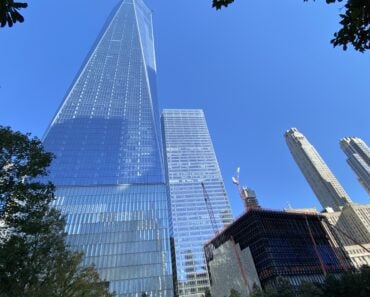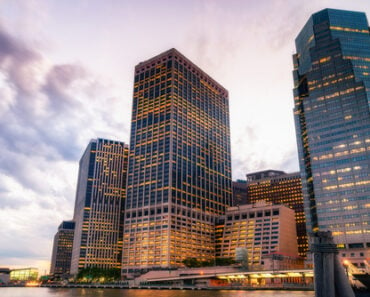
The United Nations Headquarters in New York City stands along the East River as one of Manhattan’s most recognizable international landmarks. Built in the years after World War II, the complex brought together modern architecture, global diplomacy, public art, and New York City history on a stretch of Turtle Bay that had once been part of Manhattan’s industrial waterfront.

Photo: Brian Kachejian©2020
The United Nations’ official headquarters in New York City was constructed in 1952. It occupies more than fifteen acres of land in Manhattan. The complex is bordered by East 48th Street to the north, the East River to the east, First Avenue to the west, and East 42nd Street to the south. The United Nations’ official headquarters comprises several buildings. The land where the United Nations buildings reside was originally part of a bustling industrial area in the Turtle Bay neighborhood of Manhattan in the 1910s and 1920s. The property was purchased from real estate developer William Zeckendorf Sr. in 1946 with the initial goal of creating a separate city for the United Nations’ headquarters. The site in New York was chosen after an exhaustive search of potential properties across the United States and other countries.
Several designs were created and submitted by member governments of the United Nations. Construction began in September 1948 after financing for the project was approved through loans from the United States government and the Reconstruction Finance Corporation. United Nations employees started moving into the Secretariat Building in 1950 and 1951. Construction of the headquarters was officially completed in October 1952.
The complex includes the following buildings:
- The Secretariat Building
The United Nations Secretariat Building is a 39-story, 505-foot skyscraper. The structure was designed by Swiss-French architect Le Corbusier and British architect Oscar Niemeyer. The building has offices for the Secretary-General, the Department for General Assembly and Conference Management, the Under-Secretary-General for Political Affairs and the Office of Disarmament Affairs, and the Under-Secretary-General for Legal Affairs. The building was recently renovated in 2010, and its tenants started returning to the skyscraper in 2012.

Photo: Brian Kachejian©2020
- The General Assembly Building
The General Assembly Building is where most United Nations meetings are held. The General Meeting Hall has a capacity of 1,800 people. It is also the largest room in the building, measuring 165 feet long by 115 feet wide.
The meeting hall is known for the front platform and the green marble desk where the President of the General Assembly, the Secretary-General, and the Under-Secretary-General for General Affairs and Conference Affairs sit. There’s also a lectern at the table for various speakers and presenters. The United Nations emblem is hung on a gold background behind the platform.
The hall’s ceilings are 75 feet high. Its entrance has an inscription from Iranian poet Saadi’s work, the Gulistan. The General Assembly Hall has been renovated several times over the years. The last changes were made in 1980 to add extra seating to accommodate United Nations members. Each of the 192 delegations has 6 seats at their respective desks: three for delegates and three behind the delegates for alternates.
- The Dag Hammarskjold Library
The Dag Hammarskjold Library is one of the newer buildings in the United Nations’ headquarters. It was completed in 1961 as a gift from the Ford Foundation to provide a permanent home for the ever-expanding library collections that were originally housed in the Secretariat Building. The library is located on the southwest corner of the property right next to the Secretariat. It contains more than 400,000 books, 80,000 maps, and almost 10,000 newspapers and periodicals. It’s also home to the Woodrow Wilson Collection, which includes over 8,000 volumes of League of Nations documents and more than 6,000 associated pamphlets and books.
- The Conference Building
The Conference Building is located between the Secretariat Building and the General Assembly Building. The Security Council Chamber is located in this building. The chamber was designed by renowned architect Arnstein Arneberg and was a gift from Arneberg’s home country of Norway.
- Other United Nations Buildings
DC-1 and DC-2 are later additions to the United Nations headquarters complex. They are used as office buildings for various United Nations agencies and programs. The United Nations Institute of Training (UNITAR) building and the United Nations Children’s Fund (UNICEF) buildings are also located in the United Nations Plaza. The property is home to the Office of International Oversight and the Church Center for the United Nations, a private facility owned by the United Methodist Church that contains offices for different organizations that are fully independent of government involvement.
Buildings on the United Nations campus have undergone several repairs and renovations since the complex was first established. The most recent renovations were completed in 2017. Additional storage buildings and temporary storage locations have been added as needed.

Photo: Brian Kachejian©2020
The grounds of the United Nations Headquarters have several impressive works of art. Some of them are:
– The Japanese Peace Bell. This bell is rung every year on the vernal equinox and at the opening of every United Nations General Assembly meeting.
– Non-Violence. This statue of a Colt Python revolver, whose barrel has been tied in a knot, is located at the front of the United Nations headquarters. It was a gift from the government of Luxembourg.
– Peace. This stained glass work of art was designed by Marc Chagall. It was created to honor the late Swedish diplomat Dag Hammarskjold, who was also the United Nations’ second Secretary-General.
– A tapestry copy of Pablo Picasso’s Guernica. This representation of Picasso’s 1937 painting was developed by artist Jacqueline de la Baume Durrbach. It was placed on the entrance to the Security Council room. ]
– Let Us Beat Swords Into Plowshares. The sculpture is part of the United Nations Art Collection. It is located in the United Nations Art Gardens and was a gift from the former Soviet Union.
There are also several murals in the United Nations Headquarters complex that were donated by well-known international artists. A couple of murals created by Candido Portinari are in the Delegates Hall. The murals, known as War and Peace, were gifted by the United Nations Association of the United States of America. There are a couple of decorative murals from French painter Fernand Leger in the General Assembly Hall. One mural was likened to “scrambled eggs” by former U.S. president Harry S. Truman, and the other is said to resemble Warner Brothers cartoon character Bugs Bunny.
The United Nations itself is exempt from local jurisdiction. Certain UN rules and regulations currently override existing New York City laws. However, people who commit crimes on the grounds of the United Nations headquarters are not exempt from those laws. Some United Nations staff members have diplomatic immunity. They cannot be prosecuted by New York City and state courts unless the United Nations’ Secretary-General waives that immunity.
Most people recognize the distinctive United Nations buildings from their appearances in various movies. The United Nations Headquarters was first featured in the 1953 Columbia Pictures movie The Glass Wall. Other notable appearances include Alfred Hitchcock’s North by Northwest in 1959, Voyage to the Bottom of the Sea in 1961, Superman IV: The Quest for Peace in 1987, and The Interpreter in 2005. The United Nations has also been in popular television shows ranging from 24 and the science fiction series V to Family Guy, House of Cards, and The Blacklist, to name a few.
The United Nations has helped maintain peace and good working relations among nations since its founding in 1945. 193 countries across the globe are now members of the United Nations. The organization continues to promote human rights, social progress, and improved living conditions for all of its member countries. Efforts to continue progress in these areas and other important decisions will continue to be made at the United Nations’ New York headquarters for many years to come.

Photo: Brian Kachejian©2020
In the past, free tours of the United Nations were available. Guided hour-long tours began at the Visitor Center. They were available weekdays during the center’s normal hours of operation.

Photo: Brian Kachejian©2020
Updated July 5, 2026.
Readers interested in more New York City landmarks and historic buildings may also enjoy our articles on the History of the Empire State Building, History of New York City’s Chrysler Building, History of New York’s Fascination with the Flatiron Building, and History of New York’s City Hall.