New York City’s oldest buildings are not all easy to rank. Construction records from the 1600s are incomplete, several houses were enlarged repeatedly, and some familiar landmarks have been moved, reconstructed, or redated after modern architectural study. This list ranks the 10 oldest surviving buildings in the five boroughs using the age of the oldest substantial portion that still exists.
Restoration does not disqualify a building. Repairs, replacement roofs, structural stabilization, and later additions are necessary parts of preserving structures that have stood for more than three centuries. A building is included when a meaningful part of its original historic structure survives. A later replacement built on the same site does not qualify merely because the property has an older history.
One additional distinction matters. The relocated Britton Cottage remains on this list because its circa-1670 core survives as the historic building itself. The Jan Martense Schenck House, however, was dismantled and installed inside the Brooklyn Museum using original timbers and floorboards together with newer material. It is an extraordinary surviving architectural installation, but under the stricter standard used here, it is discussed later rather than ranked as a building still standing in the conventional sense.
Several construction dates remain approximate. The placement of the Lakeman-Cortelyou-Taylor House is especially uncertain because preservation research gives a possible construction range rather than one confirmed year. The ranking therefore represents the strongest available evidence, not a claim that every position can be established with absolute precision.
10. Vander Ende-Onderdonk House, Circa 1709
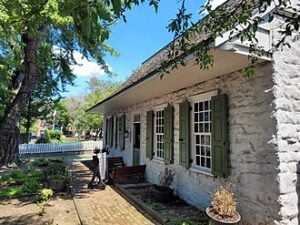
Photo credit: SnowFire, CC BY 4.0 <https://creativecommons.org/licenses/by/4.0>, via Wikimedia Commons
Address: 1820 Flushing Avenue, Ridgewood, Queens, NY 11385 | onderdonkhouse.org
The Vander Ende-Onderdonk House is generally dated to about 1709 and is recognized as New York City’s oldest surviving Dutch Colonial fieldstone house. Paulus Vander Ende acquired the farm and began construction of the house that year. The Onderdonk family later purchased the property, giving the building the name by which it is best known.
The house also played a role in defining the modern boundary between Brooklyn and Queens. A 1769 survey connected with a long-running boundary dispute used the property as an important point of reference. The surviving farmstead offers a rare reminder that the Ridgewood area was once a landscape of farms rather than city blocks and industrial buildings.
A serious fire damaged the house in 1975. Local residents organized the Greater Ridgewood Historical Society and carried out a major restoration using surviving masonry, salvaged historic material, architectural records, and traditional methods. The project restored a damaged historic structure rather than replacing a vanished building with an unrelated modern copy.
The Vander Ende-Onderdonk House operates as a museum and community history center. Public access is connected to scheduled events, exhibitions, and programs, so visitors should consult the official website before traveling.
9. Friends Meeting House, 1694
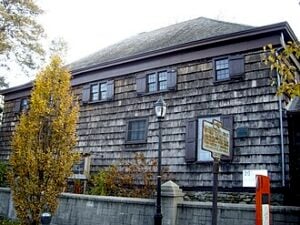
Photo: Dmadeo, CC BY-SA 4.0 <https://creativecommons.org/licenses/by-sa/4.0>, via Wikimedia Commons
Address: 137-16 Northern Boulevard, Flushing, Queens, NY 11354 | flushingfriends.org
The Friends Meeting House in Flushing was built in 1694 and is the oldest surviving house of worship in New York City. The original meeting house formed the eastern portion of the present building. It was enlarged between 1716 and 1719 as Flushing’s Quaker community grew.
The meeting house is closely connected with the history of religious freedom in New York. The Flushing Remonstrance of 1657 protested the Dutch colonial government’s restrictions on Quaker worship, and John Bowne later challenged those restrictions after being arrested for hosting Quaker meetings in his home.
British forces used the meeting house during the Revolutionary War as a prison, hospital, and storage building. It later returned to religious use and remains an active Quaker meeting house. The public may attend announced worship services and programs, but current visiting arrangements should be confirmed with the congregation.
8. Alice Austen House, Circa 1690
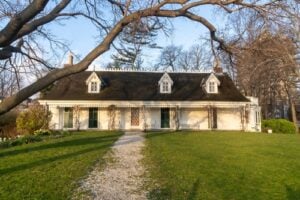
Address: 2 Hylan Boulevard, Staten Island, NY 10305 | aliceausten.org
The oldest part of the Alice Austen House, known as Clear Comfort, is traditionally dated to about 1690. It began as a small Dutch farmhouse overlooking New York Harbor. John Haggerty Austen purchased the property in 1844 and expanded the earlier house into the picturesque Gothic Revival cottage visible today.
The extensive 19th-century alterations do not erase the building’s 17th-century origins. Its oldest one-room core survives within the enlarged house, making Clear Comfort an example of how an early colonial dwelling could evolve while retaining part of its original structure.
The house became the lifelong home of photographer Alice Austen, whose work documented Staten Island, Manhattan street life, immigration, social customs, and her life with Gertrude Tate. The property is now a public museum and a nationally significant site of photographic and LGBTQ+ history. Museum hours and admission information are available through the official website.
7. Lakeman-Cortelyou-Taylor House, Circa 1683
Address: 2286 Richmond Road, Staten Island, NY 10306
The Lakeman-Cortelyou-Taylor House is a privately owned Dutch Colonial farmhouse whose earliest portion has been dated within a broad range extending from approximately 1683 to 1714. Preservation organizations commonly use circa 1683, which places the house here, but its exact position relative to the Alice Austen House, Friends Meeting House, and Vander Ende-Onderdonk House cannot be proven conclusively.
The house combines irregular fieldstone construction with wood framing and later additions. A restoration in the early 2000s removed modern coverings and revealed much of the building’s early form. The New York City Landmarks Preservation Commission designated it as a landmark in 2016, but the City Council overturned that designation in 2017.
The Lakeman-Cortelyou-Taylor House remains private property and is not a public museum. Its uncertain date is the reason this article identifies the ranking as evidence-based rather than perfectly exact.
6. Conference House, Circa 1680
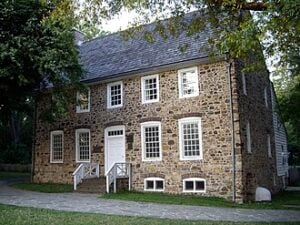
Photo by I, Dmadeo, CC BY-SA 3.0 <http://creativecommons.org/licenses/by-sa/3.0/>, via Wikimedia Commons
Address: 7455 Hylan Boulevard, Staten Island, NY 10307 | conferencehouse.org
Conference House was built around 1680 for Captain Christopher Billopp on the Manor of Bentley at the southern end of Staten Island. The substantial fieldstone residence was unusually large and formal compared with the smaller farmhouses built elsewhere in the region during the same period.
The house received its present name because of the peace conference held there on September 11, 1776. Benjamin Franklin, John Adams, and Edward Rutledge met with British Admiral Lord Richard Howe in an unsuccessful attempt to end the Revolutionary War.
The building retains surviving 17th-century masonry and has undergone repeated preservation work. It opened as a museum in 1927 and has been restored to interpret its colonial and Revolutionary-era history. The surrounding Conference House Park is publicly accessible, while interior tours operate according to the museum’s current schedule.
5. Manee-Seguine Homestead, Circa 1670s
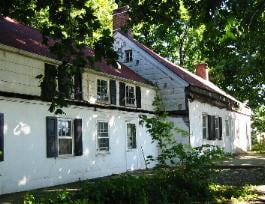
Library of Congress, Public domain, via Wikimedia Commons
Location: Prince’s Bay, Staten Island, near Seguine Avenue and Purdy Place
The Manee-Seguine Homestead is one of New York City’s most difficult early houses to date precisely. The New York City Landmarks Preservation Commission concluded that its oldest eastern section may date from the 1670s and is probably one of Staten Island’s surviving pre-1700 structures. The original portion was a one-room rubblestone dwelling with a cellar and attic.
Later owners expanded the house during the 18th and early 19th centuries. The additions document the gradual transformation of a small colonial dwelling into a larger homestead. During the late 19th century, the property became the Homestead Hotel, also known as Purdy’s Hotel, reflecting Staten Island’s former importance as a summer resort and oyster-producing community.
The Manee-Seguine Homestead is a designated New York City landmark, but it has endured prolonged neglect and remains threatened. It is private property and is not open to the public. Its inclusion is based on the surviving early stone section, not merely on the age of the property.
4. Britton Cottage, Circa 1670
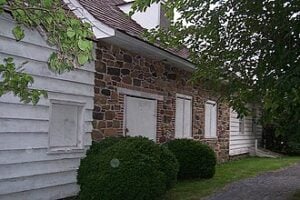
Photo by nicholas f matranga, CC BY-SA 3.0 <https://creativecommons.org/licenses/by-sa/3.0>, via Wikimedia Commons
Location: Historic Richmond Town, 441 Clarke Avenue, Staten Island, NY 10306 | Historic Richmond Town
Britton Cottage, also known as the Cubberly-Britton Cottage, contains a central fieldstone section dating to about 1670. Later sections were added during the 18th century. The earliest portion may have served both residential and civic purposes when Staten Island’s local government was still developing.
The cottage originally stood near New Dorp Beach. It was moved to Historic Richmond Town during the 1960s when development threatened its survival. Unlike a replica constructed after the loss of an original building, the relocated cottage retains its historic core and continues to exist as the same surviving structure.
Britton Cottage is awaiting restoration and is not normally open to the public. Visitors to Historic Richmond Town may view the exterior, but access conditions can change as preservation work proceeds.
3. Billiou-Stillwell-Perine House, Circa 1663
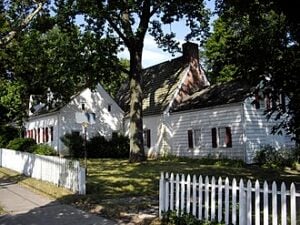
Photo by Dmadeo, CC BY-SA 3.0 <https://creativecommons.org/licenses/by-sa/3.0>, via Wikimedia Commons
Address: 1476 Richmond Road, Staten Island, NY 10304 | historicrichmondtown.org/perinehouse
The Billiou-Stillwell-Perine House is the oldest surviving building on Staten Island and one of the oldest in New York City. Historic Richmond Town’s current research dates its earliest section to about 1663, when Pierre Billiou, a settler from French Flanders, built a stone and wood dwelling after arriving in the Dutch colony.
An older New York City landmark report dated the original section to about 1679. Historic Richmond Town now uses the earlier circa-1663 date following more recent investigation of the house and its construction history. That updated institutional date places the building third in this ranking.
The house expanded through a series of additions associated with the Stillwell and Perine families. Its different rooflines, stone sections, timber framing, fireplaces, and later wings record more than two centuries of changing construction and domestic life.
The Billiou-Stillwell-Perine House remains on its original site. Historic Richmond Town is undertaking a major restoration project, and the fragile interior is not presently open for general visitation.
2. Bowne House, 1661
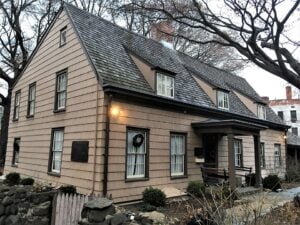
Photo by Station1, CC BY-SA 4.0 <https://creativecommons.org/licenses/by-sa/4.0>, via Wikimedia Commons
Address: 37-01 Bowne Street, Flushing, Queens, NY 11354 | (718) 359-0528 | bownehouse.org
John Bowne constructed the original section of the Bowne House in 1661. Later additions were made in 1680 and 1691, and the roof and north wing were altered during the 19th century. The 1661 portion remains part of the present building.
Bowne used his home for Quaker worship despite restrictions imposed by Peter Stuyvesant’s colonial government. He was arrested and banished, but he appealed directly to the Dutch West India Company. Its decision supporting liberty of conscience became an important episode in the history of American religious freedom.
Nine generations of the Bowne family lived in the house. The family’s later history also included abolitionism and assistance to freedom seekers during the era of the Underground Railroad.
The Bowne House operates as a museum. Tours, school programs, and special events are offered on selected dates and by arrangement, so visitors should confirm availability before arriving.
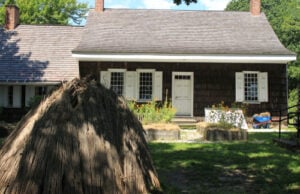
1. Wyckoff House, Circa 1652
Address: 5816 Clarendon Road, Brooklyn, NY 11203 | (718) 629-5400 | wyckoffmuseum.org
The Pieter Claesen Wyckoff House is the oldest surviving building in New York City and is generally dated to about 1652. Dendrochronology and architectural research have helped establish the age of its earliest section. Generations of the Wyckoff family expanded and altered the farmhouse while continuing to work the surrounding land until 1901.
The building reflects the complicated history of colonial farming in Brooklyn. Dutch-American landowners, enslaved and free Africans, indentured workers, and later immigrant laborers all formed part of the agricultural world connected with the property.
In 1965, the Wyckoff House became the first building designated by the newly established New York City Landmarks Preservation Commission. It was later extensively restored and opened as a public museum surrounded by gardens and parkland.
The Wyckoff House Museum offers tours, educational programs, family activities, and events connected with immigration, agriculture, food, labor, and community history. Current hours should be checked on the museum’s official website.
Why Several Famous Old Buildings Are Not Ranked
Lent-Riker-Smith Homestead: Numerous secondary sources repeat a 1654 or 1656 construction date. The official New York City landmark designation report, however, dates the existing Lent Homestead to about 1729 and attributes it to Abraham Lent. Under the strict building-based standard used here, the property’s earlier Riker history does not make the present house a surviving 1650s structure.
Fraunces Tavern: The Pearl Street site and parts of the building have genuine colonial history, but the structure underwent an extensive reconstruction in 1906 and 1907. Because the visible building is partly a Colonial Revival interpretation of the earlier tavern, it is not ranked as an uncomplicated 1719 survivor.
Voorlezer’s House: The building was long described as a circa-1695 school and religious structure. Dendrochronology and a modern historic structure report determined that the original building was lost and that the present house was constructed around 1769, possibly reusing part of an earlier foundation.
Queens County Farm Museum: The farm has roots extending to 1697, but a property’s founding date is not the same as the date of its surviving buildings. The current historic farmhouse is an 18th-century structure, so the farm cannot be ranked as a surviving 1697 building.
Jan Martense Schenck House: The original Dutch farmhouse dated to about 1675 or 1676. It was dismantled, stored, and later installed inside the Brooklyn Museum with original beams and floorboards as well as newer material. It remains one of New York’s most important surviving architectural artifacts, but this article treats it as a reconstructed museum installation rather than a conventionally standing building.
Restoration Versus Replacement: The Alice Austen House, Vander Ende-Onderdonk House, Conference House, Wyckoff House, and other entries have undergone substantial restoration. They remain on the list because meaningful portions of their historic structures survived and were preserved. Restoration maintains an old building; constructing a later replacement on an old site creates a different building.
Summary
The Wyckoff House remains the clearest choice as New York City’s oldest surviving building, followed by the Bowne House and the Billiou-Stillwell-Perine House. The middle of the ranking is less certain because several Staten Island houses have approximate construction dates, later additions, and incomplete records.
The list also reveals why the term “oldest building” must be used carefully. The age of a farm, congregation, tavern business, or historic site does not automatically establish the age of the structure now standing there. Careful ranking requires evidence that a substantial part of the early building itself survives.
Sources: Historic House Trust, Wyckoff House Museum; Bowne House Historical Society; Historic Richmond Town, Billiou-Stillwell-Perine House; Historic Richmond Town, Britton Cottage; New York City Landmarks Preservation Commission, Manee-Seguine Homestead; Historic House Trust, Conference House; Historic Districts Council, Lakeman-Cortelyou-Taylor House; Alice Austen House; New York City Landmarks Preservation Commission, Friends Meeting House; Greater Ridgewood Historical Society, Vander Ende-Onderdonk House; New York City Landmarks Preservation Commission, Lent Homestead; Historic Richmond Town, Voorlezer’s House Redating; Brooklyn Museum, Jan Martense Schenck House.
10 Oldest Surviving Buildings In New York City article published on ClassicNewYorkHistory.com © 2026