For decades, Ohrbach’s offered fashionable clothing at prices everyday New Yorkers could afford. Beginning with a single store near Union Square, the retailer built a loyal following by combining discount pricing with stylish merchandise, eventually becoming one of New York City’s most recognizable department store chains.

Ohrbach’s was a department store chain that originated in New York. The retailer was known for its popular fashion lines available at reasonable prices. They weren’t the biggest franchise in the city, but they worked hard to earn customers’ trust. Even though the organization has been out of business for more than thirty years, many residents still fondly remember their Ohrbach’s shopping experiences.
The first Ohrbach’s location opened in October 1923 in New York City’s Union Square neighborhood. The store was operated by Nathan M. Ohrbach and dressmaker Max Weisen. Both partners donated more than $60,000 of their own money to start the company. The building was designed by architect Paul Laszlo.
Nathan decided to reduce service to a minimum so he could offer his products at significant savings to consumers. Ohrbach’s specialized in women’s clothing and accessories, available as irregulars, seconds, and overstocked items from manufacturers. Clothing prices were in even numbers, unlike the odd-numbered pricing methods used by several of their competitors. At the time, the company did not provide alterations or deliveries. They initially didn’t advertise or hold any sale promotions, and all early transactions were conducted on a cash-and-carry basis.
Weisen sold out to Ohrbach in 1928 after the business partners began to disagree. Max decided to step down from the company after Nathan opened a second store location a few blocks away. After Weisen’s departure, Ohrbach decided to upgrade his product lines. Children’s and men’s clothing were added, and more upscale women’s clothing selections were introduced.
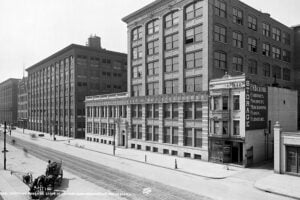
(5th Avenue and 34th Street Ohrbach’s Store in Manhattan)

Photo: Gottscho-Schleisner Collection, Public domain, via Wikimedia Commons
The company expanded to California in 1945, opening its first location in Los Angeles. The fashion industry’s rapid rise in popularity led to the decision to open a store in the Prudential Insurance Building on the Miracle Mile, along Wilshire Boulevard. The store’s success led to the addition of another Los Angeles store at Fifth and Broadway, in the former Milliron’s facility. However, the new location wasn’t as successful. Its poor performance led to the store’s closure in 1959.
(Do you remember the lunch counter at the 34st Ohrbach’s?)

Photo: Gottscho-Schleisner Collection, Public domain, via Wikimedia Commons
Ohrbach’s flagship store at Union Square in New York City was relocated to West 34th Street in 1954. The building located between Fifth and Sixth Avenues was once a McCreery’s department store. Brenninkmeyer Company, a business based in the Netherlands, began purchasing shares in Ohrbach’s in 1962. The organization assumed complete control of the retail company after Nathan Ohrbach retired in 1965.
Merchandise at Ohrbach’s stores was arranged on racks and tables that were sure to draw shoppers’ attention. More expensive items were eventually added to help the company keep up with its competition and consumer preferences. The West 34th Street store billed its recently acquired copies of original designs from Paris as “French Couture Originals” soon after its 1954 opening.
The business opened its first New Jersey store in 1967 at the Bergen Mall. Ohrbach’s would eventually have five anchor stores in Newark, New Jersey. Sales started to slump at the New York and New Jersey locations in the late 1960’s and early 1970’s in the aftermath of race riots. The Newark stores closed by 1974, and the company’s corporate offices were moved to the 34th Street store in New York City. The Bergen Mall store would be home to Ohrbach’s credit operations.
Additional Ohrbach’s locations opened in California in the 1960’s and 1970’s. Stores were launched in the Panorama Valley Shopping Center in the San Fernando Valley, the Los Cerritos Center in Cerritos, the Glendale Galleria, and the La Mirada Mall. Some stores were constructed as anchor locations in several malls to attract more business in highly competitive areas.
Ohrbach’s stores provided some of the latest fashions for popular Hollywood productions. Sitcoms such as The Donna Reed Show, I Love Lucy, and Mister Ed, and soaps such as Dark Shadows, The Doctors, and All My Children were just some of the television shows whose actors routinely wore Ohrbach’s designer outfits on camera.
Brenninkmeyer’s Amcena corporation purchased the New Jersey-based Howland-Steinbach department store chain in June 1986. Later that year, it announced the closure of all remaining Ohrbach’s stores. Six locations would reopen in February 1987 under the Steinbach name.
Nathan Ohrbach’s methods of selling quality merchandise at discounted prices worked well at first. However, as more and more clothing stores sprang up, the company found itself having to raise its prices, add more product lines, and find additional ways to stand out in a crowded industry. After his retirement, the Dutch Brenninkmeyer’s company realized that it was becoming increasingly difficult to stay on top of current trends, undercut their opponents’ prices, and still stay afloat.
Another problem was the fact that top designers had their pick of department store franchises to sell their wares. Businesses really had to stand out to attract attention, and it was an area where Ohrbach’s started falling short. They didn’t have the resources or enough locations to secure exclusive agreements with some of the biggest clothing manufacturers, which made it harder to keep up with the competition. Discounters and changing customer tastes also contributed to Ohrbach’s demise.
Steinbach ceased operations in 1999. The Asbury Park, New Jersey-based company had been in business since 1870. All remaining locations were soon sold or permanently closed. This was essentially Ohrbach’s legacy, but the department store chain was a favorite of New York residents and visitors for many years.
Generations of shoppers gathered at Ohrbach’s department stores to buy modern clothing at prices they could afford. Even though some of their selections were knock-offs, second-hand, or reproductions, the fact that the organization stayed in business for more than sixty years suggests that their clients didn’t mind. They had a loyal customer base for decades. Ohrbach’s was one of the few companies that made a lasting impression and remained successful in an ever-changing retail environment for many years.
Updated July 7, 2026.
Ohrbach’s was one of many department stores that helped define shopping in New York during the twentieth century. You can also explore the histories of Bloomingdale’s, Lord & Taylor, Gimbels, and B. Altman & Company.