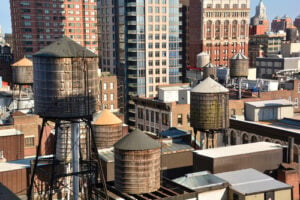

Feature Photo: Ajay Suresh from New York, NY, USA, CC BY 2.0 <https://creativecommons.org/licenses/by/2.0>, via Wikimedia Commons
Queens is home to Flushing Meadows-Corona Park. In turn, Flushing Meadows-Corona Park is home to the New York Hall of Science. New York City has no shortage of science and science-related museums. Still, the New York Hall of Science stands out because it offers a much more hands-on experience than most other science museums. As a result, it can hold its own against its competitors, particularly for people who prefer learning by doing.
The 1964 World’s Fair
The New York Hall of Science has a strong connection to the World’s Fair. For starters, Flushing Meadows-Corona Park wouldn’t exist without the exhibition. The site turned into an ash dump because of industrialization. Unsurprisingly, the locals were less than enthused by its existence, which was bad enough that F. Scott Fitzgerald immortalized it as “a valley of ashes” in The Great Gatsby. Park Commissioner Robert Moses thought about turning the site into a park in the 1920s. However, he didn’t get the chance to do so until New York City hosted the 1939 World’s Fair. The result wasn’t quite as grand as what he wanted. Still, it was a massive improvement on its predecessor in every single way.
Later, New York City held the 1964 World’s Fair. Due to that, the site received further funding for further expansion. One of those expansions was the New York Hall of Science, which was a science museum at a time when science museums were still rare. Furthermore, the building is interesting because of an architectural feature in which glass segments are arranged in concrete structures. In any case, the New York Hall of Science proved popular enough to continue operating after the 1964 World’s Fair was over. Something that wasn’t true for most of its counterparts.
A Successful Revival Under Alan J. Friedman
Unfortunately, the New York Hall of Science didn’t experience continuous success over the subsequent decades. Time took its toll on the institution. It was closed for renovations in 1979. Those renovations finished in 1983. Despite this, the New York Hall of Science remained closed because there just wasn’t anything to see. Even the exhibits had been given away.
As such, the New York Hall of Science was one step up from dead and defunct when New York City named the physicist Alan J. Friedman to oversee it. It is no exaggeration to say that the man saved the institution, as shown by how its annual visitor numbers went from 0 in the first year of his tenure to 447,000 in the last year of his tenure. Friedman wasn’t some kind of wonder curator with a perfect understanding of what people would and wouldn’t be interested in. However, he was very flexible, meaning he was willing to tweak his exhibits bit by bit over time until he achieved the results he was looking for. On top of this, Friedman was a great example of the general movement from see-but-don’t-touch displays to much more interactive experiences in science museums.
Examples of Modern Exhibits
Nowadays, the New York Hall of Science is home to a wide range of exhibits that often focus on how various sciences touch people’s day-to-day lives. For instance, there is an exhibit called Powering the City, which goes into detail on the energy sources that keep New York City running. We tend to take utilities for granted. Still, anyone who has ever been in a blackout or similar occurrence will understand just how hard a disruption to the relevant systems can hit us. On top of this, the exact mix of energy sources that society relies upon is becoming more and more talked about, not least because its consequences will affect everyone.
Another exhibit is Wild Minds, which focuses on the similarities between human minds and animal minds. Once upon a time, people believed that the difference between the two was as great as the difference between heaven and earth. Rene Descartes is famous for arguing that animals didn’t have experiences in the same way humans did, meaning they were effectively complicated machines rather than anything like us. Nowadays, we know better than this, though there is still much that remains unknown about both human minds and animal minds. Wild Minds seeks to teach interested individuals the exact similarities between the two through a mix of games, videos, and displays.
Other exhibits include both Design Lab and Maker Space. The first teaches interested individuals how to bridge the gap between theory and application. As such, it gives them the chance to experiment with coming up with solutions to problems. Meanwhile, the second is more focused on the creation of things using a wide range of tools. Woodworking coexists with 3D printing at this exhibit, which should give people some idea of the sheer range they can expect.
What Else Visitors Should Know
People can find the New York Hall of Science in Flushing Meadows-Corona Park. It is accessible by car, bike, and public transit. However, those who go by car should expect to pay a parking fee of $12, while those who go by bike should expect the bike racks to operate on a first-come, first-serve basis. General admission costs $16 for adults and $13 for children, students, and seniors. Furthermore, there are add-on options such as the 3D Theater and Rocket Park Mini Golf. There are special prices for groups plus special museum access programs. Due to that, it is a good idea for interested individuals to take a look at those to see if any apply to them. On a final note, the New York Hall of Science is open from 10 am to 5 pm from Thursdays to Sundays, with 2 to 5 pm on Fridays being community hours.
References:
https://www.nycgovparks.org/parks/flushing-meadows-corona-park/history
https://www.degruyter.com/document/doi/10.7208/9780226613161-007/pdf
https://nysci.org/about-us
https://www.re-thinkingthefuture.com/rtf-design-inspiration/a1605-new-york-hall-of-science-by-harrison-and-abramovitz-architects/
https://www.nytimes.com/1996/05/25/opinion/a-bigger-window-on-science.html
https://www.nytimes.com/1999/07/11/nyregion/new-yorkers-co-making-a-science-center-grow-without-imax.html
https://blogs.scientificamerican.com/guest-blog/the-man-who-saved-museums/
http://web.archive.org/web/20140511215949/https://nysci.org/the-physicist-who-saved-the-hall-of-science/
https://nysci.org/nysci-exhibits
https://nysci.org/visit#opening-hours