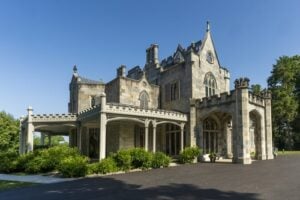

Feature Photo: Maurizio Gaeta / Shutterstock
A cloister is a kind of covered walk. Generally speaking, there is a wall on one side and a colonnade on the other, which opens into a rectangular space. A lot of churches had cloisters, thus indicating they were monastic in nature. They physically separated these institutions from the secular world in much the same way monastic practices spiritually separated these institutions from the secular world. As such, the name of New York City’s MET Cloisters Museum has a great deal of symbolic meaning. The museum lives up to the medieval connotations of its time by being dedicated to medieval art and architecture. Something that gives it increased focus when compared with its governing institution the Metropolitan Museum of Art. On top of this, the MET Cloisters Museum is sometimes called the Cloisters, not least because its buildings are centered on four authentic examples of cloisters.
The Men Who Built the Cloisters
Numerous individuals have contributed and continue to contribute to the Cloisters. However, it is no exaggeration to say that two men tend to be remembered more than others for building the museum. First, there is George Grey Barnard. Second, there is John D. Rockefeller, Jr. Besides them, J.P. Morgan and Joseph Brummer also made major contributions, though they get less focus for reasons that will be explained later.
Barnard was a successful sculptor. For example, his Struggle of the Two Natures of Man is in the Metropolitan Museum of Art. Similarly, three castings of his statue of Abraham Lincoln stand in Cincinnati, Manchester, and Louisville. Unfortunately, being a successful sculptor doesn’t seem to have paid very well, which is why Barnard also worked as an art dealer specializing in European objects from the 13th and 14th centuries. Thanks to his work, he built up a personal collection even though he was often on shaky financial grounds. Eventually, Barnard’s need for money caused him to sell his collection to John D. Rockefeller, Jr. in 1925.
In 1930, Rockefeller decided to build the Cloisters for the Metropolitan Museum of Art at an elevated but isolated location in Fort Tryon Park. As mentioned earlier, the building included authentic examples of cloisters. That was possible because construction workers quite literally disassembled parts of abbeys from France and Catalonia, shipped them over to New York City, and then reassembled them on the site. Chances are good interested individuals can guess that Barnard’s collection formed the start of the Cloisters’ collection. Still, Rockefeller didn’t stop there but also acquired more objects from more sources. One example was J.P. Morgan’s collection, much of which was donated by his son J.P. Morgan, Jr. Another example was Joseph Brummer’s collection, much of which was bought by his friend James Rorimer while working as a curator.
Romanesque and Gothic Architecture
A lot of people still see the Middle Ages in a very negative light. There is a popular belief that Classical Antiquity and the Renaissance were shining historical periods flanking a dark, dull, dismal era. That is unfair, to say the least. After all, there was a direct transition from Classical Antiquity to the Middle Ages. Yes, Odoacer ended the Western Roman Empire by deposing Romulus Augustulus. Still, it is telling that the man titled himself rex and patricius while in nominal service to both the Eastern Roman Emperor Zeno and the Western Roman Emperor Julius Nepos. Similarly, the line of division between the Middle Ages and the Renaissance is so blurry that there is no real consensus on when it should fall, which makes sense because the cultural movement took time to spread bit by bit. Summed up, it doesn’t make sense to single out the achievements of the Middle Ages for denigration when those were in continuity with the achievements of Classical Antiquity and the Renaissance.
The Cloisters exist as a rebuttal to that popular belief. It boasts a remarkable collection of medieval art. Moreover, the Cloisters is famous for both Romanesque architecture and Gothic architecture. For those unfamiliar, Romanesque architecture is the result of the medievals continuing to use Roman building methods. Its most distinctive feature would be the semi-circular arches. However, interested individuals can also recognize it because of its massiveness, barrel vaults, thick walls, thick pillars, and symmetrical layouts. Later, Romanesque architecture evolved into Gothic architecture, which is what most people think of when they think of European cathedrals. The semi-circular arches became pointed arches, visible reminders of the builders’ heaven-ward aspirations. It is no coincidence that European cathedrals are famous for their towers and spires, which served much the same purpose.
Famous Treasures of the Cloisters
It is interesting to note that the Cloisters is laid out in themed spaces. As a result, it isn’t hard for interested individuals to find what they are looking for. There are some famous treasures included in the Cloisters’ collection. For instance, the museum is home to the seven tapestries called The Hunt of the Unicorn, which were designed in Paris but made in what is now the South Netherlands. Likewise, the museum is home to a remarkable collection of stained glass and illuminated manuscripts. The last one can sound strange to modern ears. Even so, illuminated manuscripts were precious objects in medieval times because people had to produce them by hand. Never mind how those people ornated these works with lavish details and decorations.
Other than the objects, the Cloisters is also notable because of its gardens and buildings. These aren’t one-for-one copies of medieval predecessors. However, they were laid out based on the same principles as those medieval predecessors, meaning interested individuals shouldn’t be concerned about their authenticity.
What Visitors Should Know
The museum is located at 99 Margaret Corbin Drive in Fort Tryon Park. Currently, it is open every day of the week from 10 am to 5 pm except Wednesdays when it closes. General admission costs $30 for adults, $22 for seniors, and $17 for students. Anyone who is under the age of 12 can get in for free.
References:
https://www.britannica.com/biography/George-Grey-Barnard
https://www.metmuseum.org/press/news/2006/the-cloisters-a-history
https://www.metmuseum.org/visit/plan-your-visit/met-cloisters
https://www.metmuseum.org/primer/met-cloisters#journey-begins