
Photo by Brian Kachejian
There are many gateways to the Island of Manhattan. None may be more famous than the legendary 59th Street Bridge. New York’s 59th Street Bridge connects the boroughs of Queens and Manhattan. The bridge was originally completed in 1909. The bridge has always been referred to by New Yorkers as the 59th Street Bridge. However, the official name of the bridge was labeled The Queensboro Bridge. In 2010, the bridge was renamed The Ed Koch Queensboro Bridge in honor of former New York City Mayor Ed Koch.
So what’s so special about the 59th Street Bridge? Well, first and foremost most New Yorkers would agree that what makes the bridge so special is the history, location, views, and romantic nature all bound by a never-ending landscape of stalled traffic.
Who uses the 59th Street Bridge?
Most travelers utilizing the 59th Street Bridge are commuting from Long Island which includes Suffolk County, Nassau County, and the New York City borough of Queens. The two main river crossings that Long Islanders use to cross over into Manhattan are the 59th Street Bridge and the Queens Midtown Tunnel. However, there are also many more bridges that can connect travelers to the Island of Manhattan. The Triborough Bridge also connects Long Islanders and Queens residents to Manhattan. There are also many bridges that connect Manhattan to the borough of Brooklyn. The Queens-Midtown Tunnel empties into the 33 and 34th Street section of Manhattan along 2nd and 3rd Avenues, while the 59th Street Bridge empties into the section of Manhattan between 1st and 2nd Avenues across 59th and 61 Streets.
Both sections of Manhattan are extremely crowded with traffic during most of the day and early evening hours. Many people coming from Long Island prefer the Queens Midtown Tunnel because the Long Expressway bottlenecks directly into the tunnel at its end. However, the Queens Midtown Tunnel is a paid toll and most working people who travel in and out of Manhattan and Long Island utilize the 59th Street Bridge for its cost effectiveness.
Access to the 59th Street Bridge
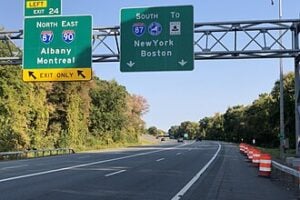
Most commuters traveling from Long Island access the 59th Street Bridge from the Van Dam Street Exit 15 on the Long Island Expressway. From there, travelers head north to Queens Boulevard which points them under the L Train and into one of the most horrific traffic jams in the country. And that is after just exciting a most probable traffic jam on the Long Island Expressway. Many Queens residents or people working in Queens will take Northern Boulevard to the 59th Street Bridges. Regardless of which direction one may drive from, make sure you have a good car stereo system or some form of mobile audio entertainment to help pass the time sitting behind the never-ending line of New York City cabs, buses and trucks all looking to enter Manhattan through the 59th Street Bridge.
59th Street Bridge Structure
The Ed Koch Queensboro Bridge is a five-span cantilever truss bridge. There are two levels to the Ed Koch Queensboro 59th Street Bridge. Drivers may utilize either the upper or lower levels to enter the city of Manhattan. Most of the time, the lower level is more heavily traveled than the upper level. However, the upper level still earns it fair share of traffic throughout the workday. Even into the late night hours the bridge is still heavily traveled.
If one may want to cross over the bridge with relative ease, then early Sunday morning before 7:00 am is the best choice. The upper level of the bridge host two lanes of traffic on both the Manhattan Queens approach lanes. The lower level also provides two lanes in each direction. The lower level also contains two outer lanes with only the Queens approach being utilized for motor vehicle traffic. The outer Manhattan-bound land is now closed to motor vehicle traffic and is utilized for foot and bicycle traffic only.

Photo: Cole Kachejian Copyright © 2017.
Early History of the Ed Koch Queensboro 59th Street Bridge
Proposals for the bridge first began circulating throughout the 19th century. It was not until the turn of the century in the early 1900’s that a new organization titled the New York City Department of Bridges began laying the groundwork and plans for the construction of the Queensboro Bridge. The Department was led by Gustav Lindenthal. In conjunction with Williamsburgh Bridge designers Leffert L. Buck and Henry Hornbostel, the three men set forth the plans in motion to begin the construction of the Queensboro Bridge. The bridge took eight years to build. The construction of the bridge began in 1901. The Queensboro Bridge was opened to traffic on June 18th, 1909.
The 59th Street Bridge in popular culture.
For many, there is an air of Romanticism found in the 59th Street Bridge. First of all, the view of Manhattan from the bridge is quite breathtaking from both levels. Although, the view from the upper level is much less unobstructed. The view and the whole idea of the entranceway into Manhattan has infiltrated popular culture from many different angles. Perhaps the most direct representation of the bridge in popular culture was defined by Paul Simon who composed the “59th Street Bridge Song(Feeling Groovy). ”
Countless movies have been filmed on the 59th Street Bridge. A small sampling of well-known movies that filmed scenes on the bridge includes notable films such as The Dark Knight Rises, The Great Gatsby, Anger Management, The Accidental Husband, Spiderman 2002, and the iconic Woody Allen film Manhattan, which even used a photographic shot of the Queensboro Bridge in the movie poster of the film. We should also not ignore the thousands of student films and amateur photography shots from a bridge that delivers the most breathtaking visuals of the Island of Manhattan.
Who could forget the opening credits to the 1970’s television show Taxi that depicted a yellow NYC Cab crossing the bridge while the credits rolled? From motion pictures to television, print ads, commercials, and songs, the majestic qualities of the 59th Street Bridge and its surroundings have served the commuter, business, political and artistic world of New York City for over a century.

Photo: Cole Kachejian Copyright © 2017.

Photo: Cole Kachejian Copyright © 2017.

Photo: Cole Kachejian Copyright © 2017.