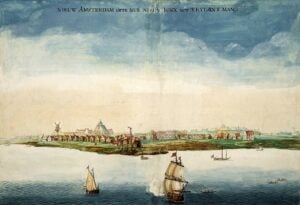
Feature Photo: Johannes Vingboons, Public domain, via Wikimedia Commons
New York City is commonly associated with skyscrapers, modern architecture, and constant reinvention. But beneath the concrete and glass lie neighborhoods whose origins stretch back nearly four centuries, to the era when New York was the Dutch colony of New Netherland. The 10 neighborhoods listed here are ranked from 10, the newest of the oldest, to 1, the oldest.
Because Native American habitation long predates European settlement, this list ranks present-day New York City neighborhoods by the earliest documented continuous European colonial settlement, organized village, land patent, or town charter directly associated with that neighborhood. The Lenape and other Native American peoples inhabited this region for thousands of years before Dutch and English colonization.
Several dates are approximate because 17th-century records are incomplete and because the boundaries of colonial towns do not always correspond precisely with modern neighborhood boundaries. Isolated farms and estates are not ranked as neighborhoods. Maspeth, Queens, is also excluded because its 1642 settlement was destroyed and did not maintain continuous colonial development. Communities founded in the same year should be considered effectively tied; where exact charter dates are available, they determine the order.
10. Jamaica (Rustdorp), Queens
Founded: 1656
Jamaica, located in central Queens, was settled under Dutch rule in 1656, when Director-General Peter Stuyvesant granted a land patent and named the community Rustdorp. English settlers had begun establishing the village after arranging for the use of land with local Native people in 1655. Among the early settlers was Robert Coe, who became one of the community’s first magistrates.
After the English took control of New Netherland in 1664, Rustdorp became known as Jamaica. When the colony was divided into counties in 1683, Jamaica became the seat of Queens County. The origin of the name Jamaica is commonly connected to a Native place-name rendered as Jameco or Yameco, although its precise meaning remains debated.
Today, Jamaica is one of Queens’ most important commercial and transportation centers. The neighborhood includes the Jamaica Avenue shopping corridor, York College, major Long Island Rail Road and subway connections, and the AirTrain link to John F. Kennedy International Airport.
9. Westchester Square (Oostdorp), The Bronx
Founded: c. 1654
Westchester Square traces its colonial origins to approximately 1654, when English settlers established a community on land acquired by Thomas Pell from local Native leaders. The settlement, situated within Dutch New Netherland, became known as Oostdorp, or East Village.
Dutch authorities disputed Pell’s claim and ordered the settlement broken up during the conflicts of the mid-1650s. Several settlers were arrested and taken to New Amsterdam. They were later permitted to return after agreeing to submit to Dutch law. Under English rule, the community became Westchester and developed into the center of the Town of Westchester.
Westchester Square is now a commercial crossroads in the eastern Bronx, centered near East Tremont Avenue, Westchester Avenue, and Crosby Avenue. The neighborhood is served by the 6 subway line and contains the Huntington Free Library and the Owen Dolen Recreation Center.
8. New Utrecht (Nieuw Utrecht), Brooklyn
Founded: 1652 land acquisition; village laid out after 1655; chartered in 1661
New Utrecht traces its beginnings to 1652, when Cornelis van Werckhoven of the Dutch West India Company began acquiring land in southwestern Brooklyn. After his death in 1655, surveyor Jacques Cortelyou received permission to lay out and sell lots for a new town. The settlement was named Nieuw Utrecht after Van Werckhoven’s hometown in the Netherlands.
New Utrecht received a charter in 1661 and became one of the six original towns of Kings County. The village developed around what are now 84th Street and 16th Avenue. The New Utrecht Reformed Church congregation was organized in 1677, and its historic cemetery preserves the names of many early families.
The name New Utrecht is now most closely associated with sections of Bensonhurst and nearby southwestern Brooklyn. It survives in New Utrecht Avenue, New Utrecht High School, the New Utrecht Reformed Church, and the New Utrecht Cemetery.
7. Elmhurst (Middleburgh / Newtown), Queens
Founded: 1652
Elmhurst was founded in 1652 as Middleburgh, an English settlement within Dutch New Netherland. Its early residents came largely from New England and eastern Long Island. The community established a local government and meetinghouse and became one of the earliest organized European towns in what is now Queens.
After the English conquest of New Netherland, Middleburgh was renamed Newtown. The village remained the population center of the much larger Town of Newtown for more than two centuries. In 1896, the village adopted the name Elmhurst during a period of suburban development.
Elmhurst is now a densely populated and highly diverse residential neighborhood. Old Saint James Episcopal Church, built in 1735 and 1736, remains one of the most important surviving links to the colonial community of Newtown.
6. Flatbush (Midwout), Brooklyn
Founded: c. 1651
Flatbush was established by Dutch settlers around 1651 under the name Midwout, meaning middle woods. Farms had appeared within the larger area during the preceding decades, but the organized village itself developed in the early 1650s along the route now followed by Flatbush Avenue.
The Reformed Dutch Church of Flatbush was organized in 1654, and the town later became an administrative and judicial center for the rural communities of Kings County. After the English takeover, the name Midwout gradually gave way to Flatbush.
Flatbush remained an independent town until it was annexed by the City of Brooklyn in 1894. The modern neighborhood retains portions of its colonial road pattern around Flatbush and Church avenues, while the present Flatbush Reformed Church building, completed in 1798, continues to serve the historic congregation.
5. Brooklyn Heights and Downtown Brooklyn (Breuckelen), Brooklyn
Founded: 1646 as an incorporated town
The Dutch town of Breuckelen was incorporated in 1646. Earlier farms and hamlets had developed across western Brooklyn, including settlements near Gowanus, Wallabout Bay, and the East River ferry landing. The ferry community, known as Het Veer, occupied land associated with modern Brooklyn Heights and Fulton Ferry.
Breuckelen was named after the Dutch town of Breukelen and eventually gave its name to the entire borough. The colonial town covered territory now divided among Brooklyn Heights, Downtown Brooklyn, Fulton Ferry, Boerum Hill, and adjoining neighborhoods, so the modern boundaries of Brooklyn Heights should not be treated as identical to those of the original town.
Brooklyn Heights became New York City’s first designated historic district in 1965. Its waterfront and high ground also played an important role in the American Revolution, particularly during George Washington’s retreat across the East River after the Battle of Long Island in August 1776.
4. Gravesend, Brooklyn
Founded: December 19, 1645
Gravesend was founded by Lady Deborah Moody and a group of English religious dissenters who left Massachusetts for New Netherland. An initial settlement effort began in 1643 but was interrupted by warfare. On December 19, 1645, Dutch Director Willem Kieft granted Moody and her associates a formal town charter.
Gravesend was the only English-chartered town among the six original towns of Kings County. Its charter was the first New York-area land document to list a woman as a patentee and included protections for religious belief. The town was laid out around a fortified central square divided by two intersecting roads, an unusual example of formal colonial town planning.
Parts of the original street arrangement remain visible near Village Road and Lady Moody Square. The old town once extended across a much larger portion of southern Brooklyn, including Coney Island and areas now identified as separate neighborhoods.
3. Flushing (Vlissingen), Queens
Founded: October 10, 1645
Flushing was established under a Dutch charter issued on October 10, 1645, to a group of English settlers. The settlement was named Vlissingen after the Dutch city whose English name is Flushing. Its charter promised residents a degree of religious liberty, although Director-General Peter Stuyvesant later attempted to prevent Quaker worship.
On December 27, 1657, residents issued the Flushing Remonstrance, protesting the persecution of Quakers and asserting that people should not be punished for their religious beliefs. John Bowne later challenged the restrictions by allowing Quaker meetings in his home. His appeal to the Dutch West India Company helped secure broader religious protections in New Netherland.
Modern Flushing is one of New York City’s largest and most diverse commercial centers. The Bowne House and the Old Quaker Meeting House preserve important parts of its colonial history, while Main Street, the 7 subway line, and the Long Island Rail Road make the neighborhood a major transportation hub.
2. Flatlands (Nieuw Amersfoort), Brooklyn
Founded: c. 1636
Flatlands traces its European colonial settlement to approximately 1636, when Dutch farmers began establishing plantations and farms in southeastern Brooklyn. The settlement became known as Nieuw Amersfoort after the Dutch city of Amersfoort and developed into the earliest of the organized Dutch towns in what became Kings County.
The village grew near the intersection of present-day Flatbush Avenue and Kings Highway and later received local governing authority under Dutch and English rule. Flatlands remained overwhelmingly rural and agricultural for more than two centuries before suburban development transformed the landscape.
Flatlands was annexed by the City of Brooklyn in 1896 and became part of New York City in 1898. Historic roads, property lines, cemeteries, and surviving Dutch-American farmhouses continue to reflect portions of the old settlement pattern.
1. Financial District (New Amsterdam), Manhattan
Founded: 1625; permanent settlement consolidated by 1626
The oldest continuously developed European colonial settlement within present-day New York City is New Amsterdam at the southern end of Manhattan. Dutch colonists arrived in New Netherland in 1624, and the Dutch West India Company established New Amsterdam as the colonial seat of government in 1625. By 1626, settlers were concentrated around Fort Amsterdam near the modern Battery and Bowling Green.
New Amsterdam received municipal government in 1653. The English seized the colony in 1664 and renamed the settlement New York in honor of the Duke of York. The original town occupied much of what is now the Financial District.
Modern streets including Broadway, Pearl Street, and Stone Street preserve routes established during the Dutch and English colonial periods. The neighborhood now contains Wall Street, the New York Stock Exchange, Federal Hall, Trinity Church, and the World Trade Center, but its irregular street plan still reveals the footprint of the city’s earliest European settlement.
Summary
The 10 oldest organized colonial communities connected to present-day New York City neighborhoods span four boroughs: Brooklyn has five, Queens has three, Manhattan has one, and The Bronx has one. Staten Island’s Old Town, originally Oude Dorp, dates to 1661 and falls outside the top 10.
Other early communities that narrowly miss the ranking include Harlem, founded as Nieuw Haarlem in 1658, and Bushwick, established as Boswijck in 1660. The Dutch colonial legacy remains visible in names including Breuckelen, Vlissingen, Nieuw Amersfoort, Midwout, Rustdorp, and Nieuw Utrecht, as well as in surviving streets, property lines, cemeteries, congregations, and public institutions.
The 10 Oldest Neighborhoods in New York City article published on ClassicNewYorkHistory.com © 2026