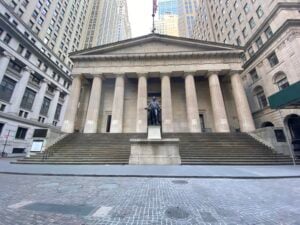
Federal Hall Photo by Brian Kachejian
Most people associate the nation’s capital with Washington, D.C., but the federal government did not always operate from the banks of the Potomac. For about five and a half years in the late eighteenth century, New York City functioned as the political heart of the newly formed United States. During that brief but consequential period, the first president took his oath of office on a Wall Street balcony, the legislative branch drafted what would become the Bill of Rights, and the highest court in the land convened for the first time. Perhaps most remarkably, the political compromise that helped relocate the capital to its permanent home was negotiated over a dinner table in lower Manhattan.
Why New York Became the Capital
The choice of New York as the seat of government was not arbitrary. Following the Revolutionary War, the governing body under the Articles of Confederation, known as the Confederation Congress, met in several cities before finding a permanent home in New York’s City Hall. Congress first convened there on January 11, 1785, and remained in New York until the government operating under the Articles gave way to the new constitutional system in 1789.
The decision made practical sense. The 1790 federal census recorded 33,131 residents in New York City, making it the largest urban center in the country at that time. Its harbor was one of the busiest on the Atlantic seaboard, and its commercial infrastructure was well developed. Although the city sat in the northern part of the country, it remained accessible to southern delegates traveling by ship. When the Constitution supplanted the Articles of Confederation, the new government began its work in the city where national operations were already established.
The History of Federal Hall
The structure that housed the first federal government had a rich history long before the Constitution existed. Construction on the original building began in 1699 and was completed around 1703, serving as the second municipal headquarters for the city of New York. James Evetts was responsible for its design, replacing an earlier Dutch structure known as the Stadt Huys that had served as the city’s original administrative seat. The building occupied a site on Wall Street in what is today the Financial District.
In its early decades as a municipal facility, the structure contained a public library, a fire station housing two engines brought over from London, and upper floors that served as a lockup for debtors. One of the most significant events tied to the building occurred in 1735, when printer John Peter Zenger was jailed there and put on trial for libel after publishing material critical of the colonial governor. His eventual acquittal became an important milestone in the development of freedom of the press in America.
A renovation in 1765 added a third level to the structure. That October, representatives from nine of the thirteen colonies assembled there for the Stamp Act Congress, a gathering organized to coordinate opposition to British taxation policies. Later, during the early months of the Revolutionary War, members of the Sons of Liberty took control of the building and seized military supplies stored inside. On July 18, 1776, shortly after the Continental Congress adopted the Declaration of Independence in Philadelphia, the document was read publicly from this location.
The Remodeling by Pierre Charles L’Enfant
Once New York was selected as the base for the new constitutional government, city officials recognized that the aging municipal structure required significant upgrades. They chose Pierre Charles L’Enfant, a French engineer and architect, to oversee the transformation. His work began in 1788 and continued into 1789. L’Enfant would later be selected by President Washington to design the layout of the permanent capital city on the Potomac.
The redesigned building blended Georgian architectural elements with symbols of the new American republic. L’Enfant created an arched passageway through the ground level, added substantial columns to support an exterior balcony, and installed taller columns above them beneath a triangular pediment adorned with an eagle grasping thirteen arrows. Inside, the ground floor contained the chamber for the House of Representatives, while the Senate occupied a smaller room on the floor above. Upon completion of the renovations, the building was renamed Federal Hall and became the first home of the government established under the United States Constitution.
The First Congress in New York
Members of the 1st United States Congress were expected to assemble at Federal Hall on March 4, 1789, the date the new constitutional framework took effect. Turnout was initially low, and it took several weeks for enough representatives to arrive. The House reached the minimum number required to conduct business on April 1, and the Senate followed on April 6. That same day, both chambers met jointly to open and count the Electoral College votes, confirming that George Washington had been selected without opposition as the first President of the United States.
The legislative accomplishments during this initial session were extraordinary in their scope and lasting impact. Congress enacted the Judiciary Act of 1789, which created the framework for the federal judiciary. On September 25, 1789, legislators approved twelve proposed constitutional amendments for submission to the states; ten would eventually be ratified as the Bill of Rights. The Senate also confirmed key executive appointments, including Alexander Hamilton as Secretary of the Treasury on September 11 and Thomas Jefferson as Secretary of State on September 26. Jefferson did not enter upon his duties until March 1790, after returning from France.
George Washington’s Inauguration in New York
On April 30, 1789, a historic ceremony took place on the exterior balcony of Federal Hall. George Washington had made his way north from his Virginia estate at Mount Vernon, reaching New York on April 23. His journey included stops in several cities along the route, and he completed the final segment aboard a barge that entered Upper New York Bay through the Kill Van Kull. He disembarked at Murray’s Wharf at the lower end of Wall Street, where a large crowd had assembled and New York Governor George Clinton offered an official welcome. A historical marker identifies the area where Washington came ashore.
On the morning of the inauguration, well-wishers began gathering outside Washington’s residence at first light. Around midday, the procession moved to Federal Hall along streets in lower Manhattan. For the ceremony, Washington wore a brown suit made from domestically produced cloth, white silk stockings, silver shoe buckles, and a sword with a steel hilt. He stepped onto the second-floor balcony, where Robert R. Livingston, Chancellor of New York, administered the presidential oath.
The Bible on which Washington placed his hand was borrowed from St. John’s Lodge No. 1, a local Masonic organization. Jacob Morton, who led the lodge and served as marshal of the parade, supplied the volume. Because it arrived only shortly before the ceremony, the book was opened at random to Genesis 49:13. Once the oath was concluded, Livingston announced to the crowd that George Washington was President of the United States. The onlookers responded with cheering and a salute of thirteen cannon shots, representing the original thirteen states.
Following the outdoor ceremony, Washington returned inside and delivered his inaugural address before a joint session of Congress in the Senate chamber. Contemporary accounts described him as visibly nervous while reading the remarks. A formal celebration ball was held in the city on May 7, one week later, although no such festivities took place on inauguration day itself.
Washington’s Presidential Residences in New York
Throughout his tenure in the city, George Washington occupied two separate homes in lower Manhattan. His first residence was the Samuel Osgood House, also known as the Walter Franklin House, at the corner of Pearl and Cherry Streets, near what is now Pearl and Dover Streets. Washington moved in on April 23, 1789, and remained there through February 23, 1790. The structure was demolished in 1856.
His second home was the Alexander Macomb House at 39 and 41 Broadway. Washington relocated there on February 23, 1790, and stayed until August 30 of that year. The federal government moved to Philadelphia later in 1790. The Macomb House was demolished in 1940.
Neither building remains standing. Together, they represent the first two official residences of an American president, occupied more than a decade before the White House was completed.
The First Supreme Court in New York
The judicial branch also traces its institutional origins to New York City. The Supreme Court was scheduled to assemble on February 1, 1790, but the absence of a quorum delayed its first official session until February 2. The justices met at the Exchange Building, also known as the Royal Exchange or Merchants’ Exchange, rather than at Federal Hall. A second session took place there in August. These early meetings were largely administrative, because no cases reached the Court until 1791. John Jay served as the first Chief Justice.
The Exchange Building was primarily a commercial structure near the waterfront. Like the original Federal Hall, it has not survived. The Supreme Court later met in Philadelphia and then in rooms within the United States Capitol in Washington before receiving a dedicated building of its own in 1935.
St. Paul’s Chapel and the Inauguration Service
As part of the inauguration proceedings, Congress agreed that the new president, accompanied by Vice President John Adams and members of the Senate and House, would proceed to St. Paul’s Chapel for a worship service. The gathering took place on the afternoon of April 30, 1789, immediately after the ceremony at Federal Hall.
The service was led by the Right Reverend Samuel Provoost, who had recently been selected as chaplain of the Senate. Provoost was also the first bishop of the Episcopal Diocese of New York.
St. Paul’s Chapel stands at the intersection of Broadway and Fulton Street in lower Manhattan. Completed in 1766, it is the oldest surviving church building on Manhattan Island and operates as part of the Parish of Trinity Church Wall Street. Unlike the original Federal Hall or the Exchange Building, St. Paul’s Chapel remains standing and is accessible to the public.
Hamilton vs. Jefferson: The Compromise of 1790
Among the most divisive questions confronting the new administration was where to place the permanent seat of the federal government. At the center of the dispute stood two of the most influential figures in Washington’s cabinet. Alexander Hamilton, serving as Secretary of the Treasury, championed a plan for the national government to assume and repay the outstanding war debts accumulated by the individual states during the fight for independence. He argued that consolidating those obligations at the federal level would strengthen the credit of the new republic and give creditors a financial stake in its survival. He also supported a national bank and a strong central government with broad fiscal authority.
Thomas Jefferson, serving as Secretary of State, and James Madison opposed important elements of Hamilton’s program. Madison argued that federal assumption of state obligations would concentrate too much authority in the national government. Resistance was especially strong among southern legislators because states including Virginia had already retired substantial portions of their wartime debt. In their view, federal assumption could force southern taxpayers to help cover the remaining obligations of states that had paid less of what they owed. This coalition initially succeeded in blocking Hamilton’s proposal.
At the same time, political leaders from the southern states were determined to place the permanent capital along the Potomac River near the border of Virginia and Maryland. Delegates from northern states, including Pennsylvania and New York, wanted the capital to remain farther north. The result was a legislative standoff, with neither side able to assemble enough support to settle both questions.
The breakthrough came through a private dinner hosted by Jefferson in New York on or around June 20, 1790. The three attendees were Jefferson, Hamilton, and Madison. According to an account Jefferson wrote roughly two years later, Madison indicated that he would not actively obstruct another effort to pass the debt-assumption measure. In return, Hamilton agreed to support the effort to move the permanent seat of government to the Potomac, while Philadelphia would serve as the temporary capital for ten years.
The dinner has become one of the most famous political bargains in American history, although historians continue to debate how decisive it actually was. The legislation concerning assumption and the capital emerged from a larger network of negotiations and votes, and both measures may have had paths to passage beyond the agreement described by Jefferson.
The Residence Act and the Departure from New York
The Residence Act, signed by President Washington on July 16, 1790, directed the president to select a location along the Potomac for the permanent federal capital. It also established Philadelphia as the temporary seat of government for ten years while the new city was being built. On January 24, 1791, Washington issued a proclamation identifying land near the junction of the Potomac and the Eastern Branch, now known as the Anacostia River. He then selected L’Enfant, the same architect who had redesigned Federal Hall, to prepare the plan for the new federal city.
The transfer of the government from New York to Philadelphia took place later in 1790. Philadelphia served as the temporary capital for the next decade. In 1800, the federal government completed its final move to the newly constructed city of Washington, D.C., bringing New York’s chapter as the national seat of government to an end.
After the federal government left New York, the original Federal Hall again served local and state governmental functions. When the present New York City Hall opened in 1812, the older structure was no longer needed. It was sold and demolished that same year.
The Legacy: Federal Hall National Memorial Today
The building where George Washington took the oath of office no longer exists. A later structure occupies the same site at 26 Wall Street and serves as a memorial to the events that occurred there. Designed principally by the architectural partnership of Ithiel Town and Alexander Jackson Davis, the Greek Revival building was constructed as the United States Custom House and opened in 1842.
The building served as the New York office of the United States Sub-Treasury from 1862 until the Federal Reserve system replaced that function in 1920. It became a national historic site in 1939, opened to the public as a memorial and museum in 1940, and was redesignated Federal Hall National Memorial in 1955. Its most prominent features include the Doric columns across the Wall Street facade, the domed rotunda associated with sculptor and architect John Frazee, and the bronze statue of George Washington created by John Quincy Adams Ward. The National Park Service describes Washington’s inauguration at this site as the beginning of the American constitutional republic.
Visiting Federal Hall National Memorial
Federal Hall National Memorial is located at 26 Wall Street, at the corner of Wall and Nassau Streets in lower Manhattan. The visitor entrance is currently at 15 Pine Street. Because operating schedules and access can change, visitors should check the National Park Service website before making the trip. Even when the interior is closed, the Wall Street facade, Washington statue, and broad front steps can be viewed from the street. For current information, visit nps.gov/feha.
St. Paul’s Chapel
St. Paul’s Chapel is located at 209 Broadway, at the corner of Broadway and Fulton Street in lower Manhattan. Dating to 1766, it is the oldest surviving church building on Manhattan Island and is affiliated with the Parish of Trinity Church Wall Street. For current visitor information, visit trinitywallstreet.org.
A Walking Tour of New York’s Capital Years
One of the remarkable aspects of New York’s time as the national capital is how concentrated the relevant historical sites are. Federal Hall National Memorial stands at 26 Wall Street. St. Paul’s Chapel is a short walk north at Broadway and Fulton Street. The site of Washington’s first residence, the Osgood House, was near Pearl and Dover Streets, while the Macomb House stood at 39 and 41 Broadway. The Exchange Building, where the Supreme Court first assembled, was also near the waterfront, although it no longer survives. A marker near the foot of Wall Street recalls Washington’s arrival at Murray’s Wharf. These locations allow visitors to walk through the same compact area where the first Congress met, the first president was inaugurated, and the first Supreme Court assembled.
New York’s tenure as the capital of the United States was brief, lasting only a handful of years. Yet the decisions made during that period established enduring foundations for the republic. The proposed amendments that became the Bill of Rights originated there. The structure of the federal judiciary was established there. The first presidential oath was administered there. The political negotiations that helped produce Washington, D.C., also unfolded in the same city. Although many of the buildings connected to those events have disappeared, their legacy remains embedded in the streets of lower Manhattan.
More New York History Articles
For more stories connected to lower Manhattan and the American Revolution, explore our History of New York’s Trinity Church, History of New York’s Fraunces Tavern, How the Taverns of New York City Stirred the American Revolution, and History of the New York Stock Exchange. Readers can also browse our New York History Article Directory.
Sources
National Park Service, Federal Hall National Memorial
United States House of Representatives, Meeting Places for the Continental and Confederation Congresses
United States Senate, Federal Hall, New York City, 1789–1790
National Archives, The Bill of Rights
Supreme Court of the United States, Meeting Sites of the Court
George Washington’s Mount Vernon, Presidential Residency in New York City
National Archives, The Compromise of 1790
Library of Congress, Residence Act: Primary Documents in American History
United States Census Bureau, 1790 Census Facts
Updated July 28, 2026.
How New York City Once Served as the Capital of the United States article published on ClassicNewYorkHistory.com © 2026