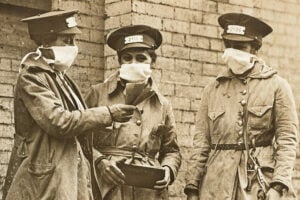
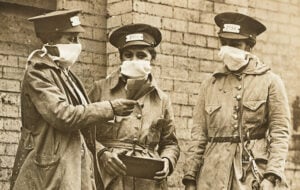
New York City streetcar conductors wearing masks during the 1918 influenza epidemic. U.S. National Archives, public domain, via Wikimedia Commons.
New York City’s rise into one of the world’s largest cities was repeatedly interrupted by disease. Long before modern sewer systems, safe drinking water, vaccines, antibiotics, and a permanent public health bureaucracy, epidemics could empty neighborhoods, close businesses, overwhelm hospitals, and send thousands of residents fleeing for safer ground. Yellow fever, cholera, polio, influenza, and smallpox each exposed a different weakness in the growing city.
Those outbreaks also helped reshape New York. Repeated epidemics strengthened demands for cleaner streets, reliable water, disease reporting, quarantine authority, school health programs, vaccination campaigns, and a professional health department. Some responses were effective, while others reflected the limited medical knowledge and social prejudices of their time. Together, these six outbreaks show how public health became part of the city’s basic infrastructure.
1. The 1798 Yellow Fever Epidemic
In the summer and fall of 1798, yellow fever struck a New York City still concentrated near the southern end of Manhattan. Contemporary and later medical accounts place the death toll at roughly 2,080 people, an enormous loss for a city that was still relatively small. Fear emptied parts of lower Manhattan as residents who could afford to leave sought refuge in more rural areas farther north, including Greenwich Village. The repeated yellow fever outbreaks of this era helped accelerate development beyond the old downtown core.
Doctors did not yet know that yellow fever was spread by Aedes aegypti mosquitoes. Many physicians instead subscribed to versions of the miasma theory, which blamed disease on foul air, decaying matter, and unhealthy surroundings. Although the mosquito vector would not be scientifically established until much later, yellow fever pushed New York toward more organized health administration. The city created an Inspector’s Office in 1804 to track mortality and established a Board of Health in 1805 in response to recurring yellow fever epidemics.
2. The 1832 Cholera Epidemic
Cholera arrived in New York City in 1832 as part of the second worldwide cholera pandemic. The disease spread rapidly through a city that depended on shallow wells and cisterns, many vulnerable to contamination from privies, waste, and poor drainage. New York City records place the death toll at roughly 3,500 people. Crowded working-class neighborhoods suffered heavily, while many residents with the means to leave the city fled during the worst weeks of the outbreak.
The epidemic intensified an already urgent debate over New York’s inadequate water supply. City leaders had been searching for a dependable source of clean water, and the cholera disaster added powerful evidence that the existing system was dangerous. Construction of the Croton water system began later in the decade, and Croton water reached the city in 1842. The aqueduct did not end every waterborne disease problem, but it gave New York a vastly larger and more reliable source of fresh water and became one of the most important infrastructure projects in the city’s history.
3. The 1866 Cholera Outbreak and the Metropolitan Board of Health
By the 1860s, New York had clean Croton water but still faced severe sanitation problems. Garbage, animal waste, overcrowded tenements, inadequate drainage, and poorly regulated housing created conditions in which infectious diseases could spread quickly. Reformers including physician Stephen Smith and the Citizens’ Association of New York documented those conditions in an extensive 1865 report on the sanitary state of the city.
With another cholera outbreak threatening, the New York State Legislature created the Metropolitan Board of Health on February 26, 1866. New York City’s Health Department identifies it as the first municipal public health authority in the United States. The new board employed physicians and sanitary inspectors and had broad authority to order cleanups, remove health hazards, disinfect infected premises, and enforce sanitary regulations. Cholera still killed 1,137 people in New York City that year, but the new system demonstrated how organized sanitation and disease control could reduce the scale of an epidemic. In 1870, New York created the Department of Health that became the institutional ancestor of today’s city health agency.
4. The 1916 Polio Epidemic
The summer of 1916 brought one of the most frightening epidemics New York families had ever faced. Poliomyelitis, then commonly called infantile paralysis, struck children especially hard. According to New York City Health Department historical records, the epidemic produced 8,991 cases and 2,448 deaths in the city. Hospitals treated thousands of patients, while fear of paralysis and death spread far beyond households directly affected by the disease.
Health Commissioner Haven Emerson’s department isolated known cases, quarantined exposed households, opened emergency clinics, delayed the opening of public schools, and imposed restrictions on children’s travel and public activities. Children leaving the city could be required to show health certificates and undergo medical examinations, while theaters, libraries, Sunday schools, and other gathering places faced restrictions. Because scientists still understood relatively little about how polio spread, some measures were ineffective or excessively coercive. The 1916 epidemic became a defining episode in the history of polio in the United States and remained New York City’s worst polio outbreak.
5. The 1918 Influenza Pandemic
The influenza pandemic of 1918 reached a city of roughly 5.6 million people at the height of World War I. Across the pandemic’s major waves from September 1918 into early 1919, New York City officially recorded approximately 30,000 deaths from influenza or pneumonia. The scale was enormous, but New York’s mortality burden was lower than that recorded in several other large Eastern cities, including Boston and Philadelphia.
Health Commissioner Royal S. Copeland relied on the city’s already extensive public health machinery rather than ordering a complete shutdown. Influenza and pneumonia became reportable diseases, the city created more than 150 emergency health districts and centers, and officials staggered business and theater hours in an effort to reduce crowding on subways and elevated trains. Public schools remained open because Copeland argued that children could be medically monitored there more effectively than in many overcrowded homes. The policy was controversial even at the time, but New York’s coordinated use of surveillance, nursing, public education, transit crowd control, and health inspections became one of the most closely studied municipal responses to the 1918 pandemic.
6. The 1947 Smallpox Outbreak and Mass Vaccination Campaign
In early 1947, Eugene Le Bar, a merchant who had recently traveled from Mexico to New York, became ill and was hospitalized. His illness was eventually identified as smallpox after he had already spent time in city hospitals. The discovery raised fears that one of history’s deadliest infectious diseases could again spread through a densely populated New York. The outbreak ultimately produced 12 cases and two deaths.
Health Commissioner Israel Weinstein and Mayor William O’Dwyer responded with an extraordinary vaccination campaign. Clinics were established across the city, private physicians received vaccine, and hospitals, police, health workers, and thousands of volunteers were mobilized. Historical studies estimate that approximately 6.35 million New Yorkers were vaccinated during the campaign. The outbreak was contained quickly. Later historical reviews have also emphasized the importance of tracing contacts and vaccinating people who had been exposed, suggesting that targeted containment worked alongside the massive public campaign. The episode remains one of the most famous examples of large-scale emergency vaccination in New York history.
7. The 2020 COVID-19 Pandemic
For this next one, and the final pandemic on this list, I speak from personal experience. Of course, anyone who has been alive over the past decade can speak about COVID from personal experience in one way or another. I contracted COVID in January 2022, when the Omicron variant was hitting hard. I wound up in NewYork-Presbyterian Hospital in New York City. I saw people dying around me. It was the worst sickness I had ever experienced in my life, and I truly thought I was going to die.
I will never forget the doctors in the hospital telling me that I was going to make it for one very important reason: I had been vaccinated. They told me that the vaccination had helped protect me from an even worse outcome. When I hear people dismiss these vaccinations for political reasons, I think back to that hospital, to the people I saw dying around me, and to the fact that I was able to walk out of there. For me, that experience permanently changed the way I think about COVID, vaccines, and the extraordinary importance of modern medicine.
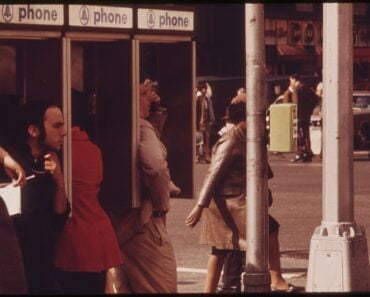
Nothing in modern New York City history compares with the speed and scale of the first COVID-19 wave in the spring of 2020. The city’s first confirmed COVID-19 death occurred on March 11, the same day the World Health Organization characterized COVID-19 as a pandemic. By May 2, New York City had recorded 13,831 laboratory-confirmed COVID-19 deaths and another 5,048 probable deaths. A CDC analysis found 24,172 excess deaths in the city between March 11 and May 2 alone, showing that the pandemic’s true mortality impact extended beyond cases formally identified as COVID-19 at the time.
The pandemic transformed daily life across all five boroughs. Hospitals faced an extraordinary surge of critically ill patients, the Jacob Javits Convention Center and other sites were converted for emergency medical use, schools shifted away from normal classroom instruction, businesses closed or operated under severe restrictions, and millions of New Yorkers changed the way they worked, traveled, shopped, and interacted. The city’s 2020 vital statistics later showed more than 20,400 New York City residents dying from COVID-19 that year. The COVID-19 mortality rate reached 241.3 deaths per 100,000 residents, exceeding the city’s recorded mortality rate during the 1918 influenza pandemic. Life expectancy in New York City fell by 4.6 years between 2019 and 2020.
The effects of COVID-19 continued long after the catastrophic first wave. Vaccination campaigns began in late 2020 and expanded dramatically in 2021, while later variants produced additional waves of illness and death. The pandemic also exposed severe racial, economic, and neighborhood disparities in health outcomes and permanently changed debates over emergency preparedness, hospital capacity, public health authority, remote work, schools, and the use of public space. In scale, mortality, and lasting impact, COVID-19 belongs unquestionably among the defining disease outbreaks in New York City history.
These epidemics did not produce New York’s modern public health system overnight. The changes came unevenly across more than a century, often after enormous human loss. Clean water, sanitation enforcement, disease surveillance, school health programs, quarantine rules, vaccination, and professional public health administration all developed through repeated encounters with diseases the city was initially poorly prepared to control. The history of epidemics in New York is therefore also a history of how the city learned to protect a rapidly growing population.
Readers interested in related New York history can also explore our Where Was Five Points in NYC? The History of New York’s Infamous Neighborhood, New York City in Pictures During the Coronavirus Pandemic, and Describing the Experience of Getting the COVID-19 Vaccine in NYC.
Sources
- New York City Department of Health and Mental Hygiene: History of the Health Department
- New York City Department of Health and Mental Hygiene: Board of Health History
- New York City Department of Environmental Protection: History of New York City’s Drinking Water
- Emerging Infectious Diseases: History of Mosquito-Borne Diseases in the United States
- National Library of Medicine: Politics of Yellow Fever
- American Journal of Public Health: Stephen Smith and the Development of Public Health
- New York City Health Department: 1805–2005 Historical Booklet
- U.S. Public Health Service: 1916 Poliomyelitis Reports
- Public Health Reports: The 1918 Influenza Epidemic in New York City
- Public Health Reports: School Medical Inspection During the 1918 Influenza Pandemic
- National Library of Medicine: Smallpox, The 20th Century Threat
- Emerging Infectious Diseases: Mass Smallpox Vaccination in New York City, 1947
- Emerging Infectious Diseases: The 1947 Smallpox Vaccination Campaign Revisited
- CDC: Excess Mortality During the COVID-19 Outbreak in New York City, March 11–May 2, 2020
- NYC Health: 2020 Vital Statistics Report and the Toll of COVID-19
- City of New York: COVID-19 Response Review