As someone who grew up in the Bronx, I started reading newspapers very young. I used to buy them for my father, and then eventually for myself. The two newspapers I bought all the time were the Daily News and the New York Post. In the 1960s and ’70s, both papers thrived, although they were very different. For myself, I was mostly interested in the sports section. Both papers did a fabulous job covering New York sports, and one of the main reasons was the writers. Some jumped back and forth between the two papers.
My earliest memories of really enjoying a sportswriter come from reading Dick Young’s column. He had already been writing for the Daily News for a long time by the time I started reading him in the ’60s, and he kept right on going into the ’70s and early ’80s. I was very surprised when he jumped to the New York Post in the ’80s, but of course, that was supposedly due to financial problems at the Daily News. Nonetheless, he kept writing in that same no-BS style that endeared him to New Yorkers.
When you write about the history of a newspaper, you can’t do it by showcasing facts alone. You have to put meaning into it, into what a newspaper meant to the community. So forgive me for the personal opening, but without the readers, these papers would never have survived.
A Founding Father’s Paper
The New York Post was founded on November 16, 1801, making it the oldest daily newspaper still published in the United States. More on that later. It came into the world as the New-York Evening Post, a respectable broadsheet, and its founder was none other than Alexander Hamilton. He raised roughly ten thousand dollars from a circle of fellow Federalists, men like Robert Troup and Oliver Wolcott, who were rattled by Thomas Jefferson’s rise to the presidency and the growing strength of the Democratic-Republicans. Hamilton gathered his first investors at Archibald Gracie’s weekend villa, the same house now known to New Yorkers as Gracie Mansion, the mayor’s residence. He installed William Coleman as his first editor. It was, from the start, a paper with a point of view.
The nineteenth century gave the Evening Post its most distinguished chapter. Its great editor was William Cullen Bryant, the poet and abolitionist, whose stewardship earned the paper such respect that even the English philosopher John Stuart Mill praised it in 1864. Alongside Bryant, a fiery writer named William Leggett produced political editorials that hammered central banking and championed the rights of organized labor, and he eventually became a co-owner. John Bigelow served as an editor and co-owner from 1849 to 1861. This was the Post at its most serious and most admired, a paper of ideas rather than a paper of screaming headlines. It’s amazing to look at the history of papers like The New York Times and the New York Post and see how their styles have changed over time.
Changing Hands
Like most great institutions, the Post passed through many hands, and not all of them were clean. One longtime business associate, Isaac Henderson, was found in 1879 to have defrauded Bryant for decades. In 1881, Henry Villard took control of the paper and folded in The Nation as its weekly edition, putting the operation under a respected trio of editors that included Carl Schurz, Horace White, and Edwin L. Godkin. Villard’s son, Oswald Garrison Villard, a founding member of the NAACP, inherited the helm in 1897. He sold the paper in 1918 after accusations of pro-German sympathy during the First World War battered its circulation.
The next stretch reads like a parade of owners. Thomas Lamont, a senior partner at J.P. Morgan, bought it and could not stop the bleeding, so he sold it to a consortium of thirty-four reform-minded financiers and politicians led by the dean of Harvard Business School. Among that group was a young Franklin D. Roosevelt. In 1924 the publisher Cyrus H. K. Curtis took over, and a decade later J. David Stern bought the paper, changed its name to the New York Post, and restored both its broadsheet size and its liberal voice. The name we know today dates to that 1934 moment.
The Schiff Era
In 1939, the paper found the owner who would shape its modern identity. Dorothy Schiff bought the Post and ran it for nearly four decades. With her husband Ted Thackrey, she recast the paper into the tabloid format that has defined it ever since. In 1945 the Post absorbed The Bronx Home News, a detail that always meant something to those of us from the borough. Under editor James Wechsler, the Schiff Post leaned proudly liberal, backing trade unions and social welfare, and it carried some of the best bylines in the business. Readers turned to columnists like Max Lerner, Murray Kempton, Pete Hamill, Eleanor Roosevelt, and the gossip writer Earl Wilson. This was the Post I grew up with, the afternoon paper you grabbed on the way home.
Schiff’s Post had real reach. Its circulation climbed to around 700,000 in the late 1960s, helped along by the fact that it was the last surviving afternoon daily in the city. But running an afternoon paper grew harder every year, with worsening traffic delaying delivery and television siphoning off the evening audience. By the time she sold, circulation had slipped to roughly 517,000, and the paper had begun to lose money. Schiff also gave the Post one of its most recognizable homes when she bought 210 South Street in 1967, the former headquarters of the New York Journal American, which became a symbol of the paper itself.
Enter Murdoch
In November 1976, Rupert Murdoch bought the Post from Dorothy Schiff for $30.5 million, and the paper has never been quite the same since. Murdoch imported the brash style of his Australian and British tabloids, and the Post leaned hard into sensational front pages. In 1977 it launched Page Six, the gossip column created by James Brady that became famous for its blind items and remains one of the most influential gossip operations in the country.
The summer of 1977 handed the Post a grim kind of triumph: on August 11, 1977, the day after the arrest of “Son of Sam” killer David Berkowitz, the paper sold a record 1.1 million copies in a single day. I will never forget that day, when I saw his picture on the cover of the Post and Daily News. He looked nothing like we had expected. He had almost a baby face. We were expecting someone who would have looked like Charles Manson. I will never forget that time hanging out on the streets of the Bronx at night, always being a little jumpy when someone walked up behind us. You can read more about that time in detail in my Son of Sam story here.
Murdoch also revived the old circulation war with the Daily News by launching a morning edition in 1978, and the all-day Post eventually peaked near 962,000. The two tabloids have been locked in that street fight ever since, each one lowering prices and chasing scoops to outsell the other. The Post even surpassed the Daily News in circulation for the first time in October 2006, only to watch its rival reclaim the lead a few months later. That rivalry, more than anything, kept both papers sharp.
Murdoch’s ownership was interrupted once. After he bought WNEW-TV to help launch the Fox network, federal cross-ownership rules forced him to sell the Post in 1988 for $37.6 million to Peter Kalikow, a real-estate magnate with no media experience. What followed was chaos. Kalikow declared bankruptcy in 1993, and the paper passed briefly through the hands of financier Steven Hoffenberg, who later pleaded guilty to securities fraud, and parking-garage tycoon Abe Hirschfeld, who lasted about two weeks. In one of the most famous acts of newsroom defiance in the city’s history, the staff revolted and ran a front page showing founder Alexander Hamilton with a single tear rolling down his cheek. Murdoch bought the paper back later that year, after a permanent FCC waiver helped along by figures including Governor Mario Cuomo. Without that ruling, the Post would have folded.
The Homes of the Paper
A paper’s address says something about its character, and the Post has had several memorable ones. It occupied the Old New York Evening Post Building, a 1906 landmark, until 1926, then moved to 75 West Street, where it stayed until 1970. The South Street building that Schiff bought in 1967 gave the Post its gritty downtown identity for a generation. In 1995, Murdoch relocated the paper’s offices to the News Corporation tower at 1211 Avenue of the Americas in Midtown, where the Post now sits under the same roof as Fox News and The Wall Street Journal. Fittingly, the paper is printed at a modern plant in the Bronx.
The Headlines, the Glory, and the Black Eyes
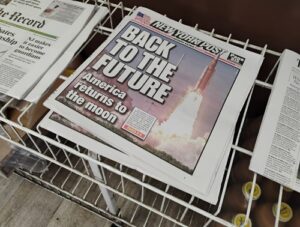
No honest history of the Post can skip its headlines, because the headline is where the paper lives. “Headless Body in Topless Bar,” written by Vincent Musetto in 1983, is the stuff of legend and routinely lands on lists of the greatest tabloid covers ever printed. The Post mastered the art of the front page that makes you laugh, gasp, or wince before you have even paid your quarter.
But the same instinct that produced the classics also produced the disgraces, and there have been plenty. In 1989, the paper’s coverage of the Central Park jogger case described the accused teenagers in language so inflammatory that it looks even worse now that their convictions have been overturned. In 2009, the Post ran a Sean Delonas cartoon that many readers found racist, and Murdoch himself apologized. During the 2013 Boston Marathon bombing, the paper splashed two innocent men across its cover under the word “Bag Men,” and it later settled a libel suit.
In October 2020 came the Hunter Biden laptop story, a piece so contested that two staffers reportedly declined to put their names on it, even as some of its underlying emails were later authenticated by other outlets. In 2021, a false front-page story about Vice President Kamala Harris led the reporter to resign, saying she had been ordered to write it. Critics have hammered the paper for bias and sensationalism for decades, and back in 1980, the Columbia Journalism Review went so far as to call it a force for evil. The Post has worn that criticism almost as a badge.
The Sports Pages
If you grew up reading the Post the way I did, you know the back page was the real front page. New Yorkers flipped the paper over before they opened it, and for decades, the Post gave them some of the finest sportswriting in America. The tradition runs deep. Jimmy Cannon, the Greenwich Village kid who learned at the elbow of Damon Runyon, wrote his column for the Post from 1946 until 1959, and by the time he left, he was the highest-paid sportswriter in the country. His “Nobody Asked Me, But…” columns, full of one-liners and street poetry, set the template for the modern sports column. He was close to Joe DiMaggio and Joe Louis, and his line that Louis was “a credit to his race, the human race” became one of the most quoted sentences in sports journalism. Cannon proved that a tabloid sports page could carry real literary weight.
The Post kept the bench stocked for generations. Milton Gross and Maury Allen covered the city’s baseball wars with the kind of access and edge that made readers feel like insiders, and Larry Merchant honed the craft on the Post’s pages before he became the famous voice of HBO boxing. That brings me back to where I started this piece, with Dick Young. In 1982, after a contract fight with the Daily News and more than four decades there, Young stunned the city by walking across the street to the Post. He brought his “Young Ideas” column and that same blunt, no-BS style with him, and even as he grew more conservative with age, he remained one of the most widely read and highest-paid columnists in the country. For a Bronx kid who had followed him since the ’60s, seeing his byline in the Post felt like the rivalry itself had switched sides.
The modern Post sports section never lost that punch. Peter Vecsey turned NBA coverage into appointment-reading with his insider scoops, and Phil Mushnick, who started as a copy boy in 1973 and became the paper’s sports media columnist in 1982, built a career on scathing watchdog commentary that spared no announcer, network, or league. He is one of my favorites, and I like the bullet-point style of writing he often uses. He manages many professionals, but that’s what makes for good internet journalism. Today, the section runs on columnists like Mike Vaccaro, Steve Serby, Joel Sherman, and Larry Brooks, names that Yankees, Mets, Giants, Jets, Knicks, and Rangers fans still argue with every single morning. The Post still treats a big game like the biggest story in town, and in a sports city like this one, that is exactly the way it should be.
Where the Post Stands Today
For all the turbulence the paper endured, it has lately even thrived. It launched an online edition back in 1996, well ahead of many rivals, and added the streaming guide site Decider in 2014. After losing money for decades, the Post finally turned a profit in September 2022, powered largely by a digital network that reached nearly 198 million unique users that summer. According to recent figures, it ranks among the largest American newspapers by print circulation, even as that print circulation has settled into the low six figures. Today, it is owned by NYP Holdings, part of News Corp, with Sean Giancola as publisher and Keith Poole as editor-in-chief.
There is one footnote worth settling for the trivia lovers. The Post calls itself the oldest daily newspaper in the country, and by its 1801 founding date, that claim holds. It is not, however, the oldest continuously published paper, since it went dark during newspaper strikes in 1958 and 1978. That distinction belongs elsewhere. Still, more than two centuries after Alexander Hamilton scraped together ten thousand dollars to start it, the New York Post is still on the newsstands, still picking fights, still printing headlines that New Yorkers argue about over coffee. For a kid from the Bronx who learned to read the world through its pages, that counts for something……and I still read it every day as well as The Times, Newsday, and The Daily News.
For more history on New York newspapers, make sure to check out our in-depth article on The History of New York Newspapers: The Publications That Shaped a City.