New York City is famous for its skyline, but height tells only part of the story. Some of the city’s most important buildings are not the tallest. They are the largest by square footage, with enormous floor plates, full-block footprints, and millions of square feet of office and commercial space packed inside.
Measured this way, New York’s biggest office buildings become a different kind of landmark. Their importance has less to do with how high they rise and more to do with how much of the city they contain.
That distinction matters because square footage reveals scale in a practical sense. A building can be relatively modest in height and still rank among the city’s largest if it spreads across an entire block or stacks enormous interior floors inside a broad structure. From the Financial District to Midtown, Chelsea, and Hudson Yards, these buildings anchor New York’s business districts and help shape the daily rhythm of commercial life.
This ranking is limited to completed office buildings in New York City. Public sources do not always measure buildings the same way. Some publish gross floor area, others use rentable square footage, and others report office space alone. The order below uses the most widely published current figure for each property. Buildings reported at nearly identical totals may change places depending on the measurement standard used.
# 10 – 3 World Trade Center

3 World Trade Center opened in June 2018 at 175 Greenwich Street within the rebuilt World Trade Center complex. Designed by Rogers Stirk Harbor + Partners, the 80-story tower rises 1,079 feet and contains approximately 2.5 million square feet of office space.
The building’s unusually flexible floor plates range from roughly 30,000 to 70,000 square feet. That broad interior capacity helps explain why it belongs on this list even though its neighboring One World Trade Center rises much higher. Three of its floors include outdoor terraces, bringing open-air space into a building designed primarily for large corporate tenants.
The recently completed JPMorgan Chase headquarters at 270 Park Avenue is also publicly listed at 2.5 million square feet. Because both figures are rounded, the tenth position can vary depending on the source and the measurement standard being used.
# 9 – PENN 1
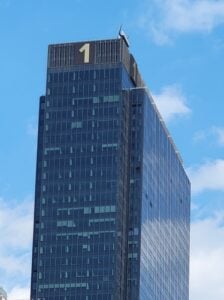
PENN 1, long known as One Penn Plaza, was completed in 1972 beside Pennsylvania Station and Madison Square Garden. The 55-story building contains more than 2.5 million square feet and occupies one of the most heavily traveled locations in Midtown Manhattan.
Its size is matched by its transportation access. The building connects directly to Penn Station and sits beside Moynihan Train Hall, placing offices above one of the most important rail and subway junctions in the United States. A major redevelopment introduced new public plazas, tenant lounges, conference space, fitness facilities, restaurants, and other amenities while preserving the building’s enormous commercial capacity.
# 8 – One New York Plaza

One New York Plaza was completed in 1969 at the southern edge of the Financial District, overlooking New York Harbor and the Battery. The 50-story building rises 640 feet and is commonly listed at approximately 2.56 million square feet.
The structure’s broad, recessed-window facade gives it a distinctive honeycomb appearance. Its harbor location and unusually large floor plates helped make it a major address for financial and professional firms. Hurricane Sandy flooded the building’s lower levels in 2012, forcing extensive repairs to electrical and mechanical systems before the property reopened.
# 7 – 30 Hudson Yards

Completed in 2019, 30 Hudson Yards stands at the intersection of West 33rd Street and Tenth Avenue. The tower rises 1,296 feet and contains approximately 2.6 million square feet, combining enormous interior capacity with one of the most prominent silhouettes on Manhattan’s West Side.
The building forms the commercial centerpiece of the Hudson Yards development. Its offices sit above retail space and direct transit access, while the cantilevered Edge observation deck projects from the tower near its upper floors. Unlike many horizontally massive buildings on this list, 30 Hudson Yards achieves its scale through both height and floor area.
# 6 – 225 Liberty Street

225 Liberty Street, formerly known as Two World Financial Center, was completed in 1987 as part of the complex now called Brookfield Place. The 44-story tower contains roughly 2.5 million square feet of rentable office space and approximately 2.67 million square feet when measured by total floor area.
Designed by Cesar Pelli and associated architects, the building stands along the Hudson River directly west of the World Trade Center. It connects to the Winter Garden Atrium and the rest of Brookfield Place through an interior network of public and commercial spaces. The building was seriously damaged by debris during the September 11 attacks and remained closed for repairs until 2002.
# 5 – Empire State Building

The Empire State Building was completed in 1931 at 20 West 34th Street. Rising 1,250 feet to the roof and 1,454 feet to the top of its antenna, the 102-story Art Deco landmark was constructed in approximately 410 days during the Great Depression.
Its fame as a symbol of New York sometimes overshadows its sheer commercial size. The building’s official figures list approximately 2.7 million square feet of office space. That makes the Empire State Building not only one of the most recognizable structures on earth, but also one of New York City’s largest working office buildings nearly a century after it opened.
# 4 – 111 Eighth Avenue

111 Eighth Avenue was completed in 1932 between Eighth and Ninth Avenues and West 15th and 16th Streets in Chelsea. The 15-story structure occupies an entire city block and contains approximately 2.9 million square feet.
The building was originally developed as an inland freight terminal for the Port of New York Authority. Reinforced floors, high ceilings, enormous open interiors, and freight elevators capable of carrying loaded trucks gave it a scale unlike that of a conventional office tower.
Google purchased the property in 2010 for approximately $1.9 billion after leasing space there for several years. Its vast floors and access to major fiber-optic routes helped transform the former freight terminal into an important technology and communications center.
# 3 – MetLife Building

The MetLife Building was completed in 1963 at 200 Park Avenue, directly behind Grand Central Terminal. Formerly known as the Pan Am Building, the broad octagonal tower rises 808 feet and is officially marketed at approximately 3.1 million square feet.
Its mass was controversial from the moment it appeared above Grand Central, but its commercial importance has never been in doubt. The building’s immense interior area, Central Park Avenue location, and direct connections to Grand Central Terminal and the surrounding transit network have made it one of Midtown’s most important office properties for more than six decades.
# 2 – One World Trade Center

One World Trade Center opened in 2014 at the northwest corner of the rebuilt World Trade Center site. Designed by Skidmore, Owings & Merrill, the tower rises to a symbolic height of 1,776 feet and contains approximately 3.1 million square feet.
The building combines office space with broadcast facilities, observation levels, restaurants, mechanical floors, and direct connections to the World Trade Center transportation and retail network. Its square base recalls the dimensions of the original Twin Towers, while its eight triangular faces taper and rotate as the structure rises.
One World Trade Center and the MetLife Building are both commonly described as 3.1-million-square-foot properties. Their exact order can change depending on whether a source counts gross area, office area, rentable space, or connected support areas.
# 1 – 55 Water Street

55 Water Street is generally recognized as the largest office building in New York City by square footage. Completed in 1972, the 53-story building rises 687 feet along the East River in Lower Manhattan and is commonly listed at approximately 3.5 million square feet, with its owner describing the entire property as nearly four million square feet.
Its scale comes from width rather than extreme height. The building occupies a massive site and includes floor plates approaching 69,000 square feet, allowing companies to place very large operations on a single level. Its 3.2 million square feet of rentable space alone would be enough to place it near the top of the ranking.
55 Water Street also incorporates the Elevated Acre, a privately owned public park raised above street level. The landscaped space offers harbor and skyline views only a short distance from the crowded streets of the Financial District. If height is what people notice first in New York, 55 Water Street proves that the city’s greatest architectural scale can also be measured from the inside out.
Measurement Note
Square-footage figures can vary because real estate owners, architects, government records, and leasing firms do not always use the same definition. Gross floor area may include mechanical levels, lobbies, retail space, basements, and support areas that are excluded from rentable office figures. This is especially important near the bottom of the ranking, where 3 World Trade Center and 270 Park Avenue are both publicly described as 2.5-million-square-foot buildings.
The list is also limited to office buildings. A broader ranking that included airport terminals, convention centers, warehouses, hospitals, shopping complexes, and multi-building campuses would produce a different result.
More New York City Building History
Readers interested in the buildings that shaped New York can continue with our History of the Empire State Building, History of New York’s MetLife Building, History of New York’s Winter Garden Atrium and Brookfield Place, and History of New York’s Pennsylvania Station.
Updated July 29, 2026.
The 10 Largest Office Buildings in New York City by Square Footage article published on ClassicNewYorkHistory.com © 2026