
Long before laptops, tablets, and smartphones became part of everyday life, students learned that neat handwriting was every bit as important as spelling or arithmetic. For generations who attended Catholic schools throughout the twentieth century, penmanship was more than simply learning to write in cursive. It was a lesson in discipline, patience, pride, and attention to detail. While technology has largely replaced handwritten communication, the memories of practicing cursive with fountain pens remain an unforgettable part of growing up.
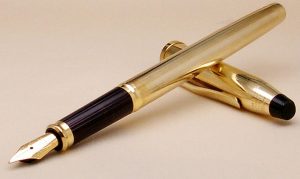
Photo: Edesaintjores [CC BY-SA 3.0 (https://creativecommons.org/licenses/by-sa/3.0)], from Wikimedia Commons
The Importance of Penmanship
The art of penmanship has long faded into the distant past. However, for anyone who attended Catholic schools during the twentieth century, the development of proper penmanship was a major part of the curriculum. Even in most public schools, penmanship was an important part of everyday classroom instruction. I can still remember those script uppercase and lowercase letters hanging above the chalkboard. We practiced penmanship every day. We were graded on our penmanship. We were told that penmanship reflected caring about our work. The discipline of practicing penmanship was a study in the development of both physical and mental skills.
The rationale for using cursive was that once the art of writing in cursive was mastered, the brain was free to engage in more analytical thinking because cursive flows much more freely than printing.[1] Of course, as kids we didn’t understand that. We just knew that if we wrote sloppily, doom and gloom would soon follow. Nonetheless, time and technology have changed the way many people think. There have been arguments against the use of cursive. In the 2012 New York State Common Core curriculum changes, there was no mention of teaching cursive. Opponents argue that cursive is unnecessary in a society that has embraced technology. Nonetheless, have you ever seen someone trying to sign a form or a check who does not know how to write in cursive?
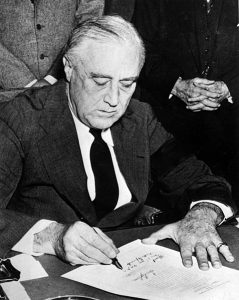
Photo: Abbie Rowe [Public domain]
The Fountain Pen Experience
In practical terms, what made the practice of penmanship difficult was the requirement that all St. Brendan’s students write with an ink cartridge fountain pen. As crazy as it may seem today, in the 1960s, ballpoint pens were not allowed in class. Ballpoint pens were evil. Ink cartridge fountain pens and pencils were the only writing utensils allowed.
Ink cartridge pens wrote beautifully when you had achieved just the right amount of pressure against the paper. Press down too hard or dot an “i” for too long, and you had yourself a nice blue blot of ink on your paper. Installing and removing the cartridges from those pens could be a mess. Nonetheless, they were cool, and everyone noticed the color or style of each other’s cartridge pens. A fountain pen was like an investment. They were expensive. Your parents would not be happy if you lost your fountain pen. Simple things in Catholic school at that age were often a very big deal.
Why Cursive Still Matters
The ability to write in cursive enables one not only to sign checks or legal documents but, in even simpler terms, to sign greeting cards or other personal correspondence with a beautiful handwritten signature. Receiving a birthday card from a thirty-year-old who printed their name just does not seem to cut it.
In the end, penmanship may no longer be regarded as that important because of technology. Yet it still serves a purpose on many different planes. However, revitalizing the lost art of penmanship just may be a battle that ran out of ink a long time ago.
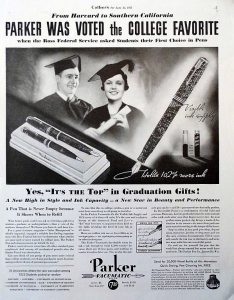
Photo: Joe Haupt from USA [CC BY 2.0 (https://creativecommons.org/licenses/by/2.0)], via Wikimedia Commons
Related ClassicNewYorkHistory.com Articles
If you enjoyed this look back at classroom life, be sure to read our articles on St. Brendan’s School in the Bronx, St. Brendan’s Church, Living in the Bronx During Son of Sam, and Williamsbridge Oval Park.
[1] Haskell, Myrna Beth. “Is Cursive Making a Comeback after Disappearing from Curriculums?” New York Parenting. Accessed January 22, 2019. https://www.nyparenting.com/stories/2017/9/teaching-cursive-handwriting_-in-schools-technology-2017-09.html.
Updated June 29, 2026.