Personal Seat Licenses, better known as PSLs, changed the experience of being a season ticket holder for thousands of New York Jets and New York Giants fans. For many longtime supporters, the move to MetLife Stadium brought higher costs, difficult financial decisions, and a very different home-field atmosphere than the one they had enjoyed for decades.
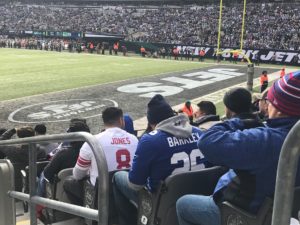
Opposing team fans at a New York Jets game. Photo: Brian Kachejian ©2019
For New York Jets fans who attend home games every Sunday against any NFL team at New Jersey’s MetLife Stadium, they often find themselves in a stadium that feels like a home game for the opposing team. Yes, the New York Jets play their home games in New Jersey. However, calling it a home game no longer makes sense. That’s because a large portion of the fan base that holds season tickets sells its games online through places like StubHub and Ticketmaster. New York Giants season ticket holders do the same thing. The fact that both teams have been having horrible seasons, as usual, plays a part in many season-ticket holders selling their tickets. However, there’s another reason a good portion of NFL season-ticket holders sell their game tickets. That reason is called the PSL license. Here’s why.
The majority of season-ticket holders at MetLife Stadium were forced to buy PSL licenses when the New York Jets moved there. The other New York team, the New York Giants, forced their fans to do the same thing. For years, it was impossible to get season tickets to New York Jets or New York Giants home games. Both teams’ ownership understood the value of NFL game tickets. Game tickets for NFL games, especially in New York, were in high demand during the 2000s and the years leading up to them. When New York State legalized selling tickets above face value during the 2000s, fans made out well, especially New York Giants season-ticket holders.
When both teams decided to build a new stadium to share, they also decided that all of their existing season-ticket holders would have to buy Personal Seat Licenses for the new stadium to continue being season-ticket holders. For longtime season ticket holders of both teams, this was a horrible stab in the back. I had three seats on the 50-yard line for the New York Giants. I had those seats for 30 years. I commuted 60 miles from Long Island back and forth to every game. I spent a lot of money on gas, tolls, and concessions, going to Giants games 10 times a year. It was worth every penny, and it was my choice to do so. No complaints about any of it. It was great. I was in the lower deck, and my tickets cost $95 a seat in the final season at Giants Stadium in 2009.
The following year, the New York Giants informed me that if I wanted to keep my seats in the same location in the new stadium, they would raise my ticket price from $95 per seat to $700 per seat. They also informed me that they would charge me a $20,000 Personal Seat License fee for each seat I owned. Since I owned three seats, the cost of my season tickets would rise to $21,000 a season for ten games. Additionally, I had to cough up $60,000 in PSL fees. The New York Jets did the same thing to their fans in the same sections.
The majority of season-ticket holders with really good seats had to give them up for both teams. There’s no way the average fan could pay $20,000 to $25,000 for a PSL. So what happened instead was all of us moved into the end zones, paying either a $4,000 or $5,000 PSL. The New York Giants wanted their PSLs paid in full within two years. The New York Jets offered their fans a 15-year payment plan with heavy interest. Many New York Jets fans took the 15-year payment plan. Even though it didn’t seem like a great investment, it wasn’t too bad because NFL tickets always had a very high resale value. We could not have been more wrong.
The New York Giants were out of the picture for me because all they offered me was the last row in the upper deck with a PSL fee attached to it. They didn’t offer me end-zone seats or anywhere else, just the last row in the corner of the upper deck with a PSL. After 30 years, that’s where they placed me because I could not come up with a $60,000 PSL fee for my three seats. I have two sons.
Now people will argue that once you’re a fan of an NFL team, you should stay a fan of that NFL team for your entire life and that you should be loyal. Well, when that NFL team tells you you’re not wealthy enough to attend its games anymore, you kind of throw that argument out the window. That’s what I did. I told the Giants to keep their tickets, and I placed a call to the New York Jets. I hated the Giants for what they did to me and all their other loyal fans who had been attending games for thirty years in that stadium. Many of them had season tickets dating back to the Polo Grounds. The New York Giants didn’t care about them. They wanted the money, and they knew they would get it from corporations looking for tax write-offs.
The New York Jets offered me two seats in the corner end zone in the ninth row with a $125 ticket price and a $5,000 PSL. The big difference between the New York Jets and the New York Giants was that the Giants wanted all their money within two years, while the Jets offered a 15-year payment plan that allowed me to make a $1,000 payment once a year for 15 years. I signed up for the 15-year payment plan because I just did not happen to have $10,000 to hand over to the New York Jets. If you do the math rather easily on this one, you will discover that’s $5,000 in interest being paid.
Most people with good sense would say that’s not really a good deal. However, I have two sons, and going to NFL games has always been a tradition in my family. Yes, this is my story, but it’s a shared story with thousands of other NFL season ticket holders dealing with the PSL issue. That’s what leads us to the NFL home-game experience being destroyed.
Having to pay those PSL fees every year has become a financial burden. It’s tough enough having to pay for tickets for ten games. Yes, I understand nobody is forced to do this, and that’s not the point of this article. What has happened with many PSL holders is that they are forced to sell multiple games every season to pay for those PSL licenses.
So now stadiums are full of opposing teams’ fans because season ticket holders are being forced to sell multiple games to pay their long-term PSL contract payments. And the word contract is important here. These were contracts fans signed, and the agreements contain language that does not bode well for the season-ticket holder if payments are missed. Further infuriating many PSL holders is that some teams have lowered PSL prices in the current market because no one is buying them anymore, thereby making season-ticket holders with high-priced PSLs owners of virtually worthless licenses.
When a fan brought suit against the New York Jets, arguing that his PSL was no longer worth anything because the team turned his section into a non-PSL section, the judge ruled in favor of the New York Jets, stating that no one forced the fan to buy the PSL in the first place.
So want to know why NFL home games are no longer home games for many teams? It’s called the PSL, and we are all still paying the price. Yes, some will argue that with big-screen televisions and the comfort of home, fans would rather stay home. However, longtime NFL season-ticket holders are families with traditions of attending games. The problem is that the NFL has allowed its teams to destroy many of those traditions with the greed surrounding the PSL. It’s sad.
Related New York Sports History Articles
If you enjoyed this article, be sure to read our related stories on the New York Jets NFL Draft Party, the Super Bowl III Champion New York Jets, and other New York sports history features on ClassicNewYorkHistory.com.
Article updated on June 26, 2026