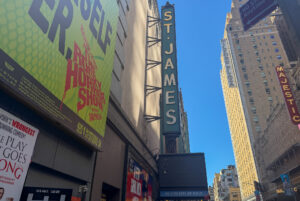
Broadway’s St. James Theatre Photo by Brian Kachejian © 2026
Broadway’s St. James Theatre at 246 West 44th Street has been part of New York City’s Theater District since 1927. With approximately 1,700 seats, it is among Broadway’s larger houses, and both its exterior and auditorium interior are protected New York City landmarks. The theater’s history also reaches well beyond the building itself. Some of the most celebrated musicals in American theater opened on its stage, including Oklahoma! and The King and I. Decades later, it became the home of The Producers, one of Broadway’s biggest hits of the twenty-first century.
The theater did not begin life with its present name. It opened as Erlanger’s Theatre, built for theatrical producer Abraham Lincoln Erlanger, whose earlier business had helped control how shows were booked around the United States. It later passed through the hands of the Astor family, Lodewick Vroom, the Shubert Organization, and Jujamcyn Theaters. Today it is operated by ATG Entertainment. The changes in ownership tell part of the story, but the performances and the people who filled its seats are what made the St. James an important Broadway institution.
Before the Building of the Theatre
The St. James stands in a section of West 44th Street that became one of the centers of Broadway theater during the early twentieth century. The Shubert and Broadhurst theaters stand nearby, and the neighborhood around Shubert Alley developed into a concentrated collection of playhouses, restaurants, and businesses serving performers and theatergoers. Before construction began on the St. James, its site contained older brownstone buildings, including a small restaurant run by Vincent and Eugenia Sardi.
The Sardi family had opened their Little Restaurant in 1921. When the buildings were cleared for Erlanger’s new theater, they relocated to 234 West 44th Street, where Sardi’s opened in March 1927. The move helped create one of Broadway’s most enduring dining institutions. At the new location, Russian-born artist Alex Gard began drawing caricatures of theatrical personalities, establishing the tradition that eventually made the restaurant’s walls famous. The story of Sardi’s is a reminder that a new theater could change the surrounding neighborhood even before its first opening night.
Under A. L. Erlanger
Abraham Lincoln Erlanger was one of the major figures in the business of American theater. With Marc Klaw, he helped build a powerful booking organization associated with the Theatrical Syndicate, which exercised considerable influence over theater circuits during the late nineteenth and early twentieth centuries. Producers who wanted to tour their shows often had to deal with the syndicate’s control of desirable venues. The system gradually faced opposition from other theatrical entrepreneurs, especially the Shubert brothers, and the Klaw-Erlanger partnership eventually came to an end.
Erlanger wanted a New York theater of his own and began planning one on West 44th Street in 1921. His early proposal was for a smaller house called the Model Theatre. Plans changed over the next several years, and construction finally moved forward in 1926 with a larger auditorium and a new name: Erlanger’s Theatre. He selected Warren & Wetmore, the firm best known to New Yorkers for its work on Grand Central Terminal. The St. James was the firm’s first theatrical commission, and its design differed from the lavish exteriors of some older Broadway playhouses.
The building’s relatively restrained Beaux-Arts facade rises above a stone and granite base. Its most striking exterior feature is an ornate wrought-iron loggia above the entrance. Inside, the architects created a broad auditorium with two balconies and boxes close to the stage. Classical columns, painted ornament, and decorative panels gave the room a formal character without overwhelming it. One of the boxes was traditionally called the Governor’s Box, and Governor Al Smith attended the theater’s opening there with his family.
Erlanger’s Theatre opened on September 26, 1927, with The Merry Malones, a musical comedy written, composed, produced, and performed by George M. Cohan. The production ultimately recorded 216 Broadway performances. Other early presentations included Cohan’s Billie and the musical Fine and Dandy. The theater was intended to accommodate major musical productions, and that association would become even more important after Erlanger’s death.
Erlanger died in March 1930, only a few years after the opening of the house that carried his name. His estate continued to operate the theater, but the effects of the Depression made the financial situation difficult. In 1932, Vincent Astor, whose family owned the land, pursued the estate over unpaid rent. The property changed hands, and with new management came a name that Broadway audiences still recognize.
Under Lodewick Vroom
Lodewick Vroom, a theatrical manager associated with producer Gilbert Miller, took over the building in 1932 and renamed it the St. James Theatre. The name referred to the Court of St. James’s and reflected a gesture toward England, rather than simply copying the title of a London playhouse. The change removed Erlanger’s name from the marquee but left the theater’s architecture and its place on West 44th Street intact.
Vroom reopened the theater in December 1932 with the revue Walk a Little Faster, featuring Beatrice Lillie, Bobby Clark, and Paul McCullough. The following years brought Gilbert and Sullivan operettas, appearances by the Ballet Russe de Monte Carlo, and Thumbs Up!, a 1934 revue associated with the songs “Autumn in New York” and “Zing! Went the Strings of My Heart.” The variety of productions demonstrated how Broadway houses adapted their schedules during the Depression.
The St. James also presented serious dramatic productions in the later 1930s. Maurice Evans appeared in Shakespearean revivals, including Richard II in 1937, and returned in other classical roles. The theater had established an identity separate from its original owner by the time the Shubert Organization took control in 1941. Its next era would produce some of the biggest Broadway musical milestones in history.
Under the Shubert Organization
The Shubert Organization acquired the St. James in 1941. Two years later, on March 31, 1943, Rodgers and Hammerstein’s Oklahoma! opened there. The musical, based on Lynn Riggs’s play Green Grow the Lilacs, brought Richard Rodgers and Oscar Hammerstein II together as a songwriting team and helped change Broadway’s approach to musical storytelling. Songs, dance, and dramatic action were integrated in ways that influenced generations of productions. Oklahoma! remained at the St. James for more than five years, a remarkable run for its period.
The theater continued to be associated with major Broadway musicals during the late 1940s and early 1950s. Frank Loesser’s Where’s Charley? opened there in 1948. Rodgers and Hammerstein returned with The King and I, which opened at the St. James on March 29, 1951, starring Gertrude Lawrence and Yul Brynner. The production ran for 1,246 performances. Later successes included The Pajama Game, whose songs and choreography helped make it another enduring Broadway title.
Despite these achievements, the Shuberts faced federal scrutiny over the extent of their control of Broadway theaters. An antitrust case led to the divestiture of some properties, including the St. James. The theater was sold in 1957 to interests associated with William L. McKnight and Scarborough House, Inc., and its operation passed to the Jujamcyn organization. The building underwent extensive interior renovation before reopening in December 1958 with Rodgers and Hammerstein’s Flower Drum Song.
Under Jujamcyn Theaters
The St. James became an important part of the Jujamcyn theater business developed by William McKnight and later associated with his daughter Virginia and her husband James H. Binger. Jujamcyn eventually expanded its Broadway holdings, making it one of the principal theater operators in New York. The St. James remained a particularly valuable house because its large stage and seating capacity made it suitable for ambitious musicals.
Its post-1958 productions included Do Re Mi, starring Phil Silvers and Nancy Walker, and the original Broadway production of Hello, Dolly!, which opened in 1964 with Carol Channing. Hello, Dolly! became one of Broadway’s defining musicals of the decade, and its success reinforced the St. James’s reputation as a destination for large-scale musical theater. The 1970s brought other productions, but the theater continued to search for the kind of sustained commercial successes it had enjoyed in earlier decades.
Those successes returned in the 1980s. Barnum, with Jim Dale in the title role, opened in 1980, followed by the Gershwin-inspired musical My One and Only in 1983. 42nd Street also played the St. James during part of its long Broadway run. In the 1990s the theater hosted The Secret Garden, The Who’s Tommy, and a revival of A Funny Thing Happened on the Way to the Forum. These productions brought new generations of Broadway performers and audiences into the house.
Meanwhile, preservation officials recognized the value of the original architecture. On December 15, 1987, the New York City Landmarks Preservation Commission designated both the theater’s exterior and portions of its auditorium interior as city landmarks. The protection covered important features of the building, including its facade, balconies, boxes, decorative plasterwork, and ceiling ornament. The St. James was therefore preserved not only as a place where famous shows had played, but as a significant work of theater architecture.
In April 2001, Mel Brooks’s The Producers opened at the St. James with Nathan Lane and Matthew Broderick. Directed and choreographed by Susan Stroman, the musical quickly became one of Broadway’s hottest tickets. It won twelve Tony Awards and ran for 2,502 performances before closing in April 2007. The extraordinary demand for tickets also prompted new approaches to premium seating and ticket collection as producers tried to limit the opportunities for scalpers. For six years, the St. James was closely identified with one of the biggest theatrical successes of its time.
Other productions followed, including the 2008 revival of Gypsy with Patti LuPone, American Idiot, Hair, and Something Rotten!. The theater’s mix of established revivals, contemporary musicals, and new works demonstrated its continuing importance within the Broadway business.
The Stage Expansion and Frozen
During the 2010s, the St. James underwent another important alteration. Jujamcyn acquired space in the alley between the theater and the neighboring Hayes Theatre, allowing the stage to be extended by approximately ten feet. The work, completed in 2017, gave productions more room for scenery and technical equipment while retaining the landmarked portions of the historic auditorium.
The improved facilities helped prepare the theater for Disney’s Frozen, which opened on March 22, 2018. Based on the enormously popular animated film, the musical required elaborate scenery and stage effects and became a major box-office attraction. It set house records at the St. James, but its Broadway run ended with the March 2020 shutdown. Disney subsequently announced that Frozen would not return to Broadway, leaving its final performance on March 11, 2020.
The St. James was also closely connected with Broadway’s reopening after the COVID-19 shutdown. On June 26, 2021, Springsteen on Broadway began a limited return engagement, making the theater one of the first Broadway houses to welcome audiences back. Bruce Springsteen’s performances offered a symbolic beginning to the industry’s recovery after an unprecedented interruption. David Byrne’s American Utopia followed later in 2021 and continued into 2022.
The St. James Theatre in the 2020s
Broadway activity at the St. James accelerated in the years after reopening. A revival of Stephen Sondheim and James Lapine’s Into the Woods began in 2022, followed by the musical New York, New York in 2023. A revival of Spamalot opened later that year. In 2024, Illinoise brought a dance-centered production inspired by Sufjan Stevens’s music to the stage, showing that the building could support forms of performance beyond the traditional book musical.
In October 2024, a new Broadway revival of Andrew Lloyd Webber’s Sunset Boulevard opened at the St. James, starring Nicole Scherzinger. The production’s striking contemporary staging attracted considerable attention and continued into July 2025. The Queen of Versailles, with music by Stephen Schwartz and starring Kristin Chenoweth, followed in late 2025. In 2026 the theater hosted Titaníque, a musical comedy that reimagined the story of the film Titanic through the songs of Céline Dion. That engagement ended on September 20, 2026.
As of November 2026, the next announced production is DOLLY: A True Original Musical, based on the life and music of Dolly Parton. Previews are scheduled to begin December 7, 2026, with an official opening planned for January 19, 2027. The announcement is another reminder of the St. James’s longstanding association with major musical productions. From Rodgers and Hammerstein to Mel Brooks and modern Broadway revivals, the theater has repeatedly provided a home for shows that reach audiences well beyond New York City.
Why the St. James Theatre Matters
The history of the St. James is closely connected to the history of Broadway itself. It began as the personal project of a powerful theatrical producer, survived the Depression, changed names and owners, and became one of the great houses of the American musical. Its stage has hosted productions that helped define their eras, while its landmarked architecture preserves something of the Broadway that existed before modern electronic marquees and large-scale stage technology became familiar.
Standing on West 44th Street, the theater remains part of a remarkable concentration of New York theatrical history. The neighboring playhouses have stories of their own, including the Belasco Theatre and the Hudson Theatre. For a broader view of the district, see our guide to Broadway theaters in New York City. The St. James continues to justify its place among them because it is both a historic building and a stage where Broadway’s story is still being written.
Updated November 10, 2026.