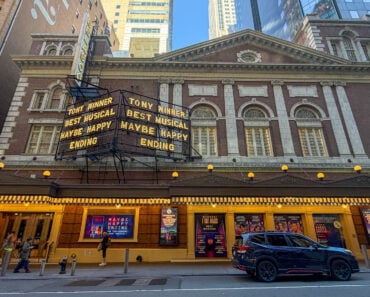
Majestic Theater NYC: Photo by Brian Kachejian ©2026
The Majestic Theatre at 245 West 44th Street has been one of Broadway’s grand musical houses since 1927. With a seating capacity of roughly 1,600 to 1,700, depending on the seating configuration, it was built for productions that needed a large stage and a substantial audience. Its name became known around the world during the 35-year Broadway run of The Phantom of the Opera, but that extraordinary success is only one chapter in the building’s history.
The Majestic was part of a development that helped establish the familiar heart of the Theater District. It hosted early revues, celebrated Rodgers and Hammerstein musicals, The Music Man, Camelot, The Wiz, and 42nd Street before Phantom arrived in 1988. When the musical finally closed in April 2023, the theater faced a new question: what would happen to a Broadway house that had been occupied by the same production for more than three decades? The answer involved a major restoration, a celebrated revival of Gypsy, and a return to the changing world of Broadway musicals.
Building the Majestic Theatre
Irwin Chanin was an engineer and real estate developer who became one of the busiest theater builders in New York during the 1920s. He had been interested in the stage since his student years at Cooper Union. Working with his brother Henry, Chanin expanded from residential construction into a series of theater projects at a time when Broadway was flourishing around Times Square. The brothers employed architect Herbert J. Krapp, whose work helped shape much of the Theater District.
In 1926, the Chanins began an ambitious development occupying part of the block between West 44th and West 45th Streets, near Shubert Alley. Their plan included the Lincoln Hotel on Eighth Avenue and three adjoining theaters of different sizes. The largest was the Majestic, intended for light opera, musical revues, and other major productions. The middle-sized house was the Royale, now the Bernard B. Jacobs Theatre, while the smallest was the Theatre Masque, later renamed the John Golden Theatre.
The arrangement reflected a deliberate business strategy. A producer with a large musical could use the Majestic, while a less expensive or more intimate production might be better suited to the Royale or the Masque. Together with the hotel, the three theaters formed a coordinated development rather than a collection of unrelated buildings. Their construction also helped complete the concentration of theaters around Shubert Alley that remains one of the most recognizable parts of Broadway.
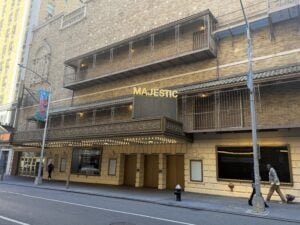
Krapp designed the Majestic in a style the Chanins called “modern Spanish.” Its West 44th Street facade features decorative brickwork, terra-cotta ornament, arched openings, and an elaborate motif above the entrance. Inside, the architect created a steeply sloped orchestra section and one large balcony instead of the more traditional arrangement of two balconies. The design was intended to improve sightlines and make even a large auditorium feel connected to the stage. Decorative plasterwork and a broad ceiling gave the interior the kind of grandeur audiences expected from a major Broadway house.
The Majestic opened on March 28, 1927, with Rufus LeMaire’s Affairs, a musical revue that played 56 performances. Its early schedule also included the operetta The Love Call and later revues and musical productions. Although its opening attraction was not a lasting hit, the building quickly proved desirable to producers who needed room for ambitious shows and large audiences.
How the Shubert Organization Acquired the Majestic Theatre
The Chanins entered theater construction during a period of confidence in New York real estate, but the financial climate changed dramatically after the stock market crash of 1929. Their interests also extended well beyond Broadway, and they began moving toward other kinds of development. In 1930, they transferred their interests in the Majestic, Royale, and Theatre Masque to the Shubert Organization in an exchange involving the Century Theatre property on Central Park West.
This was more complicated than a simple sale for cash. The exchange allowed the Chanins to pursue new development on Central Park West, where they built apartment towers, while the Shuberts expanded their already substantial control of Broadway theaters. The economic difficulties of the Depression continued to affect the properties, but the Majestic remained associated with the Shubert organization and eventually became one of its most important houses.
During the 1930s, the theater presented a mixture of revues, operettas, and productions transferred from other Broadway venues. Among its attractions were George and Ira Gershwin’s Pardon My English, Strike Me Pink with Jimmy Durante, and the 1939 revue Stars in Your Eyes, featuring Ethel Merman and Durante. In the early 1940s, the Majestic hosted a revival of Porgy and Bess and a new production of The Merry Widow. Not every show succeeded, but the stage remained well suited to large musical productions.
Rodgers and Hammerstein and Broadway’s Golden Age
The Majestic developed a particularly strong association with Richard Rodgers and Oscar Hammerstein II. Their musical Carousel opened there in 1945, followed by Allegro in 1947, South Pacific in 1949, and Me and Juliet in 1953. These productions helped establish the theater as one of Broadway’s leading destinations for musicals during a period when the American musical was undergoing important artistic changes.
South Pacific, starring Mary Martin and Ezio Pinza in its original production, was a major critical and commercial success. The score included songs that became standards, while the story confronted questions of prejudice and relationships during World War II. Like Carousel, it showed how Broadway musicals could combine memorable music with serious dramatic material. For the Majestic, the continuing association with Rodgers and Hammerstein was an enormous distinction.
The theater’s successes continued after that partnership’s productions. Fanny opened in 1954, and The Music Man, starring Robert Preston, opened at the Majestic in December 1957. Lerner and Loewe’s Camelot, starring Richard Burton, Julie Andrews, and Robert Goulet, followed in 1960. These shows brought new audiences into the large auditorium and helped build its reputation as a theater where major musical productions could flourish.
The 1960s and 1970s were not without disappointments, but the Majestic remained a significant Broadway address. Productions included Golden Boy, Fiddler on the Roof during part of its original run, Sugar, Mack and Mabel, and The Wiz. The latter opened at the Majestic in 1975 before eventually transferring to another Broadway house. In 1981, 42nd Street moved into the Majestic from the Winter Garden Theatre and continued there until 1987. The musical’s spectacular tap-dancing routines helped fill the auditorium during the years immediately preceding its most famous tenant.
Becoming a New York City Landmark
In the early 1980s, the demolition of historic Broadway theaters raised concerns about how much of the Theater District could be lost to redevelopment. Preservation advocates pushed for landmark protections for surviving playhouses, including those whose architectural importance was not always apparent from the sidewalk. The Majestic was among the theaters examined by the New York City Landmarks Preservation Commission.
On December 8, 1987, the commission designated both the Majestic’s exterior and important interior spaces as New York City landmarks. The reports emphasized Herbert J. Krapp’s distinctive design and the theater’s significance within the Chanin brothers’ development. The interior designation protected architectural features of the lobby and auditorium, including the balcony, ceiling, decorative surfaces, and other permanent elements.
Several major theater owners challenged aspects of the city’s landmark program, arguing that the restrictions complicated the operation and alteration of their buildings. The protections ultimately survived those legal challenges. As a result, the Majestic remained a working Broadway theater whose important architectural features also received recognition as part of New York City’s cultural history.
The Phantom of the Opera Arrives at the Majestic Theatre
No production is more closely associated with the Majestic than Andrew Lloyd Webber’s The Phantom of the Opera. After opening in London’s West End in 1986, the musical began previews on Broadway in January 1988 and officially opened at the Majestic on January 26. Produced by Cameron Mackintosh and Lloyd Webber’s Really Useful organization, it featured direction by Harold Prince and the celebrated staging of the chandelier, the underground lake, and the mysterious masked figure beneath the Paris Opera House.
Preparing the Majestic for Phantom required substantial changes to the stage and backstage areas. The theater had always been built for major musical productions, but the new show’s scenic effects and technical equipment presented unusual demands. The work included structural alterations beneath the stage to accommodate the production’s machinery. Those modifications helped turn the historic building into a home specifically adapted to one of Broadway’s most technically ambitious musicals.
The musical became a phenomenon. It won seven Tony Awards in 1988, including Best Musical, and attracted audiences from around the world. For countless New York visitors, seeing The Phantom of the Opera at the Majestic became part of the experience of visiting Broadway. Generations of performers, musicians, stagehands, and theater employees worked on the production, and its extended run created a connection between a single show and a single Broadway address that was almost without precedent.
In 2006, Phantom surpassed Cats to become Broadway’s longest-running show. The milestone did not end its remarkable longevity. It continued year after year, maintaining a recognizable presence on West 44th Street while most other Broadway theaters changed productions regularly. Its performances were interrupted by the COVID-19 shutdown in March 2020, and it returned to the stage in October 2021. The financial realities of maintaining such a large production eventually led to the announcement that it would close.
The End of Phantom and the Majestic’s Restoration
The Phantom of the Opera played its final Broadway performance at the Majestic on April 16, 2023. Its total reached 13,981 regular performances, making it the longest-running show in Broadway history. The final curtain ended a run of more than 35 years and brought an emotional farewell for the company and audiences who had made the theater a destination for so long. For the first time since the 1980s, producers and theater managers could consider what the Majestic might become without Phantom.
The departure of the elaborate production also exposed the need for major work on the building. The Shubert Organization undertook a restoration that addressed both its historic appearance and the practical needs of contemporary Broadway shows. Workers refurbished the auditorium and decorative finishes, installed new heating and cooling equipment, improved electrical systems and restrooms, and rebuilt portions of the stage and trap areas that had been altered for Phantom.
The project also involved modernizing backstage dressing rooms, rigging and other technical infrastructure, and accessibility features. The marquee and signage were updated, while the restoration revealed architectural details that had been obscured by the longstanding production. The goal was not to turn the Majestic into a museum but to make it possible for a wider variety of future shows to use the historic theater.
On September 9, 2024, the newly restored Majestic was formally unveiled at an event featuring music from Gypsy, the musical that was preparing to become the theater’s first Broadway production after Phantom. The event marked another transition for a theater that had already experienced nearly a century of changes in Broadway entertainment.
The Majestic Theatre After Phantom
The Majestic returned to regular Broadway performances in November 2024 with a revival of Gypsy starring Audra McDonald as Rose. Directed by George C. Wolfe, with choreography by Camille A. Brown, the production officially opened December 19, 2024. McDonald was one of Broadway’s most celebrated performers, and the revival offered the large theater another musical built around a formidable leading role. Gypsy continued until August 17, 2025, when it closed after 269 regular performances.
The next Broadway musical at the Majestic was Beaches, A New Musical, based on Iris Rainer Dart’s novel and the film that followed it. Starring Jessica Vosk and Kelli Barrett, the show began previews in March 2026 and officially opened April 22. It closed on May 24, 2026, after 38 regular performances. Its comparatively brief run contrasted sharply with the decades spent at the theater by Phantom, reminding audiences that even a large and beautifully restored Broadway house cannot guarantee a long run for every production.
As of November 2026, the next announced production is Purple Rain, a stage musical based on Prince’s 1984 film and music. The production is scheduled to begin Broadway previews at the Majestic on March 12, 2027, with an official opening planned for April 12. The announcement suggests another chapter for a theater that has repeatedly adapted to different forms of popular musical entertainment, from operettas and Rodgers and Hammerstein to elaborate contemporary productions.
Why the Majestic Theatre Remains Important to Broadway History
The Majestic’s history is larger than any single musical. The Chanin brothers built it as part of a development that helped define the Theater District. Herbert J. Krapp gave it an architectural character designed around both impressive decoration and useful sightlines. Rodgers and Hammerstein helped establish its reputation during Broadway’s golden age, and later hits brought new generations into the auditorium. Then The Phantom of the Opera made the theater internationally famous for 35 years.
The years since Phantom have shown that the Majestic can have another life without losing that history. Its restoration preserved the building while preparing it for future productions. On West 44th Street, it continues to stand among other historic houses, including the St. James Theatre and the Hudson Theatre. Readers interested in the surrounding district can explore our guide to Broadway theaters in New York City. Nearly a century after its opening, the Majestic remains an important part of New York’s theatrical landscape.
Updated November 10, 2026.
History Of The Majestic Theatre On Broadway ClassicNewYorkHistory.com ©2022