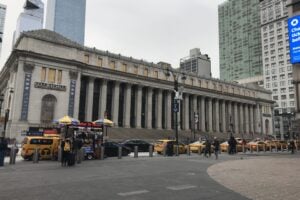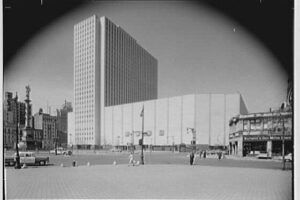
For more than three centuries, newspapers have documented every triumph, tragedy, scandal, championship, election, and defining moment in New York history. From colonial presses to the modern tabloids and broadsheets found on today’s newsstands, New York newspapers have shaped public opinion, preserved history, and chronicled the lives of millions of people. This guide explores the remarkable history of the newspapers that informed generations of New Yorkers and helped define one of the world’s greatest cities.
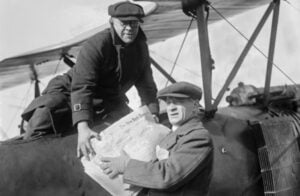
Feature Photo: Everett Collection / Shutterstock.com
When I was about 6 or 7 years old, actually maybe even younger, my father used to send me to the candy store, which is what we called it; it was actually a newsstand on the corner of 206th Street and Bainbridge Avenue, to wait in line for the Daily News Night Owl Edition. That’s right, to wait in line for a newspaper. You heard me correctly. Of course, he wanted it for the late scratches for the trotters at Yonkers Raceway. I just had fun reading the paper as I walked home.
I didn’t realize it at the time, but that was the beginning of my lifelong love for newspapers. Almost 60 years later, I still wake up at 5:00 in the morning, go to the bagel store, and get a copy of the Daily News and Newsday. I subscribe to the digital edition of The New York Times, and I have to tell you, I read most of the paper every day. I still prefer to hold it in my hand, to sit outside at a table drinking a cup of coffee, eating an everything bagel, and just scouring through the sports section, the entertainment, and then, of course, the news. My friends make fun of me. They say if you pass by the bagel store every morning at 5:30, you’ll see me in the window reading a newspaper.
As a historian, I consider newspapers among the most essential primary sources we can use. It’s not just a record of what happened; it’s a record of how people reacted to it. And it’s very interesting to see how, over time, newspapers change their idealism. Read an issue of The New York Times from the late 1800s and you’ll see a very different attitude towards politics and society than they have nowadays. I’m not judging, I’m just stating facts. So I thought it would be an interesting journey to dive back in time and list as many papers as I could find to show you just how important New York newspapers were to the general public, and in many ways, for certain people, still are. Listen, when the New York Knicks won an NBA championship just a few weeks ago, everybody ran to the newsstands to get a copy, and sadly, the only one that had the cover story was the New York Post; the others published too early. In the old days, that never happened.
SECTION ONE: STILL IN PRINT TODAY
New York Post (Founded 1801 by Alexander Hamilton as the New-York Evening Post) — The oldest continuously published daily newspaper in the United States. It evolved from a Federalist broadsheet into the famous tabloid it is today, owned by Rupert Murdoch’s News Corp since 1976 (with a brief interruption in the late 80s and early 90s). I think the post, has probably the best sports section of all the papers still being published. I’m not crazy about the new section because of its tabloid approach; the back part of the paper is almost a completely different paper from the first half.
New York Times (Founded 1851 by Henry Raymond and George Jones) — Started as a penny paper and grew into “the newspaper of record.” Still family-controlled by the Ochs-Sulzberger family since 1896. There is no bigger paper on the market than the Sunday edition of The New York Times. You can spend a week reading the whole thing until the next Edition is out the following Sunday.
Staten Island Advance (Founded 1886) — The dominant paper of Staten Island and the founding paper of the Newhouse family’s Advance Publications empire, which grew into Conde Nast.
Wall Street Journal (Founded 1889 by Charles Dow and Edward Jones) — Began as a financial bulletin and grew into the nation’s premier business daily. Owned by News Corp since 2007. What I love about this paper is the technology it covers. They always go very in-depth. I know why they’re doing it for investors, but for me I just find it fascinating stuff to read
New York Amsterdam News (Founded 1909) — One of the oldest and most influential Black-owned newspapers in America, based in Harlem. Still publishing weekly.
El Diario La Prensa (La Prensa founded 1913; merged with El Diario de Nueva York in 1963) — The oldest Spanish-language daily in the United States.
New York Daily News (Founded 1919 by Joseph Medill Patterson) — America’s first successful tabloid, once the largest-circulation paper in the country. Much diminished today but still printing. This is my all-time favorite newspaper. It brings me right back to the Bronx. It has always echoed the community it ser I can’t hear you I’ve missed water raining down on me lookingves. My favorite sports writer of all time, Mike Lupica, still writes for the paper at least once a week.
Newsday (Founded 1940 by Alicia Patterson) — Long Island’s dominant daily, headquartered in Melville. Winner of numerous Pulitzers and still one of the largest-circulation papers in the country. This is a great newspaper, but boy do they love to raise their prices.
amNewYork Metro (amNewYork founded 2003; merged with Metro New York in 2020) — The free commuter tabloid, still distributed in print around the city.
SECTION TWO: NO LONGER IN PRINT
New-York Gazette (1725–1744) — New York’s very first newspaper, founded by William Bradford, the city’s first printer. It was essentially a government-friendly official organ.
New-York Weekly Journal (1733–1751) — Founded by John Peter Zenger as an opposition paper to the Gazette. Zenger’s 1735 acquittal on seditious libel charges became the foundational moment for freedom of the press in America. Arguably the most historically important newspaper New York ever produced.
New-York Gazette and Weekly Mercury (1752–1783) — Hugh Gaine’s paper, one of the most successful of the colonial era. It died with the British evacuation of New York, as Gaine had sided with the Crown during the Revolution.
Rivington’s New-York Gazetteer / Royal Gazette (1773–1783) — James Rivington’s fiercely Loyalist paper during the Revolution, hated by Patriots. It also folded when the British left in 1783.
Independent Journal (1783–1788) — Short-lived but historically monumental: it was the first paper to publish the Federalist Papers by Hamilton, Madison, and Jay in 1787.
Daily Advertiser (1785–1806) — New York’s first daily newspaper, marking the transition from weekly colonial-style journalism to the modern daily press.
Commercial Advertiser / New York Globe (1793–1923) — Founded by Noah Webster (of dictionary fame) as the American Minerva. Under various names it ran for 130 years before being absorbed into the Sun in 1923.
New York Herald (1835–1924) — James Gordon Bennett’s revolutionary penny paper that essentially invented modern news gathering, crime reporting, and the interview. For decades it was the largest paper in America. Merged with the Tribune in 1924.
New York Tribune (1841–1924) — Horace Greeley’s crusading paper, the most influential voice of the antebellum North and the abolition movement. “Go West, young man” is forever tied to Greeley. Merged with the Herald in 1924 to form the Herald Tribune.
New York Evening Mail (1867–1924) — A respected evening paper that was merged into the Telegram in 1924.
New York World (1860–1931) — Joseph Pulitzer’s paper, the crown jewel of American journalism in the 1880s and 90s, the birthplace of the modern front page, comics, and crusading investigative journalism. Its circulation war with Hearst’s Journal gave us the term “yellow journalism.” Its 1931 shutdown was mourned as the death of an era.
New York Evening Graphic (1924–1932) — The most notorious tabloid in city history, known for its faked composite photographs and lurid sensationalism. Walter Winchell got his start there.
New York American (1882–1937) — William Randolph Hearst’s morning paper (originally the Journal’s morning edition), merged into the Journal-American in 1937.
New York Sun (1833–1950) — Benjamin Day’s original penny paper, the one that started the whole popular press revolution, and home of the famous 1897 editorial “Yes, Virginia, there is a Santa Claus.” Merged into the World-Telegram in 1950.
Brooklyn Daily Eagle (1841–1955) — Brooklyn’s great hometown paper, once edited by Walt Whitman. Its 1955 closure after a long strike left Brooklyn, then a borough of nearly three million people, without a major daily of its own. (The name was later revived by an unrelated publication.)
New York Daily Mirror (1924–1963) — Hearst’s tabloid answer to the Daily News, home of Walter Winchell’s column at its peak. It died in the aftermath of the devastating 114-day newspaper strike of 1962–63.
New York Journal-American (1937–1966) — Hearst’s flagship evening paper, formed from the merger of the Journal and the American. A casualty of the strikes and rising costs of the mid-1960s.
New York World-Telegram and Sun (1931–1966) — The Scripps-Howard evening paper that had absorbed both the World and the Sun. Another casualty of 1966.
New York Herald Tribune (1924–1966) — The merger of the Herald and the Tribune, and for decades the great Republican-leaning rival to the Times, famed for its brilliant writing. Its death in 1966 is still mourned by journalism historians.
World Journal Tribune (1966–1967) — The doomed merger of the Journal-American, the World-Telegram and Sun, and the Herald Tribune, nicknamed the “Widget.” It lasted barely eight months, and its death in May 1967 left New York with only three major dailies: the Times, the News, and the Post.
Long Island Star-Journal (1841–1968) — Queens’ hometown daily, based in Long Island City, part of the Newhouse chain.
Long Island Press (1821–1977) — The other great Queens daily, based in Jamaica. Its 1977 closure ended daily newspaper publishing based in Queens.
New York Newsday (1985–1995) — Newsday’s ambitious city edition, a well-funded attempt to crack the New York City market. Times Mirror pulled the plug in 1995 despite critical acclaim.
The New York Sun (revival) (2002–2008) — A revival of the old Sun name as a conservative broadsheet. The print edition folded in 2008, though the brand lives on today as an online publication.
New York Observer (1987–2016) — The salmon-colored weekly chronicling Manhattan’s media, real estate, and society worlds. Ended print in 2016 and went digital-only (as Observer). Notably owned for a time by Jared Kushner.
The Village Voice (1955–2017) — America’s first alternative weekly, co-founded by Norman Mailer. It ended regular print publication in 2017, a genuine cultural loss. The brand was later revived online with occasional print issues, but the weekly Voice that generations of New Yorkers grew up with is gone. As a musician, I answered an ad from a famous band looking for a keyboard player back in the 1980s. I auditioned, and a week later I was performing in Atlantic City. The power of Newspapers in society at that time was indisputable.
If you enjoyed exploring the history of New York newspapers, continue your journey through the city’s media and cultural history with our articles on Radio City Music Hall, Times Square, Grand Central Terminal, Penn Station, The New York Public Library, and The Woolworth Building. Together, these landmarks tell the story of how New York became America’s publishing, transportation, business, and cultural capital, a city where newspapers once connected millions of people every single day.