When people think of New York City real estate, images of glass skyscrapers, sleek penthouses, and classic brownstones usually come to mind. But hidden across the five boroughs, tucked inside public parks, overlooking historic waterfronts, and standing along busy avenues, are remarkable estates and historic homes that have survived from the city’s past.This is a New York that most people not from here know nothing about. Quite humbly, many of us who have lived here our entire lives are not aware of some of these locations. I hope this article will change that. It did for me.
From Gilded Age residences built by industrial titans to Revolutionary War sites used by George Washington, New York City preserves an extraordinary collection of historic houses. Some are grand mansions in the traditional sense, while others are colonial farmhouses, merchant residences, and manor houses whose stories are every bit as important.
Many of these buildings are open as museums, although public access can change because of restoration work, government use, special events, or seasonal schedules. Visitors should always confirm current hours and tour availability before making a special trip.
Here are ten historic mansions and homes in New York City, along with the stories behind them and the best available information on how to visit today.
1. The Frick Collection in the Henry Clay Frick House
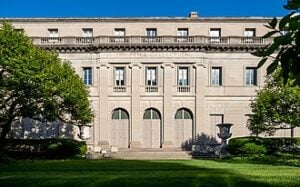
Ajay Suresh from New York, NY, USA, CC BY 2.0<https://creativecommons.org/licenses/by/2.0>, via Wikimedia Commons
Location: 1 East 70th Street, Manhattan
Built: 1912–1914
Architectural style: Beaux-Arts
Occupying a prominent site along Fifth Avenue’s Museum Mile, this Gilded Age mansion was built for industrialist and art collector Henry Clay Frick. Thomas Hastings of Carrère and Hastings designed the limestone residence, which was completed in 1914.
Frick planned the house around both family life and his growing art collection. Its grand rooms, interior courtyard, garden, and long picture gallery created a residential setting for paintings, sculpture, furniture, and decorative arts. After the death of Frick’s wife, Adelaide, the house was converted into a museum and opened to the public in 1935.
Today, visitors can see works by artists including Bellini, Fragonard, Rembrandt, Titian, and Vermeer while moving through one of the few surviving Gilded Age mansions on Fifth Avenue. Following a major renovation, the Frick Collection reopened its historic home in April 2025, including second-floor rooms that had never previously been open to the public.
Visitor information: The museum is generally open Monday and Wednesday through Sunday from 10:30 a.m. to 5:30 p.m. It is closed on Tuesdays, and timed tickets are required for most visitors.
2. Morris-Jumel Mansion
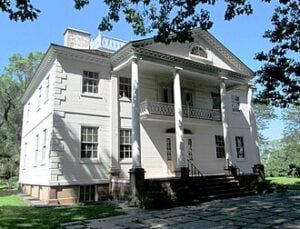
Beyond My Ken, CC BY-SA 4.0 <https://creativecommons.org/licenses/by-sa/4.0>, via Wikimedia Commons
Location: 65 Jumel Terrace, Manhattan
Built: Around 1765
Architectural style: Palladian-inspired Georgian
Perched on a hill in Washington Heights, the Morris-Jumel Mansion is Manhattan’s oldest surviving residence. British Colonel Roger Morris and his wife, Mary Philipse Morris, built the house as a summer retreat on an estate originally known as Mount Morris.
During the Revolutionary War, General George Washington used the house as his headquarters during the 1776 campaign surrounding the Battle of Harlem Heights. Washington returned in 1790 for a dinner attended by members of his future cabinet.
French wine merchant Stephen Jumel and his wife, Eliza, purchased the mansion in 1810. After Stephen’s death, Eliza married former Vice President Aaron Burr in the front parlor in 1833. The marriage quickly deteriorated, and Eliza later filed for divorce.
Visitor information: The mansion’s interior is temporarily closed during a roof-replacement and restoration project. The surrounding park remains open, and the museum continues to offer selected weekend walking tours, outdoor events, and community programs. Reopening is expected sometime in fall 2026, so visitors should check the museum’s current schedule before traveling.
3. Bartow-Pell Mansion Museum and Gardens
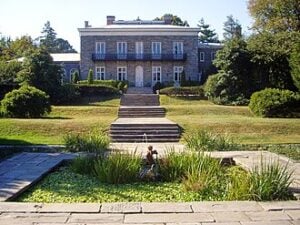
Dmadeo, CC BY-SA 3.0 <https://creativecommons.org/licenses/by-sa/3.0>, via Wikimedia Commons
Location: 895 Shore Road, Pelham Bay Park, the Bronx
Built: 1836–1842
Architectural style: Late Federal exterior with Greek Revival interiors
Set inside Pelham Bay Park, New York City’s largest public park, Bartow-Pell offers a rare glimpse of the country estates that once lined the shores of what is now the Bronx.
The land formed part of a vast tract connected to Thomas Pell and the colonial Manor of Pelham. Robert Bartow, a Pell descendant, and his wife, Maria Lorillard Bartow, acquired the property in 1836 and completed the present mansion and carriage house by 1842.
The Bartow family remained until 1888, when New York City acquired the estate while assembling Pelham Bay Park. The International Garden Club later restored the mansion, and the architectural firm Delano & Aldrich designed the formal gardens. The house opened as a public museum in 1946.
Visitors can explore period rooms, the carriage house, formal terraced gardens, and grounds overlooking Long Island Sound.
Visitor information: The mansion and carriage house are normally open for walk-in visits on Wednesdays, Saturdays, and Sundays from noon to 4 p.m. Guided tours generally begin shortly after each hour.
4. Gracie Mansion
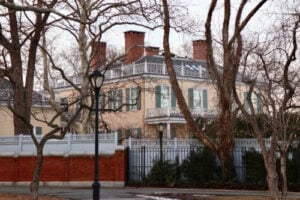
Location: East 88th Street and East End Avenue in Carl Schurz Park, Manhattan
Built: 1799
Architectural style: Federal
Gracie Mansion is one of Manhattan’s oldest surviving wooden houses and has served as the official residence of New York City’s mayor since 1942.
Scottish-born merchant Archibald Gracie built the country house on a bend of the East River overlooking the dangerous tidal waters of Hell Gate. The property stood far north of the developed city at the time and served as a retreat where Gracie entertained prominent political and business figures.
After passing through several owners, the estate became city property in 1896 and was incorporated into what became Carl Schurz Park. The mansion later housed the Museum of the City of New York before Parks Commissioner Robert Moses helped have it designated as the mayor’s official residence. Fiorello La Guardia and his family moved in during 1942.
Visitor information: Public tours are currently paused while the Gracie Mansion Conservancy plans its next period of public programming. The exterior can still be seen from Carl Schurz Park, but visitors should not expect interior access until tours are formally resumed.
5. Van Cortlandt House Museum
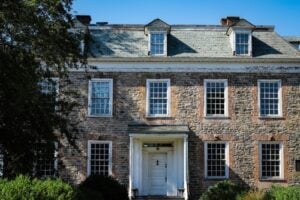
Location: Broadway at West 246th Street in Van Cortlandt Park, the Bronx
Built: 1748–1749
Architectural style: Georgian colonial fieldstone
The oldest surviving building in the Bronx, Van Cortlandt House was built by Frederick Van Cortlandt as the center of a large working plantation. The estate produced wheat, rye, corn, and other crops, and its prosperity depended in part on the labor of enslaved Africans held by generations of the Van Cortlandt family.
During the Revolutionary War, the estate stood on contested ground and was occupied at different times by British and American forces. George Washington stayed at the house in 1776 and returned in 1783 before the triumphant American entry into Manhattan after the British evacuation.
New York City acquired the property in the late nineteenth century, and the house opened as a museum in 1897. Its rooms now interpret the intertwined histories of the Van Cortlandt family, enslaved people, servants, soldiers, and laborers connected to the estate.
Visitor information: The museum is normally open for self-guided tours Wednesday through Sunday from 11 a.m. to 4 p.m., with last entry at 3:30 p.m.
6. Merchant’s House Museum
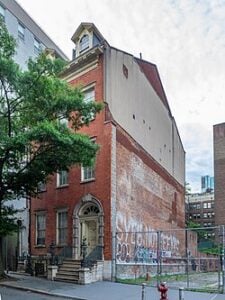
Ajay Suresh from New York, NY, USA, CC BY 2.0 <https://creativecommons.org/licenses/by/2.0>, via Wikimedia Commons
Location: 29 East 4th Street, Manhattan
Built: 1832
Architectural style: Late Federal and Greek Revival
The Merchant’s House Museum is one of New York City’s most complete architectural time capsules. The red-brick row house was built in 1832 and purchased three years later by retired hardware merchant Seabury Tredwell.
The Tredwell family lived there for nearly a century. When the house became a museum in 1936, it retained an extraordinary collection of original family possessions, including furniture, clothing, household goods, lighting fixtures, decorative arts, and personal objects.
Unlike a mansion reconstructed with furnishings gathered from other places, the Merchant’s House preserves the belongings of the family that actually occupied it. Its parlors, bedrooms, servants’ areas, and kitchen provide a remarkably intimate view of domestic life in nineteenth-century Manhattan.
Visitor information: The museum remains open during restoration work. Regular self-guided visiting hours are generally Thursday through Sunday from 1 to 5 p.m., with last entry at 4:30 p.m.
7. King Manor Museum
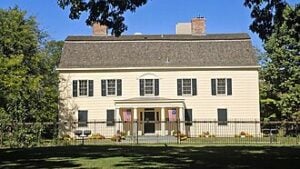
CaptJayRuffins, CC BY-SA 4.0 <https://creativecommons.org/licenses/by-sa/4.0>, via Wikimedia Commons
Location: 150-03 Jamaica Avenue in Rufus King Park, Queens
Built: Eighteenth century, with major additions after 1805
Architectural style: Georgian farmhouse with Federal-era additions
King Manor was the country home of Rufus King, a signer of the United States Constitution, United States senator, ambassador to Great Britain, and prominent opponent of the expansion of slavery.
King and his wife purchased the existing farmhouse and approximately 90 acres in 1805. They enlarged the house and developed the property into a working farm and landscaped estate. The farm eventually grew to approximately 122 acres.
King delivered major Senate speeches opposing Missouri’s admission as a slave state. His son, John Alsop King, later served as a congressman and governor of New York. The house remained in the family until 1896 and opened as a museum in 1900.
Today, King Manor interprets the political legacy of Rufus King, antislavery history, the Constitution, agriculture, and domestic life in nineteenth-century Jamaica.
Visitor information: Guided tours are generally offered every hour from noon to 4 p.m., Tuesday through Saturday. Reservations are encouraged but are not usually required.
8. The Old Stone House
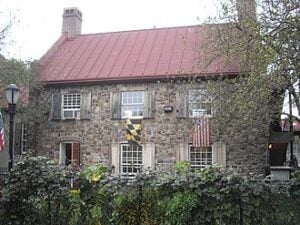
Dmadeo, CC BY-SA 3.0 <https://creativecommons.org/licenses/by-sa/3.0>, via Wikimedia Commons
Location: 336 Third Street in Washington Park, Brooklyn
Original house built: 1699
Present reconstruction completed: 1934
Architectural style: Dutch Colonial reconstruction
The Old Stone House is a reconstruction of the Vechte-Cortelyou farmhouse, which originally stood nearby and played a central role in the Battle of Brooklyn in August 1776.
During the battle, approximately 400 Maryland troops repeatedly attacked a much larger British and Hessian force near the house. Their rear-guard action delayed the enemy and helped other American soldiers escape toward the fortified positions at Brooklyn Heights.
The original farmhouse disappeared during Brooklyn’s nineteenth-century development. The present building was reconstructed in the 1930s using stones recovered from the original site. It now serves as a museum, educational center, cultural venue, and neighborhood gathering place.
Visitor information: The Old Stone House is generally open Friday through Sunday from noon to 4 p.m. and at other times by appointment.
9. The Conference House
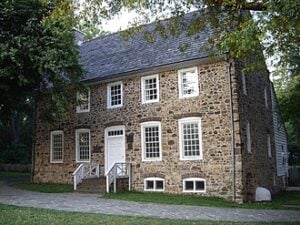
I, Dmadeo, CC BY-SA 3.0 <http://creativecommons.org/licenses/by-sa/3.0/>, via Wikimedia Commons
Location: 7455 Hylan Boulevard, Tottenville, Staten Island
Built: Around 1680
Architectural style: Colonial fieldstone
Standing near the southern tip of Staten Island, the Conference House was built by English immigrant and naval officer Captain Christopher Billopp. The two-story stone residence originally formed part of a working wheat farm overlooking the Arthur Kill and Raritan Bay.
The house entered American history on September 11, 1776, when British Admiral Lord Richard Howe met there with Continental Congress representatives John Adams, Benjamin Franklin, and Edward Rutledge.
The meeting was an attempt to find a negotiated end to the Revolutionary War. Howe could not recognize American independence, while the congressional delegation had no authority to accept terms that failed to include it. The conference ended without an agreement.
Visitor information: The Conference House normally offers interior tours on Saturdays and Sundays from noon to 4 p.m. during its operating season, which generally runs from spring into December.
10. Cooper Hewitt in the Andrew Carnegie Mansion
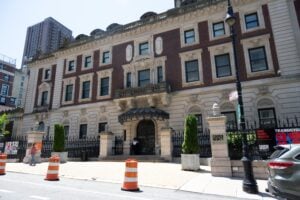
Location: 2 East 91st Street, Manhattan
Built: 1899–1902
Architectural style: English Georgian Revival
Industrialist and philanthropist Andrew Carnegie commissioned this 64-room mansion as a spacious but comfortable family home. The architectural firm Babb, Cook & Willard designed it in the style of an English Georgian country house.
The building was technologically extraordinary for its time. It was the first private residence in the United States constructed with a structural steel frame and one of New York’s earliest private homes with a passenger elevator. It also included central heating, an early air-conditioning system, and a miniature rail system that transported coal to its boilers.
Carnegie deliberately built far north of the fashionable residential district occupied by many of his wealthy contemporaries. The mansion and its large enclosed garden helped establish the neighborhood now known as Carnegie Hill.
The Smithsonian opened the building as the Cooper-Hewitt Museum in 1976. Today, Cooper Hewitt is the nation’s museum devoted to historic and contemporary design.
Visitor information: The museum, shop, and garden are generally open daily from 10 a.m. to 6 p.m. The museum offers pay-what-you-wish admission during the final hour of each day.
Planning a Historic House Tour in New York City
These sites are spread across all five boroughs, and several are inside large public parks. It is usually better to plan one or two houses per day rather than attempt to visit the entire list at once.
Hours at historic house museums can change more often than those at major institutions. Seasonal closures, restoration projects, private events, and limited staffing may affect access. Morris-Jumel Mansion and Gracie Mansion are especially important examples because both currently have restrictions on interior tours.
Many of the properties are members of the Historic House Trust of New York City, a partnership that works with NYC Parks and individual nonprofit organizations to preserve the city’s publicly owned historic houses.
NYC Historic Mansions and Homes at a Glance
| Historic house | Borough | Era or focus | Current access |
|---|---|---|---|
| The Frick Collection | Manhattan | Gilded Age art and architecture | Open as an art museum; closed Tuesdays |
| Morris-Jumel Mansion | Manhattan | Colonial and Revolutionary War history | Interior temporarily closed; outdoor programs and walking tours continue |
| Bartow-Pell Mansion | The Bronx | Nineteenth-century country estate | Open Wednesdays, Saturdays, and Sundays |
| Gracie Mansion | Manhattan | Federal architecture and mayoral history | Public tours currently paused |
| Van Cortlandt House | The Bronx | Colonial plantation and Revolutionary War history | Open Wednesday through Sunday |
| Merchant’s House Museum | Manhattan | Nineteenth-century family and domestic life | Open Thursday through Sunday during restoration |
| King Manor Museum | Queens | Constitutional and antislavery history | Tours Tuesday through Saturday |
| Old Stone House | Brooklyn | Battle of Brooklyn | Open Friday through Sunday |
| Conference House | Staten Island | Revolutionary War diplomacy | Seasonal weekend tours |
| Cooper Hewitt | Manhattan | Gilded Age innovation and design | Open daily |
More New York City Building and Revolutionary War History
Readers interested in New York’s surviving architecture can continue with our guide to the 10 oldest surviving buildings in New York City, our look at the famous New York City landmarks that were lost and what replaced them, and our feature on the history of New York’s spite houses and tiny homes. For more Revolutionary War history, explore our history of Fraunces Tavern.
Updated August 4, 2026.
10 Historic Mansions and Homes You Can Visit in NYC article published on ClassicNewYorkHistory.com © 2026