Featured Photo: Detroit Publishing Company, Public domain, via Wikimedia Commons
As a New Yorker, it always hurts me to see a historic building, statue, or playground torn down for another purpose, usually an apartment building or an office tower. Even when something is demolished and replaced with a modern version, an old playground set is swapped out, or a beloved fountain is rebuilt, it still stings to watch the past disappear in front of my eyes. I understand that a living city has to keep moving forward, but that understanding never quite kills the ache.
New York is a metropolis built on relentless reinvention. In the pursuit of taller skyscrapers, faster transit, and more valuable real estate, the city has often shown little mercy to its architectural past.
Before the landmark preservation movement gained real legal power during the 1960s, Beaux-Arts train stations, Gilded Age mansions, grand newspaper towers, and enormous theaters were routinely reduced to rubble. In many cases, the heartbreaking loss of these structures finally forced New Yorkers to stand up and protect what remained of their architectural heritage.
Here are 10 of the most famous lost landmarks in New York City history, the stories behind their demolitions or destruction, and what occupies their sites today.
A quick note before we begin: If you are wondering why the Polo Grounds, Ebbets Field, and the original Yankee Stadium are not included, it is not because we forgot them. Those iconic ballparks meant too much to too many New Yorkers to be squeezed into a general roundup, so the lost sports arenas of New York will receive their own dedicated article. They deserve their own place, just as they had in our hearts.
The Turning Point: The Loss That Changed Preservation in New York
Many historic buildings were demolished before the 1960s, and preservation efforts in New York had already begun taking shape. Still, no single loss became a more powerful symbol than the destruction of the original Pennsylvania Station.
The public outrage surrounding Penn Station helped build support for the New York City Landmarks Law, which Mayor Robert F. Wagner Jr. signed on April 19, 1965. The law gave the Landmarks Preservation Commission permanent authority to identify and protect significant buildings, sites, and historic districts.
Without the preservation movement strengthened by the loss of Penn Station and other threatened structures, neighborhoods such as SoHo, Brooklyn Heights, and Greenwich Village might have suffered far greater destruction.
There is a bitter irony in all of this. We so often fail to appreciate what we have until the moment it is gone, and only then do we resolve to protect everything else.
1. The Original Pennsylvania Station
Cervin Robinson, Public domain, via Wikimedia Commons
Location: Midtown Manhattan
Built: 1910
Demolished: 1963–1966
Architects: McKim, Mead & White
What Replaced It: Madison Square Garden, Penn 2, and the underground Penn Station
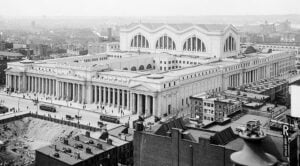
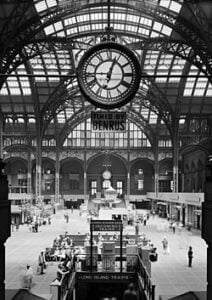
Designed by Charles Follen McKim, the original Penn Station was a breathtaking Beaux-Arts masterpiece covering approximately eight acres between Seventh and Eighth Avenues and West 31st and 33rd Streets. Inspired by the ancient Baths of Caracalla in Rome, it featured immense granite colonnades, vaulted glass-and-steel train sheds, and a monumental waiting room framed by 84-foot Corinthian columns.
Walking into that great room must have felt like entering a civic cathedral. Sunlight poured through the glass and steel, and every traveler, rich or poor, was given a grand entrance into the largest city in the nation.
As passenger rail travel declined during the automobile and airline boom of the 1950s, the financially troubled Pennsylvania Railroad pursued a plan to sell the station’s air rights. Despite furious protests by architects, writers, and preservationists, demolition began in October 1963 and continued into 1966. Much of the masonry was dumped in the New Jersey Meadowlands.
Architectural historian Vincent Scully famously observed that travelers once entered the city like gods and were later forced to scurry in like rats. Madison Square Garden and the office building now known as Penn 2 rose above a cramped underground station that opened in its redesigned form in 1968.
The opening of Moynihan Train Hall and continuing improvements around the Penn District have restored some light and dignity to the travel experience, but nothing can recreate the grandeur of the building New York willingly destroyed.
2. The Singer Building
Public domain, via Wikimedia Commons
Location: Financial District
Built: 1908
Demolished: 1967–1969
Architect: Ernest Flagg
What Replaced It: One Liberty Plaza
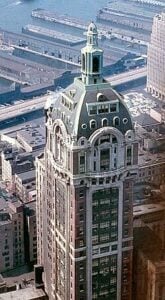
Rising 612 feet above Broadway and Liberty Street, the 47-story Singer Building served as the headquarters of the Singer Manufacturing Company. Upon its completion in 1908, it briefly held the title of the tallest building in the world.
Architect Ernest Flagg gave the tower a slender shaft crowned with a richly detailed mansard roof. Its marble-and-bronze lobby looked more like the entrance to a European opera house than a corporate office building. The Singer Building proved that a skyscraper could be both practical and beautiful.
By the 1960s, however, its owners considered the tower’s relatively small floor plates inefficient for modern office tenants. The building was demolished along with the adjoining City Investing Building to clear a much larger site for One Liberty Plaza.
For decades, the Singer Building was the tallest structure ever deliberately demolished by its owner. That record was eventually surpassed by the demolition of the former Union Carbide Building at 270 Park Avenue. The Singer Building nevertheless remains one of the most painful examples of New York sacrificing architectural artistry for additional office space.
3. The Original Waldorf-Astoria Hotel
Public domain, via Wikimedia Commons
Location: Midtown Manhattan
Built: 1893 and 1897
Demolished: 1929
Architect: Henry Janeway Hardenbergh
What Replaced It: Empire State Building
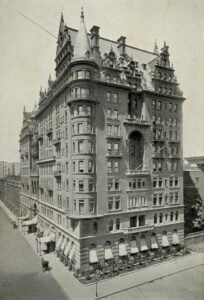
Before the Waldorf-Astoria moved to Park Avenue, the original hotel stood on Fifth Avenue between West 33rd and 34th Streets. It began as two neighboring hotels created by feuding branches of the Astor family. William Waldorf Astor opened the Waldorf in 1893, and John Jacob Astor IV answered with the connecting Astoria in 1897.
The combined hotel became one of the defining social institutions of the Gilded Age. It was famous for Peacock Alley, the long promenade where the wealthy went to see and be seen, and for a level of luxury that helped redefine the modern American hotel.
The original Waldorf-Astoria also became associated with dishes and drinks that outlived the building, most famously the Waldorf salad. Its public rooms hosted political gatherings, charity events, society dinners, and some of the most powerful people of the era.
By the late 1920s, fashionable New York had moved farther uptown, and the land beneath the hotel had become extraordinarily valuable. The property was sold and demolished in 1929, clearing the site for the Empire State Building.
There is something almost fitting about that exchange, one monument to American ambition giving way to another. Still, the rise of the Empire State Building does not erase the loss of the hotel that once defined New York society.
4. The New York Hippodrome
Miscellaneous Items in High Demand, PPOC, Library of Congress, Public domain, via Wikimedia Commons
Location: Midtown Manhattan
Built: 1905
Demolished: 1939
Architects: Frederic Thompson and Jay H. Morgan
What Replaced It: The office building at 1120 Avenue of the Americas
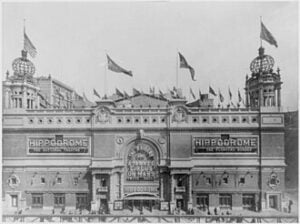
Advertised as the largest theater in the world, the New York Hippodrome occupied the eastern blockfront of Sixth Avenue between West 43rd and 44th Streets. It seated more than 5,000 spectators and possessed a stage large enough to accommodate enormous casts, circus animals, elaborate machinery, and mass spectacles that no ordinary Broadway theater could attempt.
Its most astonishing technical feature was a hydraulic water tank built into the stage floor. The tank allowed divers, swimmers, boats, and aquatic choruses to appear and disappear as part of live productions.
The Hippodrome became associated with circus spectacles, musical revues, patriotic pageants, and larger-than-life entertainment. In 1918, Harry Houdini famously made an elephant named Jennie disappear before a packed audience.
Changing entertainment tastes, high operating costs, and the Great Depression gradually weakened the theater. It was demolished in 1939. The present office building, completed in the early 1950s, still carries the Hippodrome name at 1120 Avenue of the Americas.
There is something especially sad about a theater capable of making elephants vanish being replaced by an ordinary office building. It tells us how carelessly the city once treated its own magic.
5. The William K. Vanderbilt House, the Petit Chateau
Location: Fifth Avenue and West 52nd Street
Built: 1882
Demolished: 1927
Architect: Richard Morris Hunt
What Replaced It: Commercial buildings at 660 Fifth Avenue
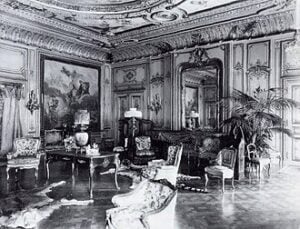
Located on the northwest corner of Fifth Avenue and West 52nd Street, the William Kissam Vanderbilt House was a magnificent French Renaissance-style mansion commissioned by Vanderbilt and his socially ambitious wife, Alva.
Designed by Richard Morris Hunt, the limestone palace became known as the Petit Chateau. Its towers, steep rooflines, carved ornament, and lavish interiors helped establish the Châteauesque style as the preferred architectural language of New York’s new industrial aristocracy.
In March 1883, Alva Vanderbilt held her legendary masquerade ball for approximately 1,200 guests. The event became one of the most famous social gatherings of the Gilded Age and helped force Caroline Astor, the reigning queen of New York society, to acknowledge the Vanderbilt family.
As Fifth Avenue changed from a residential avenue into a commercial corridor, the mansion was sold in 1926 and demolished the following year. A commercial building first replaced it, and the current office tower at 660 Fifth Avenue now occupies the site.
A mansion that helped reorder New York society survived for barely more than four decades.
6. The Cornelius Vanderbilt II Mansion
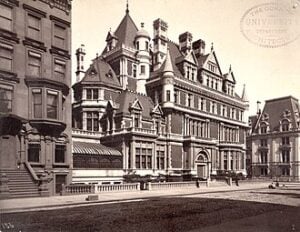
Location: Fifth Avenue between West 57th and 58th Streets
Built: 1883; expanded in 1894
Demolished: 1927
Architects: George B. Post and Richard Morris Hunt
What Replaced It: Bergdorf Goodman
The Cornelius Vanderbilt II Mansion occupied the west side of Fifth Avenue between West 57th and 58th Streets, directly across from the future Plaza Hotel. With approximately 130 rooms, it became the largest private residence ever constructed in New York City.
The house began as an imposing mansion designed by George B. Post and was expanded during the 1890s with work by Richard Morris Hunt. Its interiors contained grand staircases, ballrooms, imported stonework, European antiques, and decorative arts gathered on a scale almost impossible to imagine today.
An entire stretch of Fifth Avenue belonged to one family. Where shoppers now move through luxury retail floors, the Vanderbilts once lived behind the walls of a private palace.
Rising property taxes and the northward expansion of commercial Fifth Avenue made the house increasingly impractical. It was sold in 1926 and demolished in 1927. Bergdorf Goodman opened its present store on the site in 1928.
7. The Brokaw Mansions
Location: Fifth Avenue and East 79th Street
Built: 1887–1905
Demolished: Principally in 1965, with the final adjoining Brokaw houses removed later in the 1960s
Architects: Rose & Stone
What Replaced Them: Apartment buildings at 980 and 985 Fifth Avenue
The Brokaw Mansions formed a remarkable group of French-inspired houses near the northeast corner of Fifth Avenue and East 79th Street. Clothing manufacturer Isaac Vail Brokaw commissioned the principal mansion for himself and additional houses for members of his family.
With their turrets, steep slate roofs, carved limestone, stained glass, and Gothic detailing, the houses framed the entrance to the Upper East Side like a scene transported from the Loire Valley.
Developers acquired the main Brokaw properties during the early 1960s. Preservationists appealed to city officials, but the city still lacked an effective landmarks law. The principal mansion and adjoining houses were demolished in February 1965, while the remaining Brokaw houses along Fifth Avenue disappeared later in the decade.
The apartment towers at 980 and 985 Fifth Avenue now occupy the former Brokaw sites. The public battle over the mansions helped move the pending landmarks legislation forward, giving the buildings a tragic place in preservation history. They could not be saved, but their destruction helped save others.
8. The New York World Building
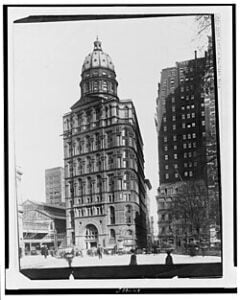
Miscellaneous Items in High Demand, PPOC, Library of Congress, Public domain, via Wikimedia Commons
Location: Park Row near City Hall
Built: 1890
Demolished: 1955–1956
Architect: George B. Post
What Replaced It: Brooklyn Bridge approach ramps
Commissioned by publisher Joseph Pulitzer as the headquarters of The New York World, the World Building rose above Park Row with a great gilded copper dome. Pulitzer placed his own office high inside the dome, looking over City Hall, the East River, and the Brooklyn Bridge.
The building became one of the defining structures of Newspaper Row, where the World, Tribune, Times, and other papers competed in the center of American journalism. Its completion in 1890 announced the power of the mass-circulation press in unmistakable architectural form.
Plans to redesign the Manhattan approach to the Brooklyn Bridge placed the World Building directly in the path of new automobile ramps. Demolition began in 1955, and the site was largely cleared by 1956.
A monument to the power of journalism was sacrificed to create more room for automobile traffic. Few exchanges better summarize the priorities of mid-20th-century urban planning.
9. The Astor House
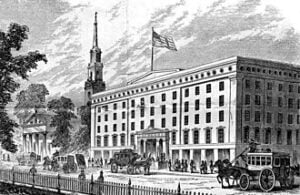
Astor House ; digitalised and put online with “Courtesy of Special Collections, University of Houston Libraries.”, Public domain, via Wikimedia Commons
Location: Broadway between Barclay and Vesey Streets
Built: 1836
Demolished: In stages during 1913 and 1926
Architect: Isaiah Rogers
What Replaced It: Commercial office buildings, including the Transportation Building at 225 Broadway
Standing opposite City Hall Park, the Astor House was New York City’s first great luxury hotel. John Jacob Astor commissioned the Quincy-granite building at a time when modern hotel service was still a new idea.
The Astor House offered indoor plumbing, gas lighting, spacious public rooms, hundreds of guest rooms, and a central courtyard. It became the preferred Manhattan address for presidents, visiting dignitaries, writers, actors, military officers, and business leaders throughout much of the 19th century.
Its most historic moment came in February 1861, when President-elect Abraham Lincoln appeared before a crowd during his journey to Washington for his inauguration.
The hotel closed in 1913. Its southern portion was demolished that year, while the remaining northern section survived until 1926. The Transportation Building at 225 Broadway, completed in 1927, occupies part of the former hotel site.
That a building connected with Lincoln and generations of national history could disappear in stages with so little protection is a sobering reminder of how much New York allowed to slip away.
10. The New York Crystal Palace
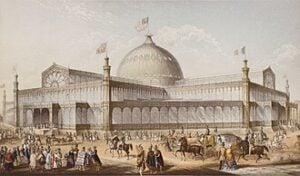
Location: Reservoir Square, now Bryant Park
Built: 1853
Destroyed by Fire: October 5, 1858
Architects: Georg Carstensen and Charles Gildemeister
What Occupies the Site Today: Bryant Park
Inspired by London’s Crystal Palace, New York’s iron-and-glass exhibition hall rose on Reservoir Square, immediately west of the Croton Reservoir that once occupied the site of the New York Public Library.
The building was arranged in the form of a Greek cross and crowned by a dome approximately 100 feet in diameter. It opened for the Exhibition of the Industry of All Nations, one of the earliest international exhibitions held in the United States.
In 1854, inventor Elisha Otis staged the demonstration that changed the future of cities. Standing on a raised platform, he ordered the supporting rope cut. His safety brake caught the platform after a short drop, proving that an elevator could survive a cable failure.
That demonstration made safe passenger elevators commercially believable and helped make the future skyscraper city possible.
On October 5, 1858, the Crystal Palace caught fire during an exhibition and burned to the ground with astonishing speed. The site remained public land and eventually became Bryant Park.
The building that had displayed the technology of the future vanished in a single afternoon. Not every landmark is lost to a wrecking ball. Some disappear in smoke and flame before a city has time to understand what it is losing.
10 Lost New York City Landmarks at a Glance
| Lost Landmark | Year Lost | What Occupies the Site Today |
|---|---|---|
| 1. Original Pennsylvania Station | 1963–1966 | Madison Square Garden, Penn 2, and the underground Penn Station |
| 2. Singer Building | 1967–1969 | One Liberty Plaza |
| 3. Original Waldorf-Astoria | 1929 | Empire State Building |
| 4. New York Hippodrome | 1939 | 1120 Avenue of the Americas, the Hippodrome Building |
| 5. William K. Vanderbilt House | 1927 | 660 Fifth Avenue |
| 6. Cornelius Vanderbilt II Mansion | 1927 | Bergdorf Goodman |
| 7. Brokaw Mansions | 1965–1968 | 980 and 985 Fifth Avenue |
| 8. New York World Building | 1955–1956 | Brooklyn Bridge approach ramps |
| 9. Astor House | 1913–1926 | Commercial office buildings, including 225 Broadway |
| 10. New York Crystal Palace | 1858 | Bryant Park |
Classic New York History Tip: Visitors to the Brooklyn Museum’s Steinberg Family Sculpture Garden can see the monumental Night clock figure and a massive column fragment salvaged from the original Penn Station. An original Penn Station eagle was also returned to public display near Penn 2 in the Penn District in 2025.
Continue exploring New York’s architectural history on ClassicNewYorkHistory.com with our in-depth features on the history of Penn Station, the Empire State Building, the Brooklyn Bridge, and Bryant Park.