Standing high above the Saranac River in Plattsburgh, New York, the Macdonough Monument honors one of the greatest naval victories in American history. Built in tribute to Commodore Thomas Macdonough and his decisive leadership during the Battle of Plattsburgh in the War of 1812, the monument serves as a lasting reminder of the courage and determination that helped shape the young United States. Today, visitors can admire both the impressive monument and the historic landscape where one of New York’s most important military victories unfolded.
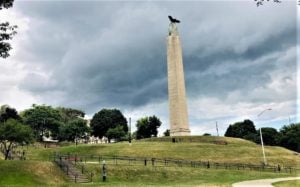
Macdonough Monument – Photo: Brian Kachejian ©2019
The Macdonough Monument majestically stands overlooking the Saranac River in the historic city of Plattsburgh, New York. The Macdonough Monument was erected in tribute to United States Naval Officer Thomas Macdonough. The brilliant naval officer began his military career in the United States Navy in 1800. Born on New Year’s Eve in 1783, Thomas Macdonough became an orphan by the age of twelve. His father had served in the American Revolution.
Thomas Macdonough’s Early Naval Career
Thomas Macdonough began his Navy career at a young age. At sixteen, he served as a junior officer in the Navy. Thomas Macdonough’s career led him to serve during the Barbary War. It was a conflict that pitted the United States, beginning with the presidency of Thomas Jefferson, against pirates supported by the nations of Algiers, Morocco, Tunis, and Tripoli. Thomas Macdonough later became captain of the merchant ship Gullivar, transporting goods between England, New York, and India. Upon hearing of the outbreak of war between the United States and Britain in 1812, Thomas Macdonough returned to New York to become one of the most important figures in United States history.
The Battle Of Plattsburgh
When Thomas Macdonough returned to New York, he was placed in charge of the naval forces stationed at Lake Champlain. While the War of 1812 between Britain and the United States raged on, Thomas Macdonough oversaw the building of new United States naval vessels. The capture and surrender of many American ships during the war fueled the need to build new vessels and convert other ships into warships.
During the Battle of Plattsburgh in 1814, Thomas Macdonough commanded his naval fleet against the British, who had sailed south from Canada. British soldiers under the command of George Prevost were simultaneously preparing to attack Plattsburgh by land. At the time, the United States had only about 2,000 soldiers under the command of General Alexander Macomb. Thomas Macdonough understood that protecting the city was vital because a defeat on both land and water would have had devastating consequences for the American war effort.
Commanding the British fleet was Captain George Downie, an experienced naval officer who had enjoyed great success during Britain’s war with France. Heading into the Battle of Plattsburgh, Captain Downie commanded Britain’s flagship, HMS Confiance.
Thomas Macdonough’s fleet met Downie’s fleet on September 11, 1814. In a moment that changed the course of history, a cannonball fired from Macdonough’s fleet struck a mounted cannon aboard HMS Confiance. The cannon crashed onto Captain Downie, killing him instantly. Recognizing the opportunity, Thomas Macdonough skillfully maneuvered his flagship into position and unleashed a devastating broadside against HMS Confiance, forcing the British flagship to surrender.
With HMS Confiance out of the battle, the remaining British ships were overwhelmed by the American fleet, resulting in a decisive American victory at the Battle of Plattsburgh. The British withdrew into Canada, and the victory helped pave the way toward the negotiations that ultimately brought an end to the War of 1812.
The Macdonough Monument
In honor of Thomas Macdonough’s heroic victory during the Battle of Plattsburgh, the Macdonough Monument was dedicated in 1926. More than 7,000 people attended the dedication ceremony. Plans for the monument had first been proposed in 1896. The monument was designed by renowned architect John Russell Pope, who would later become famous for designing the Jefferson Memorial and the National Archives Building in Washington, D.C.
The Macdonough Monument stands in the park directly across from Plattsburgh City Hall. It overlooks the Saranac River, which flows into Cumberland Bay before joining Lake Champlain.

Macdonough Monument – Photo: Brian Kachejian ©2019
The Macdonough Monument rises 135 feet into the sky. Inscribed at its base are the names of the ships under Macdonough’s command: Saratoga, Ticonderoga, Eagle, and Preble. Pope constructed the monument from Indiana limestone, and its summit features a bronze eagle with an impressive wingspan of twenty feet.
The monument stands in a beautifully landscaped park offering spectacular views of both the memorial and the Saranac River. Standing before this remarkable monument, it is impossible not to reflect on the battle that unfolded here more than two centuries ago and the men whose courage helped preserve the young nation.
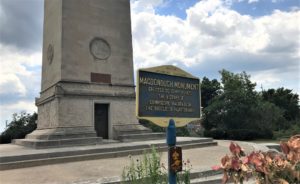
Macdonough Monument – Photo: Brian Kachejian ©2019
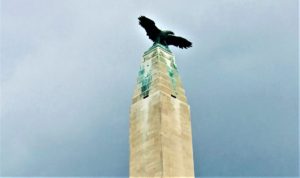
Macdonough Monument – Photo: Brian Kachejian ©2019
Related Articles
If you enjoyed learning about the Macdonough Monument, be sure to explore more of ClassicNewYorkHistory.com’s stories on New York’s military and historic landmarks, including The History of Fort Ticonderoga, The History of Crown Point State Historic Site, The History of the Battle of Saratoga, How the Taverns of New York City Stirred the American Revolution, and The History of Lake Champlain.
Updated June 29, 2026.
Sources:
Eisenstadt, P. E. (2005). The Encyclopedia of New York State. Syracuse, NY: Syracuse University Press. p. 939.