
Photo: New York Public Library – Full Credit below article
B.Altman and Company department stores were a popular shopping destination for more than 100 years. Native New Yorkers and visitors would trek to their locations to find great deals on quality merchandise. Unfortunately, the company no longer exists. Many people still have some of their popular products in their homes more than 30 years after their last store closed.
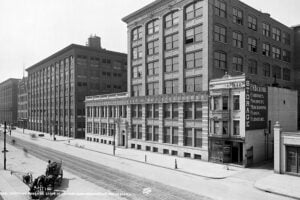
The company was founded by Benjamin Altman in 1865. His first store opened that year on the corner of 10th Street and Third Avenue in Manhattan. The store was moved to 621 Sixth Avenue in 1877. The new Neo-Grec building was initially designed by architects John and David Jardine. Later additions and extensions were designed by William Hume, Albert Buchman and Mortimer Fox. The facility was constructed in four stages. It would later be known as the “Palace of Trade” by faithful customers.
Altman’s continued to grow in the early 20th century to meet the needs for additional retail space. It moved once again in 1906, this time to midtown Manhattan. The B. Altman and Company Building encompassed much of 34th and 35th Streets. The extensions and original building were created in the Italian Renaissance style by the architectural firm Trowbridge & Livingston. It was the first major department store in New York City that wasn’t in the popular “Ladies Mile” Manhattan shopping district. Other competitors would soon follow in later years.
The impressive new store had eight floors of retail space. Men’s clothes, toiletries, handbags, perfumes and other notions were sold on the first floor. The second floor was dedicated to shoes and children’s apparel. The third floor featured the latest fashions by Versace, Geoffrey Beene and many others, as well as activewear, coats, blouses and dresses. Bedding, glassware, fine china, curtains, collectibles and other related products were located on the fourth floor. The fifth floor was where many shoppers went to find cutlery, kitchenware, utensils, books, plants, lamps, candles and travel services. The sixth floor stored designer coats, dresses and related items for young men and women. Art, furniture, Charleston Town House products and American Gallery items were on the seventh floors. Customers could find the latest music, toys sporting goods and games on the eighth floors. They could also relax in the tea room or enjoy a nice meal in the Charleston Garden Restaurant.
Benjamin Altman passed away in 1913. His shares of company stock would be put into the Altman Foundation after his death. His extensive art collection was eventually donated to the Metropolitan Museum of Art in New York City. Altman’s will stated that the artworks he collected will be listed as a gift from him and that all of the pieces should be made available for the public to view.
Altman was frequently described as a “humane businessman.” He was rather reserved and quiet. He genuinely cared about his employees. Benjamin was a strong supporter of closing the company on Saturdays and reduced working hours so that workers had more time to spend with their family and friends. He also ensured that all employees had equal access to education, lunch and break rooms and tidy restrooms.
Benjamin’s cousin Michael Friedsam took over the company after Altman’s death. Friedsam had been with the business since 1979 and was also an avid art collector. The organization’s board of directors promoted vice president John Burke to president of the company after Friedsam’s passing in 1931. Burke would remain company president until he retired in 1955. Both Friedsam and Burke followed Altman’s traditions of giving back to the community.
Additional Altman’s locations opened in East Orange, New Jersey; Manhasset, New York and White Plains, New York in the 1930’s. Their stores were known for providing high-quality merchandise at affordable prices. Their unique Charleston Gardens restaurants and lavish Christmas display windows attracted shoppers from hundreds of miles around.
John Burke Jr. assumed the role of Altman’s chief executive officer. He served in that role until 1986. Under his tenure, new stores were opened in Paramus, New Jersey; Radnor, Pennsylvania and Short Hills, New Jersey in the mid-1950’s.
The Altman Foundation sold the department store chain to an investment group in 1986. This was necessitated by a new tax rule that prohibited charitable organizations from owning operations that were their sources of income. Several members of the Delotte & Touche financial company and the Gucci family were part of that group. It was rumored that this group planned on renting out the top floors of Altman’s Manhattan location and reducing their workforce. A year later, the controlling interest in B. Altman & Company was acquired by LJ Hooker, an Australian real estate development business.
LJ Hooker’s chief executive officer at the time was George Herscu. Altman’s stores would soon be used as anchor stores in expensive new shopping centers that were often in less than optimal locations. The company had a progressive approach, but unfortunately didn’t quite know how to properly run retail outlets. Stores were opened without considering demographic research or effective marketing strategies. Additional locations in Cincinnati, Ohio; Buffalo, New York and Syracuse, New York were planned but never fully developed, due to the company’s poor financial performance.
Altman’s stores’ sales started to sag significantly toward the end of the 1980’s. The company filed for bankruptcy protection in August 1989. All Altman’s locations were closed by the end of 1990. Some stores were later converted into other retail outlets such as Adam, Meldrum & Anderson Company (AM&A’s) and Bon-Ton. A few mall outlets were redesigned to add retail space while others were torn down to make way for other commercial buildings.
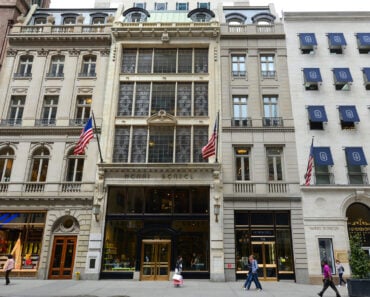
The Fifth Avenue Altman’s location was designated a landmark by New York City in 1985. After the company went out of business, the building remained empty until 1996. The Gwathmey Siegel & Associates and Hardy Holzman Pfeiffer architectural firms redesigned the interior and exterior of the former Altman’s store. The Oxford University Press and the New York’ Public Library’s Science, Industry and Business Library would occupy the Fifth Avenue section of the building, while the City University of New York’s Graduate Center moved into the Madison Avenue side.
Benjamin Altman’s legacy still lives on today. The Altman Foundation still grants money to New York-based organizations. To date, the foundation has donated more than $200 million since its retail chain went out of business. The 2017 Amazon television series The Marvelous Ms. Maisel used the Brooklyn B. Altman store as the lead character’s place of employment. Many people still fondly remember spending time at their stores. Their prices may have been a little higher than some of their competitors such as Macy’s or Gimbels, but the quality and dedication to customers and employees were things that few other retail outlets could match even to this day.
Feature Photo: Science, Industry and Business Library: General Collection , The New York Public Library. “The Altman Building.” The New York Public Library Digital Collections. 1914. https://digitalcollections.nypl.org/items/510d47e3-930f-a3d9-e040-e00a18064a99