
Feature Photo: Anne Czichos / Shutterstock.com
The History Of The Al Hirschfeld Theatre On Broadway looks at a theater that was
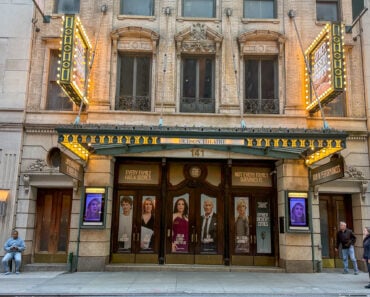
built for a vaudevillian and later renamed for an illustrator. The Al Hirschfeld Theatre is a Broadway theatre with 1,404 seats situated over two levels. It has borne more than one name over its lifetime. Originally, it was the Martin Beck Theatre to honor the man who had it built. Later, it became the Al Hirschfeld Theatre to honor a long-time Broadway illustrator. Regardless, it has been at 302 West 45th Street since 1924, meaning it has hosted some well-known shows.
As the Martin Beck Theatre
Martin Beck was a vaudeville theater owner and manager. He founded the Orpheum Circuit, which was extremely influential on the West Coast of the United States in the early 20th century. Indeed, it was so powerful that it could form an agreement with its eastern counterpart, the Keith-Albee Circuit, to divide the U.S. market between themselves. The Orpheum Circuit would dominate vaudeville west of Chicago, while the Keith-Albee Circuit would dominate vaudeville east of Chicago.
As such, Beck’s decision to enter New York City’s theater scene caused serious tensions between the two in the 1910s. He funded the construction of the Palace Theatre in 1913. Subsequently, he lost control of the theater to his rivals, with the result that it became their flagship in the 1910s and 1920s. Later, Beck lost control of the Orpheum Circuit in 1923. That wasn’t necessarily a bad thing. Vaudeville was already showing signs of its eventual demise in the early 1920s.
Regardless, it seems safe to say that Beck retained his interest in New York City’s theater scene. In 1923, he bought seven residences with the intent of building a theater on the combined site. Gustave Albert Lansburgh designed the exterior, which stood out because of both Byzantine and Moorish influences. Meanwhile, Albert Herter designed the interior. By 1924, the Martin Beck Theatre was ready for use. Supposedly, it was the one New York City theater owned outright without a mortgage at its time of completion. Something that presumably proved very helpful when the Great Depression struck just a few years later.
Under Martin Beck
The first show at the Martin Beck Theatre was Madame Pompadour, an operetta based on the one-time chief mistress of King Louis XV of France. It ran for 80 performances. Subsequently, the theater hosted Captain Jinks for 167 performances, The Shanghai Gesture for 210 performances, and The Shannons of Broadway for 288 performances. That was enough to see the Martin Beck Theatre through to the late 1920s. After that, several theatrical groups proceeded to keep the theater busy until the 1940s, which was a very tumultuous time for New York City’s theater scene. Examples of shows from this period included Wings Over Europe in 1928, The Lake in 1933, Saint Joan in 1936, Victoria Regina in 1938, and Ladies and Gentlemen in 1939.
Under Louise Heims Beck
Beck died in 1940. However, the theater saw a smooth transition to the not-so-new leadership of Beck’s wife, Louise Heims Beck, who had already been helping him out with his business. She became a notable name in theater beyond her running of the Martin Beck Theatre. After all, she co-founded the American Theater Wing, which might be best known to interested individuals because of the Tony Awards. Later, she even went on to serve as the Chairperson of the governing board of the Actors’ Fund of America from 1960 until she died in 1978.
The Martin Beck Theatre remained under Louise Heims Beck from the 1940s to the early 1960s. As always, some shows were successful, while others were less so. One example of a notable name from this period was A Watch on the Rhine, which ran for 378 performances starting in 1941. Another was Bye Bye Birdie, which ran for 607 performances starting in 1960. Others included but were not limited to A Connecticut Yankee in 1943, St. Louis Woman in 1946, and Sweet Bird of Youth in 1959.
Sold to Jujamcyn
In 1965, Jujamcyn made a $1.5 million offer for the Martin Beck Theatre. By 1966, the change in ownership was complete. It took some time for the Martin Beck Theatre to secure a hit under its new ownership. Most of the shows in the 1970s had short runs, which says much about their popularity. It wasn’t until 1977 that it secured a revival of Dracula. That managed 925 performances, which was particularly remarkable because the original production had managed just 261 performances. In the 1980s, the Martin Beck Theatre had other hits, such as Into the Woods in 1987 and Grand Hotel in 1989.
Of course, the 1980s are also notable for being the decade in which the New York City Landmarks Preservation Commission started looking into ways to preserve Broadway theaters. That culminated in a series of landmark designations in 1987, which included both the exterior and the interior of the Martin Beck Theatre. Jujamcyn was one of the three theater operators that sued over the designations because they didn’t like the resulting restrictions on modifications. However, the designations would be upheld when the Supreme Court of the United States refused to hear the case in 1992.
As the Al Hirschfeld Theatre
The Martin Beck Theatre was renamed the Al Hirschfeld Theatre in June 2003. It was meant to celebrate what would have been the illustrator’s 100th birthday. Unfortunately, Hirschfeld didn’t live to see it because he died just a few months earlier, though he did know that he would be receiving the honor. On the whole, it was quite a gesture, not least because it made him the first visual artist to have a Broadway theater named for him.
As for the Al Hirschfeld Theatre, it has seen some remarkable successes in recent decades. Examples ranged from Annie and The Sound of Music in the 1990s to Wonderful Town and Hair in the 2000s. For comparison, it hosted a small number of shows in the 2010s. However, that is clear evidence of how successful those shows have been. Kinky Boots ran for 2,507 performances from 2013 to 2019. Afterward, it was followed by Moulin Rouge, which is still running as of 2022. There was an interruption from March 2020 to September 2021 because of the COVID-19 pandemic. Since then, Moulin Rouge has smoothly resumed.
References:
https://www.spotlightonbroadway.com/theater/al-hirschfeld
Haskell, David. The Encyclopedia of New York. New York: Avid Reader Press, an imprint of Simon & Schuster, Inc., 2020.
Jackson, Kenneth T. The Encyclopedia of New York City. New Haven, CT: Yale University Press, 2011.
Bloom, Ken. Broadway: Its History, People, and Places: An Encyclopedia. New York: Routledge, 2004.
http://s-media.nyc.gov/agencies/lpc/lp/1315.pdf
History Of The Al Hirschfeld Theatre On Broadway ClassicNewYorkHistory.com ©2022
ClassicNewYorkHistory.com claims ownership of all its original content and Intellectual property under United States Copyright laws and those of all other foreign countries. No one person, business or any organizations is allowed to republish any of our original content anywhere on the web or in print without our permission.