Feature Photo: Linda Harms / Shutterstock.com
New York City parks have always served as an escape for those of us who grew up here. Yet I have never been sure that escapism is even the right word, because we live right alongside these parks. They sit beside us, behind us, and down the block from us, woven into the neighborhoods we call home.
When we go to a park in this city, we are really just walking to a different section of the city itself. The parks give us trees, grass fields, basketball courts, tennis courts, and benches where we can sit and watch the world go by. But we always know exactly where we are.
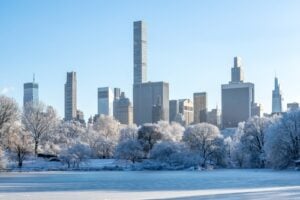
The skyline never lets us forget. Look through the trees in almost any city park and there they are, the rooftops, water towers, and apartment buildings standing watch over the greenery. It is like that even at the Bronx Zoo. You may feel as though you are on an African safari for a moment, but glance above the treetops and the buildings surround you.
So it is hard to call our parks a true escape. They are something better than that. They are an essential element of how we live in this city, as much a part of daily New York life as the subway or the corner deli.
For people who do not live in New York, the word “park” often means one thing: Central Park. But there is far more to the New York City park landscape than Manhattan’s famous green space. Across the five boroughs are coastal shorelines, salt marshes, deep forests, former estates, World’s Fair grounds, and one of the most ambitious landfill reclamation projects ever attempted.
Central Park covers 843 acres, yet it does not place among the four largest single parks in this ranking. Pelham Bay Park is more than three times its size, while the planned footprint of Freshkills Park is nearly three times as large.
Ranking methodology: This list ranks large, individually named destination parks by their commonly published total acreage. Freshkills Park is ranked by its full 2,200-acre master-plan footprint, although most of the site remains closed while construction proceeds in phases. The Staten Island Greenbelt is discussed separately because it is a connected system of parks, preserves, and natural areas rather than one unified park. Linear beach and boardwalk properties are also excluded.
Where the Staten Island Greenbelt Fits
The Staten Island Greenbelt deserves special recognition even though it is not placed in the numbered ranking. NYC Parks has historically listed the Greenbelt at 1,778 acres when treating it as a mapped park property, while the Greenbelt Conservancy describes the broader connected system of parks, preserves, and natural areas as approximately 2,800 acres.
That larger network stretches through the center of Staten Island and includes High Rock Park, LaTourette Park, Willowbrook Park, Blood Root Valley, and other protected landscapes. It is one of New York City’s greatest conservation achievements, but it is not a single park in the same way as Pelham Bay Park, Central Park, or Prospect Park.
1. Pelham Bay Park
Size: 2,772 acres
Borough: The Bronx
Scale comparison: More than three times the size of Central Park
Reigning as the undisputed heavyweight champion of New York City parkland, Pelham Bay Park occupies the northeastern corner of the Bronx along the Long Island Sound. For generations of Bronx families, this has been the place where summer memories are made.
The park contains a remarkable mixture of saltwater shoreline, forest, meadow, tidal marsh, athletic fields, bridle paths, and two golf courses. Its 13-mile shoreline gives the northeastern Bronx a coastal landscape that many visitors never expect to find inside New York City.
Grow up in the Bronx and Pelham Bay Park becomes part of your DNA. It is where children learn to ride bicycles, where families claim barbecue spots on Sunday mornings, and where the smell of charcoal and salt air mixes on a hot July afternoon.
Orchard Beach
Robert Moses created Orchard Beach during the 1930s by joining several small islands and extending the shoreline. The 1.1-mile crescent became known as “The Riviera of New York.” On summer weekends, the beach and its monumental pavilion come alive with music, and the sound of salsa drifting across the sand remains one of the great soundtracks of Bronx summers.
Bartow-Pell Mansion Museum
The Bartow-Pell Mansion is a Greek Revival country estate that preserves a piece of the Bronx from the period when this section of the city was still open countryside. Its interiors and formal gardens offer a striking contrast to the beaches, golf courses, and athletic facilities elsewhere in the park.
Split Rock and the Park’s Natural Areas
Split Rock is a massive glacial boulder divided into two sections. The surrounding landscape is historically associated with Anne Hutchinson, the religious dissenter whose name survives in the Hutchinson River and Hutchinson River Parkway. Nearby trails lead through some of the most ecologically diverse natural areas in the city.
2. Freshkills Park
Size: 2,200 acres when complete
Borough: Staten Island
Scale comparison: Approximately 2.6 times the size of Central Park
Freshkills Park represents one of the most ambitious land reclamation and environmental transformation projects in the world. The site served as the Fresh Kills Landfill until it closed in 2001. It is now being rebuilt in stages as a vast landscape of grasslands, wetlands, waterways, recreational areas, and wildlife habitat.
For decades, Fresh Kills was a burden that Staten Islanders carried for the entire city. Watching the landscape transform into rolling hills and restored habitat is nothing short of remarkable. It stands as proof that even one of the city’s most damaged places can be given an entirely different future.
Freshkills requires an important qualification in any size ranking. Its planned park footprint covers 2,200 acres, but most of the site is not yet open for everyday public access. North Park Phase 1 opened in 2023, and additional areas are being developed gradually, with full buildout planned over many years.
North Park
North Park Phase 1 provides daily public access to paths, overlooks, restored landscape, and views across the enormous reclamation site. It offers New Yorkers their clearest look at the transformation from landfill to park.
Schmul Park, Owl Hollow, and the Greenway
Projects around the park’s outer edges opened before the interior. These include the rebuilt Schmul Park, the Owl Hollow athletic fields, and the New Springville Greenway. Together, they demonstrate how Freshkills is being opened from the surrounding neighborhoods inward.
Wildlife and Environmental Research
Grassland birds, ospreys, hawks, and other wildlife have returned to the site. Freshkills has also become a center for studying habitat restoration, water quality, soil, reforestation, and the long-term recovery of an engineered landscape.
3. Van Cortlandt Park
Size: 1,146 acres
Borough: The Bronx
Scale comparison: Approximately 36 percent larger than Central Park
Anchoring the northwestern Bronx at the end of the 1 subway line, Van Cortlandt Park combines athletic facilities, wetlands, a freshwater lake, historic structures, and extensive woodland. Step off the elevated train at 242nd Street and the park is right there, which is about as New York as a park entrance gets.
The landscape contains layers of city and national history, from Indigenous presence and Colonial farming to Revolutionary War activity and the development of public recreation.
Van Cortlandt House Museum
Built in 1748, Van Cortlandt House is the oldest surviving building in the Bronx. The property was used by American and British forces during the Revolutionary War, and George Washington stayed there during his return to New York in 1783.
Historic Cross-Country Course
Van Cortlandt’s cross-country course is famous among runners throughout the United States. High school and college athletes have tested themselves on its fields, wooded trails, and demanding back hills for generations.
The Nation’s First Public Municipal Golf Course
The Van Cortlandt Golf Course opened in 1895 as the first public municipal golf course in the United States. Its creation made a sport associated with private clubs available to the general public.
4. Flushing Meadows Corona Park
Size: Approximately 898 acres
Borough: Queens
Scale comparison: Approximately 55 acres larger than Central Park
Before it became the flagship park of Queens, this land was a notorious ash dump associated with the “valley of ashes” in F. Scott Fitzgerald’s The Great Gatsby. Its transformation is one of the most dramatic land-reclamation stories in New York City history.
The site hosted both the 1939–1940 and 1964–1965 New York World’s Fairs. Today, the park reflects Queens itself, with families playing soccer, cricket, volleyball, baseball, and tennis beside landmarks that once represented visions of the future.
The Unisphere
The 140-foot stainless steel Unisphere was created for the 1964 World’s Fair. Surrounded by fountains, it remains one of the defining landmarks of Queens and one of the most recognizable structures in New York City.
Cultural Institutions
The park is home to the Queens Museum, the New York Hall of Science, and Queens Theatre. The Queens Museum contains the enormous Panorama of the City of New York, which was created for the 1964 fair.
Major Sports Venues
Citi Field and the USTA Billie Jean King National Tennis Center stand beside the park. Every summer, the US Open brings the international tennis world to a landscape that was once an ash dump.
5. Central Park
Size: 843 acres
Borough: Manhattan
Scale comparison: The citywide benchmark
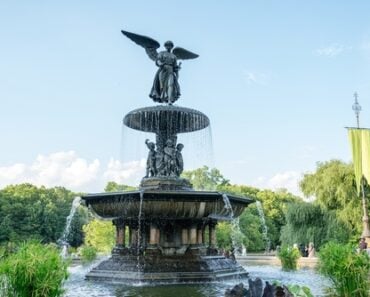
Central Park places fifth in this ranking, yet it remains the cultural and historic center of New York City’s park system. It was the first major landscaped public park in the United States, and nearly every important urban park built afterward owes something to the example established by Frederick Law Olmsted and Calvert Vaux.
What many visitors never realize is how carefully engineered the landscape is. The lakes, lawns, paths, bridges, wooded sections, and scenic overlooks were designed and constructed to create the appearance of nature inside Manhattan’s street grid.
Central Park may not be New York City’s largest park, but it remains the park against which all the others are measured.
6. Marine Park
Size: 798 acres, including land under water
Borough: Brooklyn
Scale comparison: Approximately 45 acres smaller than Central Park
Surrounding the western edge of Jamaica Bay, Marine Park is a coastal sanctuary made up largely of salt marsh, upland habitat, and tidal water around Gerritsen Creek. Many New Yorkers are surprised to discover that Brooklyn’s largest conventional park is not Prospect Park.
The park protects a landscape that resembles the Brooklyn coastline before large-scale urban development. A historic tide-powered mill once operated along Gerritsen Creek, connecting the area to some of the borough’s earliest European settlement.
Salt Marsh Nature Center
The Salt Marsh Nature Center provides access to trails and boardwalks through habitat used by egrets, herons, horseshoe crabs, and migratory birds. At dawn, with mist rising from the creek, it can be difficult to believe that the surrounding city is still Brooklyn.
Recreation and Community Life
Marine Park also includes a golf course, ballfields, cricket fields, bocce courts, handball courts, playgrounds, and kayak access. Its natural areas and recreational facilities have long served the surrounding southern Brooklyn neighborhoods.
7. Bronx Park
Size: 718 acres
Borough: The Bronx
Defining characteristic: Home to the Bronx Zoo, New York Botanical Garden, and Bronx River
Bronx Park is one of the most important green spaces in New York City, although much of its acreage is associated with two institutions that many people do not immediately think of as part of a public park: the Bronx Zoo and the New York Botanical Garden.
The Bronx River runs through the park, passing woodland, waterfalls, paths, playgrounds, and recreation areas. The river corridor also links Bronx Park to a larger greenway system that extends north and south through the borough.
The Bronx Zoo
The Bronx Zoo occupies a large section of the southern park. Its exhibits, historic architecture, and wooded landscape have made it one of the most famous zoological parks in the world.
New York Botanical Garden
The New York Botanical Garden occupies the northern section and includes extensive gardens, historic structures, and the Thain Family Forest, an old-growth woodland that preserves a surviving piece of the landscape that existed before New York became a modern city.
The Bronx River
The Bronx River gives the park a natural spine. Walking paths, waterfalls, and restored sections of shoreline reveal a side of the Bronx that remains invisible to people who know the borough only from its streets and highways.
8. Alley Pond Park
Size: More than 635 acres
Borough: Queens
Historical feature: Home to one of New York City’s oldest and tallest trees
Located in northeastern Queens, Alley Pond Park contains forests, meadows, kettle ponds, freshwater wetlands, and salt marsh. The landscape was shaped by the glaciers that formed Long Island thousands of years ago.
The park lies near the meeting point of freshwater and saltwater ecosystems, giving it an unusual range of habitats. The Alley Pond Environmental Center has introduced generations of children to the natural world without requiring them to leave the city.
The Alley Pond Giant
Deep in the park stands a tulip tree estimated to be approximately 350 years old and about 133 feet tall. NYC Parks describes it as possibly the oldest and tallest living organism in the city. The tree was already growing long before the surrounding landscape became part of modern New York.
9. Forest Park
Size: 538 acres
Borough: Queens
Defining characteristic: A major forest, recreation, and performance landscape
Forest Park stretches across central Queens along the terminal moraine left by the glaciers that formed Long Island. Its hills, depressions, and wooded areas give it a rolling character that feels different from the flatter sections of the borough.
The park contains approximately 165 acres of trees, along with hiking routes, bridle paths, an 18-hole golf course, playgrounds, ballfields, and the George Seuffert Bandshell.
Forest Park Carousel
The Forest Park Carousel was built in 1903 and contains hand-carved figures created by master carousel craftsman Daniel Carl Muller. It is a designated New York City landmark and one of only two surviving Muller carousels.
Bridle Paths and Golf
Forest Park remains one of the few places in New York City where horseback riders are a regular part of the landscape. Its golf course and bridle paths make the park an unusual meeting point between urban recreation and older park traditions.
10. Prospect Park
Size: 526 acres
Borough: Brooklyn
Design legacy: Frederick Law Olmsted and Calvert Vaux
After their work on Central Park, Frederick Law Olmsted and Calvert Vaux created Prospect Park as another sweeping urban landscape of meadow, woodland, water, and carefully planned views. The Brooklyn park is often regarded as a fuller expression of ideas they had developed in Manhattan.
Ask many Brooklyn residents and they will tell you without hesitation that Prospect Park is better than Central Park. That borough pride runs deep, and once you have spent a Saturday on the Long Meadow with music drifting across the grass, it becomes easy to understand why.
The Long Meadow
The 90-acre Long Meadow stretches for nearly a mile and is widely described as the longest uninterrupted meadow in an American urban park. It unfolds in a broad green sweep near Grand Army Plaza and remains one of the great open landscapes in New York City.
The Ravine and Lake
Prospect Park contains extensive woodland, a designed watercourse, the Ravine, and a 60-acre lake. Together, these landscapes create a feeling of distance from the surrounding streets even though Brooklyn remains just beyond the trees.
Why Pelham Bay Park Became So Large
The scale of Pelham Bay Park was not accidental. Journalist John Mullaly helped establish the New York Park Association in 1881 to advocate for major new parks in the rapidly developing Bronx. That effort led to the New Parks Act of 1884 and the city’s acquisition of thousands of acres for Pelham Bay, Van Cortlandt, Bronx, Crotona, Claremont, and St. Mary’s Parks.
On December 12, 1888, New York City took title to approximately 4,000 acres of new Bronx parkland. The decision preserved enormous sections of shoreline, forest, river valley, and open land before development could consume them. More than a century later, those parks remain among the greatest public assets New York City ever created.
10 Largest Public Parks in New York City, Ranked by Acreage
| Rank | Park | Approximate Size | Borough |
|---|---|---|---|
| 1 | Pelham Bay Park | 2,772 acres | The Bronx |
| 2 | Freshkills Park | 2,200 acres when complete | Staten Island |
| 3 | Van Cortlandt Park | 1,146 acres | The Bronx |
| 4 | Flushing Meadows Corona Park | 898 acres | Queens |
| 5 | Central Park | 843 acres | Manhattan |
| 6 | Marine Park | 798 acres | Brooklyn |
| 7 | Bronx Park | 718 acres | The Bronx |
| 8 | Alley Pond Park | More than 635 acres | Queens |
| 9 | Forest Park | 538 acres | Queens |
| 10 | Prospect Park | 526 acres | Brooklyn |