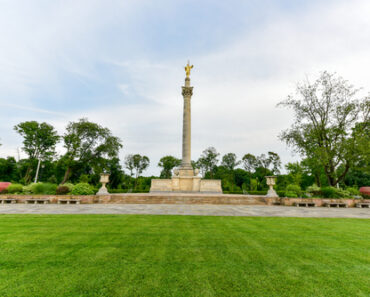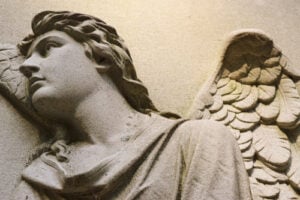
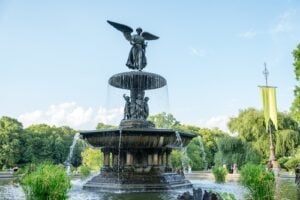
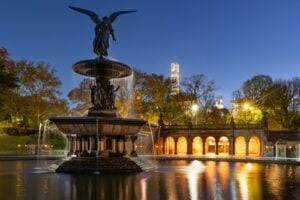
Bethesda Fountain and Emma Stebbins’ Angel of the Waters in Central Park. Photo: DenisProduction.com / Shutterstock.com.
Water has always shaped the survival and spectacle of New York City. Before the mid-19th century, Manhattan depended on local wells, cisterns, and ponds that could become badly contaminated as the city grew. The arrival of fresh Croton water from Westchester County in 1842 transformed New York’s water supply, and the city celebrated the achievement with a great public procession and spectacular fountain displays.
Over the decades that followed, public fountains evolved from symbols of clean water and civic progress into architectural landmarks, memorials, works of public art, and neighborhood gathering places. They offer calm amid traffic, cool mist during hot summers, and backdrops for generations of New York rituals.
Here are 10 of the most iconic fountains in New York City and the stories behind them.
1. Bethesda Fountain and Angel of the Waters
Francois Roux / Shutterstock.com
- Location: Bethesda Terrace, Central Park, Mid-Park at 72nd Street
- Design: Fountain basin by Jacob Wrey Mould; sculpture by Emma Stebbins
- Dedicated: 1873
Anchoring the architectural heart of Central Park, Bethesda Fountain is crowned by Emma Stebbins’ bronze Angel of the Waters. Stebbins became the first woman to receive a public art commission in New York City. The angel holds a lily symbolizing purity and stands above four cherubs representing peace, health, purity, and temperance. Stebbins drew inspiration from the Gospel of John and the healing Pool of Bethesda in Jerusalem. The fountain commemorates the Croton Aqueduct, which first brought fresh water to New York City in 1842 and represented a major advance in public health. Dedicated in 1873, Bethesda Fountain remains one of the most recognizable works of public art in New York.
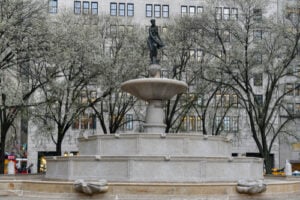
2. The Pulitzer Fountain
Felix Lipov / Shutterstock.com
- Location: Grand Army Plaza, Fifth Avenue at 59th Street, Manhattan
- Architect / Sculptor: Thomas Hastings / Karl Bitter
- Dedicated: May 1916
Across from the Plaza Hotel stands one of Midtown’s great Beaux-Arts fountains. Newspaper publisher Joseph Pulitzer left $50,000 in his will for a fountain inspired by the great public squares of Europe. Architect Thomas Hastings designed the cascading composition, while sculptor Karl Bitter conceived the bronze figure of Pomona, the Roman goddess of abundance, holding a basket of fruit. Bitter died in 1915 before the sculpture was completed, and Isidore Konti helped bring the final work to completion. Dedicated in May 1916, the Pulitzer Fountain gives the southern half of Grand Army Plaza the feeling of a formal European square at the edge of Central Park.
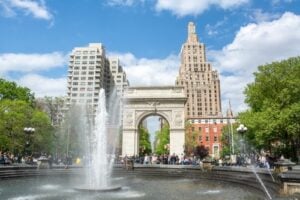
3. Washington Square Park Fountain
Alizada Images / Shutterstock.com
- Location: Center of Washington Square Park, Greenwich Village
- Historic Design: Larger 19th-century basin attributed to Jacob Wrey Mould
- Major Changes: 1930s, 1970, and the 21st-century park reconstruction
The fountain at Washington Square Park has changed repeatedly along with the park itself. A circular ornamental fountain was installed in 1852, and around 1870 it was replaced by a larger basin attributed to architect Jacob Wrey Mould. During Robert Moses-era work in the 1930s, steps were added so the fountain could function as a wading pool. After automobiles were finally removed from the park, the fountain plaza became one of Greenwich Village’s great informal stages for musicians, performers, demonstrations, and neighborhood gatherings. During the modern reconstruction of Washington Square Park, the fountain was shifted east to bring it into closer alignment with the Washington Square Arch.
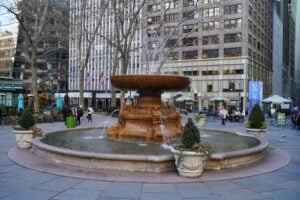
4. The Josephine Shaw Lowell Memorial Fountain
Mariusz Lopusiewicz / Shutterstock.com
- Location: Bryant Park, Sixth Avenue side
- Architect: Charles Adams Platt
- Dedicated: 1912
At the western entrance to Bryant Park stands the pink-granite Josephine Shaw Lowell Memorial Fountain. Lowell was a major social reformer and a founder of the New York Consumers’ League, and the fountain became New York City’s first public memorial dedicated to a woman. Charles Adams Platt designed the restrained classical monument, which was dedicated in 1912. The fountain has also developed an unexpected second identity during bitter New York winters, when freezing temperatures can transform its flowing water into dramatic layers of ice. In a park surrounded by Midtown towers, it remains a quiet memorial to a woman whose work was centered on social reform and public service.
5. Prometheus and the Lower Plaza Fountain at Rockefeller Center
Leonard Zhukovsky / Shutterstock.com
- Location: Lower Plaza, Rockefeller Center
- Sculptor: Paul Manship
- Installed: 1934
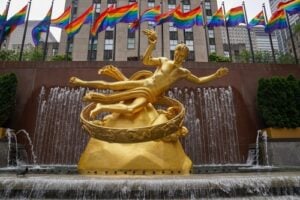
Few New York fountain settings are more recognizable than the gilded Prometheus at Rockefeller Center. Paul Manship’s monumental bronze depicts the Greek Titan who stole fire from the gods and gave it to humanity, a story that fit Rockefeller Center’s larger artistic themes of civilization, progress, and human achievement. The sculpture made its debut in 1934 and was first gilded several years later. Prometheus appears to glide above the fountain at the western end of the Lower Plaza, framed by the famous sunken space that becomes the Rockefeller Center skating rink each winter. The combination of moving water, gold sculpture, surrounding skyscrapers, and the seasonal rink has made the scene one of the defining images of Midtown Manhattan.
6. The Jacob Wrey Mould Fountain at City Hall Park
ARK NEYMAN / Shutterstock.com
- Location: City Hall Park, Lower Manhattan
- Designer: Jacob Wrey Mould
- Original Installation: 1871; returned to City Hall Park in 1999
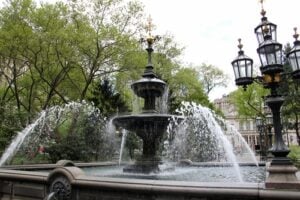
The history of fountains at City Hall reaches directly back to the arrival of Croton water. In 1842, New Yorkers gathered in City Hall Park to celebrate the new aqueduct as water surged from an elaborate public fountain. That first Croton fountain was eventually replaced in 1871 by a Victorian design from Jacob Wrey Mould. In 1920, Mould’s fountain was removed from City Hall Park and relocated to Crotona Park in the Bronx. Decades later, as City Hall Park underwent a major restoration, the historic Mould fountain was restored and returned to its downtown setting in 1999. Its round trip from Manhattan to the Bronx and back again gives it one of the most unusual histories of any New York fountain.
7. The Bailey Fountain
Lennox Wright / Shutterstock.com
- Location: Grand Army Plaza, Brooklyn, at the entrance to Prospect Park
- Architect / Sculptor: Edgerton Swartwout / Eugene Savage
- Completed: 1932
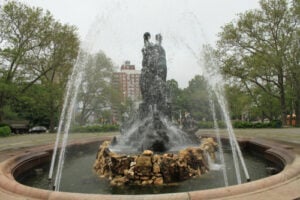
Just outside Prospect Park, the Bailey Fountain gives Brooklyn’s Grand Army Plaza an enormous burst of sculptural drama. Financier Frank Bailey funded the fountain as a memorial connected to his wife, Marie Louise Bailey. Architect Edgerton Swartwout and sculptor Eugene Savage created the 1932 composition. Its central bronze figures represent Wisdom and Felicity and stand above the prow of a ship, surrounded by mythological and marine figures, including a particularly imposing Neptune. Set near the Soldiers’ and Sailors’ Memorial Arch, the fountain forms one of Brooklyn’s grandest civic ensembles and has long been a favorite backdrop for photographs and celebrations.
8. The Metropolitan Museum of Art Plaza Fountains
Ruben Martinez Barricarte / Shutterstock.com
- Location: David H. Koch Plaza, Fifth Avenue between 80th and 84th Streets
- Landscape Architect / Fountain Designer: OLIN / Fluidity Design Consultants
- Completed: 2014
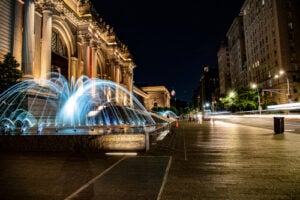
The monumental Fifth Avenue steps of the Metropolitan Museum of Art gained a completely redesigned setting in 2014. A $65 million reconstruction of the museum’s four-block-long plaza replaced deteriorating 1970s-era fountains with two contemporary granite water features designed by Fluidity Design Consultants as part of an overall plan led by OLIN. Each fountain holds 21,000 gallons of water and uses 48 programmable jets capable of creating changing geometric patterns. Recycled steam warms the water during cold weather, allowing the fountains to operate year-round. Rather than competing with the Met’s enormous Beaux-Arts facade, the low modern fountains frame the famous front steps and give visitors another place to gather along Fifth Avenue.
9. The Fountain of the Continents at the Unisphere
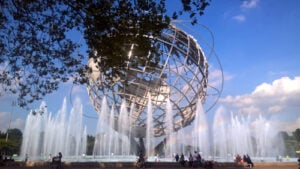
BalazsSebok / Shutterstock.com
- Location: Flushing Meadows–Corona Park, Queens
- Designer: Gilmore D. Clarke
- Built For: The 1964–1965 New York World’s Fair
The Unisphere and the fountain surrounding it were created as the symbolic heart of the 1964–1965 New York World’s Fair. Landscape architect Gilmore D. Clarke designed the 140-foot-high stainless-steel globe, which was constructed and donated by United States Steel. The Unisphere rises from the Fountain of the Continents, a broad circular reflecting pool whose water jets helped turn the globe into a theatrical centerpiece. The three orbital rings surrounding the earth symbolized the new space age, while the fair itself promoted the theme “Peace Through Understanding.” New York City later designated the Unisphere together with its surrounding pool and fountains as an official landmark, preserving one of the most enduring physical reminders of the 1964 World’s Fair.
10. The Revson Fountain at Lincoln Center
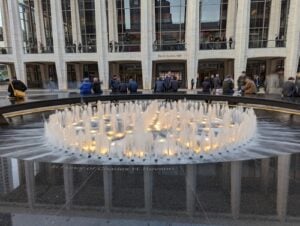
quiggyt4 / Shutterstock.com
- Location: Josie Robertson Plaza, Lincoln Center
- Original Design: Philip Johnson
- Dedicated: 1964; redesigned in 2009
Framed by the Metropolitan Opera House, David Geffen Hall, and the David H. Koch Theater, the Revson Fountain is the centerpiece of Lincoln Center’s great public plaza. The original fountain, designed as part of Philip Johnson’s plaza plan, was dedicated in 1964. During Lincoln Center’s major 21st-century renovation, Diller Scofidio + Renfro, Beyer Blinder Belle, and WET Design reimagined the fountain while preserving its role as the center of the plaza. The redesigned version uses hundreds of computer-controlled jets to create choreographed displays that can send bursts of water high above the basin. The Revson Fountain has also become part of New York’s movie history, appearing in films including Moonstruck and Ghostbusters.
NYC’s 10 Iconic Fountains at a Glance
| Fountain | Location | Year | Designer / Sculptor | Notable Feature |
|---|---|---|---|---|
| Bethesda Fountain | Central Park | 1873 | Jacob Wrey Mould / Emma Stebbins | Angel of the Waters and Croton Aqueduct symbolism |
| Pulitzer Fountain | Grand Army Plaza, Manhattan | 1916 | Thomas Hastings / Karl Bitter | Bronze figure of Pomona above cascading basins |
| Washington Square Park Fountain | Greenwich Village | 1852 / later rebuilt | Later basin attributed to Jacob Wrey Mould | Historic gathering place aligned with Washington Square Arch |
| Josephine Shaw Lowell Memorial Fountain | Bryant Park | 1912 | Charles Adams Platt | First NYC public memorial dedicated to a woman |
| Prometheus and Lower Plaza Fountain | Rockefeller Center | 1934 | Paul Manship | Gilded Prometheus above the Lower Plaza |
| Jacob Wrey Mould Fountain | City Hall Park | 1871 / 1999 | Jacob Wrey Mould | Historic Victorian fountain returned from Crotona Park |
| Bailey Fountain | Grand Army Plaza, Brooklyn | 1932 | Edgerton Swartwout / Eugene Savage | Monumental bronze figures of Wisdom and Felicity |
| Metropolitan Museum Plaza Fountains | Fifth Avenue | 2014 | OLIN / Fluidity Design Consultants | Programmable granite fountains operating year-round |
| Fountain of the Continents | Flushing Meadows–Corona Park | 1964 | Gilmore D. Clarke | Surrounding fountain and pool beneath the Unisphere |
| Revson Fountain | Lincoln Center | 1964 / 2009 | Philip Johnson / Diller Scofidio + Renfro / WET Design | Computer-controlled choreographed water displays |
For more on the New York public spaces surrounding these fountains, explore our histories of Central Park, Washington Square Park, Bryant Park, and Prospect Park.
Sources
- New York City Department of Environmental Protection — History of New York City’s Drinking Water
- Central Park Conservancy — Bethesda Fountain
- Smithsonian American Art Inventories — Pulitzer Fountain
- The Cultural Landscape Foundation — Washington Square Park
- Bryant Park — The Grounds
- Rockefeller Center — The Story of the Prometheus Sculpture
- City Hall Park Conservancy — Park History
- Historic Districts Council — Bailey Fountain
- The Metropolitan Museum of Art — David H. Koch Plaza Opens to the Public
- New York City Landmarks Preservation Commission — Unisphere and Surrounding Pool and Fountains Designation Report
- Lincoln Center — Josie Robertson Plaza and Revson Fountain
Published September 8, 2026.