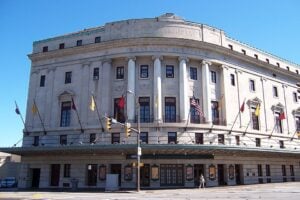
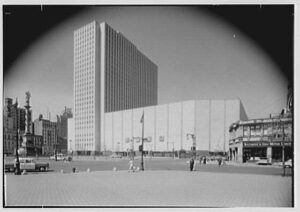
New York Coliseum at Columbus Circle, 1956. Photo: Gottscho-Schleisner, Inc., Library of Congress, Prints and Photographs Division.
For more than three decades, the southwest corner of Columbus Circle was dominated by the New York Coliseum, a massive convention and exhibition complex conceived during the Robert Moses era. It opened in 1956 as New York City’s principal large-scale exhibition hall and became home to the New York International Auto Show, trade conventions, photography shows, boat exhibitions, antiques fairs, and one of the most memorable Cold War cultural exchanges ever staged in Manhattan.
The Coliseum was never universally loved. Its huge windowless exhibition block and attached office tower were criticized almost from the beginning for turning one of New York’s most important public spaces into a wall of stone and brick. Yet the building became an unmistakable part of mid-century New York. When the Jacob K. Javits Convention Center opened on Manhattan’s West Side in 1986, the Coliseum lost its primary purpose. Fourteen years later, it was demolished.
Today, the site is occupied by the Deutsche Bank Center, the twin-tower mixed-use complex originally opened in 2004 as the Time Warner Center. The contrast between the two buildings tells a larger story about changing ideas of architecture, urban renewal, commerce, and public space in New York City.
Where Was the New York Coliseum?
The New York Coliseum stood on the west side of Columbus Circle, occupying the block between West 58th and West 60th Streets. The site faced the southwest entrance to Central Park and sat at one of the most visible intersections in Manhattan.
That location was one of the reasons the building became so familiar to New Yorkers. Anyone coming through Columbus Circle could hardly miss it. The exhibition hall occupied the lower portion of the complex, while a 26-story office tower rose beside it.
The Coliseum was designed by architects Leon and Lionel Levy. Construction began in 1954 under the Triborough Bridge and Tunnel Authority, which was then chaired by Robert Moses.
Why Did Robert Moses Want a Convention Center at Columbus Circle?
By the early 1950s, New York needed a modern convention and exhibition facility capable of competing with newer halls being built in other American cities. The aging Grand Central Palace on Lexington Avenue could no longer provide the kind of flexible exhibition space that trade organizations and large national shows increasingly demanded.
Robert Moses saw Columbus Circle as the ideal location for a new exhibition center. The project also fit his broader use of federal Title I urban-renewal powers to clear and redevelop sections of New York that public agencies classified as blighted or substandard.
The Coliseum project became controversial because the redevelopment area was not simply a collection of abandoned tenements. It also contained businesses, offices, stores, parking areas, and occupied housing. Critics of the Moses approach argued that urban-renewal powers were being used to clear valuable Manhattan land for large institutional projects while displacing people and businesses that had little influence over the process.
The result was a characteristically Moses-scale project: a convention hall, office tower, parking facilities, and an adjacent housing development reshaping the western edge of Columbus Circle.
How Big Was the New York Coliseum?
The complex cost approximately $35 million to build and contained more than 300,000 square feet of exhibition space. Its multiple exhibition levels were designed so that several shows could operate at the same time.
The exhibition building included large freight facilities, elevators, escalators, and a truck ramp intended to move enormous displays into and through the building. An attached 26-story office tower gave the complex a vertical component beside the broad exhibition block.
The scale was impressive for the 1950s, but the building’s multi-level organization eventually became one of its greatest weaknesses. Later convention centers were designed around enormous single-level halls with higher ceilings and more direct loading access.
The 1955 Construction Collapse
The Coliseum’s history nearly began with disaster. On May 9, 1955, while the complex was still under construction, a large section of temporary concrete formwork collapsed as concrete was being poured.
One worker was killed and approximately fifty were injured. Investigators later focused on inadequate bracing in the temporary supporting structure and the additional forces created by heavy motorized concrete buggies moving across the work area.
The collapse delayed the project, but construction resumed and the Coliseum was completed the following year.
When Did the New York Coliseum Open?
The New York Coliseum officially opened on April 28, 1956. Three major exhibitions were staged during the opening period: the New York International Auto Show, the National Photographic Show, and the Fifth International Philatelic Exhibition.
The philatelic exhibition, known as FIPEX, helped turn the opening into a major public event. A United States postage stamp was even issued depicting the Coliseum and Columbus Circle.
The new building immediately established itself as New York’s primary exhibition center. Its location near multiple subway lines and major Midtown hotels made it convenient for local visitors, suburban travelers, and convention attendees arriving from around the country.
The New York International Auto Show at the Coliseum
The New York International Auto Show became one of the events most closely associated with the Coliseum. The show had existed since 1900, but the opening of the Coliseum gave it a permanent modern exhibition home for the next thirty years.
Automakers used the Columbus Circle venue to introduce new models, display concept cars, and stage elaborate exhibits that drew huge crowds. Over time, cars became larger, displays became more complex, and the limitations of the multi-floor Coliseum became increasingly obvious.
The 1986 New York Auto Show was the final edition held at the Coliseum. The following year, the show moved to the new Jacob K. Javits Convention Center, where it remains today.
The 1959 Soviet Exhibition at the New York Coliseum
One of the most historically significant events ever held inside the Coliseum came during the summer of 1959, when the Soviet Union mounted a huge exhibition of science, technology, industry, culture, and everyday life in New York.
The Soviet exhibition was part of a reciprocal cultural exchange between the United States and the Soviet Union during a brief thaw in Cold War tensions. While Soviet displays filled the New York Coliseum, the United States staged its own exhibition in Moscow’s Sokolniki Park, the site that became famous for the “Kitchen Debate” between Vice President Richard Nixon and Soviet Premier Nikita Khrushchev.
At Columbus Circle, visitors saw Soviet industrial equipment, scientific displays, art, consumer goods, models, and space-age technology. More than one million people visited the exhibition before it closed in August 1959.
The event gave the utilitarian Coliseum an unexpected place in Cold War history. For several weeks, a convention hall built by Robert Moses became one of the most visible stages for competition between the world’s two superpowers.
Why Was the New York Coliseum So Widely Criticized?
The Coliseum worked as an exhibition hall, but its architecture drew criticism almost immediately. The lower convention portion presented a massive, largely windowless face toward Columbus Circle, while the office tower rose beside it with a very different visual rhythm.
Architectural critics objected to the way the building met one of Manhattan’s most important public spaces. Rather than opening toward Central Park and the circle, the structure seemed to block them. Frank Lloyd Wright reportedly dismissed the building as a utilitarian achievement rather than meaningful architecture, while later critics described the Coliseum as one of New York’s least successful major public buildings.
The problem was not simply style. Columbus Circle sits at the meeting point of Broadway, Central Park, Midtown, and the Upper West Side. A building on that site has an unusually important urban role. The Coliseum’s blank walls made the complex feel inward-looking at precisely the place where many planners believed architecture should engage the street and park.
Why Did the Coliseum Become Obsolete?
By the 1970s, the convention industry had changed dramatically. Exhibitors increasingly wanted enormous uninterrupted floor plates, tall ceilings, advanced loading systems, better freight access, and large amounts of flexible space that could be reconfigured quickly.
The Coliseum had been designed around multiple stacked exhibition floors. That arrangement made sense in land-constrained Manhattan in the 1950s, but it became a disadvantage when compared with newer convention centers built on larger sites.
New York eventually committed to a replacement on the West Side. The Jacob K. Javits Convention Center opened in 1986 with vastly more space and a layout better suited to the modern convention industry.
The effect on the Coliseum was immediate. Major shows moved west, including the New York International Auto Show. The building no longer had a clear long-term purpose.
Did the New York Coliseum Close in 1986?
The Coliseum’s era as New York’s principal convention center effectively ended in 1986 when the Javits Center opened. The building was then placed on the redevelopment track by the Metropolitan Transportation Authority, successor to the agency structure that had originally built it.
The property did not simply disappear, however. Redevelopment plans repeatedly stalled, and the Coliseum remained standing for years. It was used periodically for smaller events and other purposes while the city, the MTA, developers, architects, and civic organizations fought over what should replace it.
The First Battle to Redevelop Columbus Circle
One of the most ambitious redevelopment proposals came from developer Mortimer Zuckerman and Boston Properties in the mid-1980s. Architect Moshe Safdie designed a massive twin-tower project intended for the site.
The proposal immediately triggered opposition. Civic organizations and neighborhood groups argued that the towers were too large for Columbus Circle and would cast significant shadows over Central Park. Jacqueline Kennedy Onassis became one of the prominent public figures associated with opposition to the project.
Legal challenges and design revisions followed. The original project never moved forward, and the early-1990s real-estate downturn further weakened the development effort.
The failed proposal became another chapter in the long-running New York argument over development around Central Park: how much private construction should be permitted on a site whose scale and shadows could affect one of the city’s greatest public spaces?
The Final Plan for the Coliseum Site
By the late 1990s, the city and MTA again pushed to redevelop the property. In 1997, Mayor Rudolph Giuliani created a Coliseum Site Advisory Panel to review planning, design, and cultural issues surrounding the site.
In July 1998, the city approved Columbus Centre LLC, a partnership involving Related Companies and Apollo Real Estate Investment Fund III, as developer of the site. Time Warner was announced as a major owner-occupant. The approved plan called for a large mixed-use project combining offices, residences, a hotel, retail and entertainment space, and a major home for Jazz at Lincoln Center.
The agreement finally ended a redevelopment fight that had lasted more than a decade.
When Was the New York Coliseum Demolished?
Demolition of the New York Coliseum began in 2000. By the middle of that year, the building that had dominated the west side of Columbus Circle since 1956 had been cleared away.
The demolition was not simply the removal of an obsolete convention center. It erased one of the most visible surviving examples of Robert Moses-era urban renewal in Midtown Manhattan.
Construction on the replacement complex began later in 2000.
What Stands on the New York Coliseum Site Today?
The former Coliseum site is now occupied by the Deutsche Bank Center at 10 Columbus Circle. The complex was developed by Related Companies and designed by David Childs of Skidmore, Owings & Merrill. It opened in 2004 as the Time Warner Center.
The building contains offices, residences, the Mandarin Oriental hotel, restaurants, retail space, and Jazz at Lincoln Center. Its curved base follows the geometry of Columbus Circle, while twin glass towers rise above it.
In 2021, the Time Warner Center was renamed the Deutsche Bank Center when Deutsche Bank established its Americas headquarters there. The Shops at Columbus Circle remain one of the best-known public parts of the complex.
The difference between the old Coliseum and the present building could hardly be more dramatic. The Coliseum turned inward behind broad windowless walls. The modern complex uses glass, retail entrances, restaurants, performance space, and a large atrium to make the edge of Columbus Circle far more active at street level.
Why the New York Coliseum Still Matters
The New York Coliseum was never one of New York’s most beautiful buildings, but beauty is not the only reason a building belongs in the city’s history.
For thirty years, the Coliseum was where New Yorkers saw the newest cars, boats, cameras, industrial products, inventions, collectibles, and trade exhibits. It became a stage for Cold War diplomacy and a symbol of Robert Moses’s ability to reshape entire sections of the city through public authority and federal urban-renewal programs.
Its downfall is just as revealing. The building became obsolete because conventions changed. Its architecture came to symbolize an older approach to urban planning. The fourteen-year battle to replace it demonstrated how much more difficult major development had become in New York by the end of the 20th century.
Today, thousands of people pass through Columbus Circle without realizing that the glass towers in front of them occupy the site of a huge convention hall that once helped define postwar Manhattan.
More Columbus Circle, Convention, and Robert Moses History
Readers interested in the Coliseum’s replacement as New York’s primary exhibition hall can continue with our History of New York’s Jacob K. Javits Convention Center. For the site today, see our feature on the Shops at Columbus Circle. The Coliseum also belongs to the much larger story of Robert Moses, explored in our article on how Robert Moses shaped Long Island and metropolitan New York, and to the redevelopment of the West Side represented by Lincoln Center.
Sources
Library of Congress, New York Coliseum at Columbus Circle, 1956
U.S. Department of State, 1959 U.S.-Soviet Exhibition Exchange
New York International Auto Show, Historical Timeline
Jacob K. Javits Convention Center, Building History
New York City Mayor’s Office, 1998 Coliseum Site Developer Approval
Related Companies, Deutsche Bank Center Renaming
Skidmore, Owings & Merrill, Deutsche Bank Center
New York Coliseum History at a Glance
| Year | Milestone |
|---|---|
| 1954 | Construction begins on the Robert Moses-backed convention and office complex at Columbus Circle. |
| 1955 | A construction-formwork collapse kills one worker and injures approximately fifty. |
| April 28, 1956 | The New York Coliseum opens with the Auto Show, National Photographic Show, and FIPEX. |
| 1959 | The Soviet Union stages a major Cold War science, technology, and cultural exhibition at the Coliseum. |
| 1986 | The Jacob K. Javits Convention Center opens, ending the Coliseum’s role as New York’s principal exhibition hall. |
| 1986 | The New York International Auto Show makes its final appearance at the Coliseum. |
| 1998 | The city approves Columbus Centre LLC to redevelop the Coliseum site. |
| 2000 | The New York Coliseum is demolished. |
| 2004 | The Time Warner Center opens on the former Coliseum site. |
| 2021 | The Time Warner Center is renamed the Deutsche Bank Center. |
Published August 10, 2026.
What Happened to the New York Coliseum? History of Columbus Circle’s Lost Convention Center article published on ClassicNewYorkHistory.com © 2026