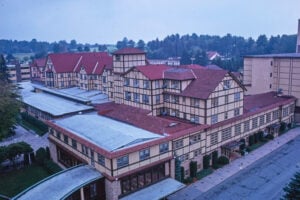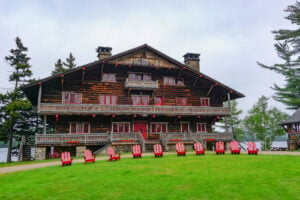
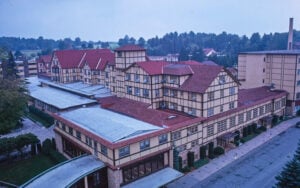
Grossinger’s Hotel in Liberty, New York, one of the legendary resorts of the Catskills Borscht Belt. Photo by John Margolies, Public domain, via Wikimedia Commons.
During the middle decades of the twentieth century, Sullivan and Ulster counties became one of the great training grounds for American comedy. The hotels and bungalow colonies of the Borscht Belt; Grossinger’s, the Concord, Brown’s Hotel, Kutsher’s, and scores of smaller resorts—needed constant entertainment for vacationing guests, and that demand created an unusual place for young performers to learn their craft.
Some worked as busboys, waiters, musicians, lifeguards, social directors, or tummlers before they became headliners. Others arrived with a little experience already behind them but developed the timing, characters, one-liners, and stage confidence that would define their careers. The audiences could be demanding, and there was nowhere to hide when a joke failed. For generations of comedians, that made the Catskills one of the toughest and most valuable classrooms in show business.
Here are fifteen legendary comedians and performers who got their start in the Catskills Borscht Belt resorts and carried what they learned there into television, film, Broadway, nightclubs, and American popular culture.
Jerry Lewis
Long before becoming an international box-office phenomenon, Jerry Lewis was learning how to make audiences laugh in the Catskills. Born Joseph Levitch to vaudevillian parents, Lewis worked the Borscht Belt in the early 1940s as a young novelty performer and all-purpose entertainer, using physical comedy, pantomime, and lip-synching routines to records. His father had also worked the mountain resorts, so the Catskills were already part of the family’s show-business world. Lewis later became closely associated with Brown’s Hotel in Loch Sheldrake, where the Jerry Lewis Theater Club carried his name. The frantic physical style that later made Martin and Lewis one of the biggest comedy teams in America had roots in the demanding resort circuit where Lewis first learned how to hold a room.
Mel Brooks
Before writing and directing The Producers, Blazing Saddles, and Young Frankenstein, Mel Brooks was working the Catskills as a musician, performer, comic, and eventually a tummler. Brooks first spent a summer entertaining in the Catskills as a teenager and returned after World War II, working at a number of Borscht Belt resorts and nightclubs. When a scheduled comedian became ill one night, Brooks stepped in and began doing stand-up, including impressions and rapid-fire jokes. He eventually became a tummler at Grossinger’s, where keeping guests entertained all day demanded quick thinking and fearless improvisation. By 1949, Sid Caesar had hired him as a television comedy writer, beginning one of the most influential careers in American comedy.
Sid Caesar
Sid Caesar entered the Catskills as a musician. After graduating from high school, the future star of Your Show of Shows played saxophone in resort bands, including at the Avon Lodge in Woodridge. While working there, Caesar began helping comedian Jackie Michaels with comedy sketches and discovered that he had a natural gift for physical humor, impressions, and the double-talk routines that later became one of his trademarks. The Catskills did not simply give Caesar a summer job; they helped reveal that his future belonged in comedy rather than solely in music. After World War II, Caesar brought those instincts into radio, Broadway, and especially live television, where his sketch work helped define the medium’s earliest golden age.
Buddy Hackett
Born Leonard Hacker in Brooklyn, Buddy Hackett began working in the Catskills while he was still in high school. He took jobs as a waiter and bellhop before beginning to perform in Borscht Belt nightclubs under the name Butch Hacker. After serving in the Army during World War II, he returned to the resort circuit and continued developing his act, eventually becoming one of the Catskills’ most successful comedians. Hackett’s rubbery facial expressions, conversational delivery, willingness to push boundaries, and ability to turn long stories into escalating comic disasters were sharpened in rooms where audiences expected to laugh. Those years led to Broadway, television, Las Vegas, and memorable films including The Music Man and It’s a Mad, Mad, Mad, Mad World.
Don Rickles
Don Rickles originally wanted to be a serious actor. After serving in the United States Navy during World War II, he studied at the American Academy of Dramatic Arts but struggled to find acting work. He began doing impressions and jokes wherever he could and spent time working as a tummler and comic in the Catskills. Those small resort rooms became important laboratories for the style that eventually made him famous. When audience members interrupted him, Rickles discovered that firing back at them was often funnier than his prepared material. He gradually turned those exchanges into the aggressive but playful insult-comedy style that became his trademark. By the time he reached nightclubs in Los Angeles and Las Vegas, much of the Don Rickles persona had already begun taking shape.
Rodney Dangerfield
Before the world knew him as Rodney Dangerfield, Jacob Cohen was trying to build a comedy career under the stage name Jack Roy. He began writing jokes as a teenager and, at nineteen, landed a ten-week Catskills engagement that paid twelve dollars a week plus room and board. The work was difficult, the money was small, and success did not come quickly. Dangerfield spent years performing in rough clubs and resort rooms before temporarily leaving show business to support his family. When he returned to comedy later in life, he created the nervous, sweating, perpetually disrespected character that finally made him a star. The Catskills belonged to that long apprenticeship, where he learned the discipline of joke writing and the reality of performing night after night for unforgiving audiences.
Joan Rivers
Joan Rivers was one of the young comedians who worked the Borscht Belt while trying to establish herself in stand-up. Born Joan Alexandra Molinsky in Brooklyn, she spent years struggling through small clubs and resort engagements before finding the voice that would eventually make her famous. The Catskills forced Rivers to learn how to survive difficult rooms, think quickly, and keep moving even when a joke failed. Her style became increasingly personal and self-deprecating, with material about dating, appearance, family, ambition, and the pressures placed on women. Rivers later said that she truly found herself as a comedian at Second City in Chicago, but the Catskills were part of the early professional grind that prepared her for the breakthrough appearances that followed on The Tonight Show.
Milton Berle
Milton Berle had been performing since childhood, but the Catskills became one of the places where the young entertainer developed the relentless comedy style that later made him famous. Born Milton Berlinger, Berle moved through silent films, vaudeville, nightclubs, and resort stages while building an enormous storehouse of jokes, bits, costumes, and ad-libs. He became closely associated with the Borscht Belt circuit, where quick pacing and constant audience reaction rewarded performers who could produce laughs without hesitation. By the time television turned Berle into “Mr. Television” through Texaco Star Theater, he had already spent years learning how to dominate a live audience. The exaggerated confidence and anything-for-a-laugh energy of his television persona fit naturally with the Catskills tradition.
Jackie Mason
Jackie Mason was one of the purest products of the Borscht Belt system. Born Yacov Maza into a family of rabbis, Mason followed the family tradition for a time and became a rabbi himself. Comedy, however, kept pulling him in another direction. He began working at a Catskills resort as a social director, leading games and activities while telling jokes to the guests. After one season, he was earning better money performing in clubs throughout the mountains. The rhythms of his speech, argumentative delivery, Jewish-American observations, and ability to turn everyday complaints into elaborate comic debates all flourished in the Catskills. Mason eventually brought that voice to television and Broadway, winning a special Tony Award for The World According to Me!
Danny Kaye
Danny Kaye’s Catskills beginnings are among the best documented of any performer on this list. In 1929, the future star joined the entertainment staff at White Roe, a summer resort in the Catskills. He returned for several seasons and worked as a tummler, singing, dancing, clowning, and filling the time between scheduled events with comic routines. The job demanded versatility because resort entertainers could be asked to do almost anything necessary to keep guests amused. Kaye developed his skills as a physical comedian, singer, dancer, mimic, and rapid-fire verbal performer in that environment. His Catskills experience eventually led to touring work and then Broadway and Hollywood, where films such as White Christmas and The Court Jester displayed the range he had begun developing in the mountains.
Henny Youngman
Henny Youngman entered the Borscht Belt as a musician rather than a stand-up comedian. He led a small band called the Swanee Syncopaters and played the Swan Lake Inn, where he also entertained guests between songs and worked in the role of a tummler. The constant need to produce quick laughs helped shape the rapid one-liner style that became his trademark. Youngman later recalled the Catskills as a kind of comedy laboratory where a performer had to be ready with jokes on any subject at any hour. His musical career gradually gave way to comedy, although the violin remained part of his act for the rest of his life. Youngman went on to become the “King of the One-Liners,” working steadily for more than six decades.
Red Buttons
Red Buttons began performing while still a teenager and was working a comedy act in the Catskills by age sixteen. Born Aaron Chwatt on the Lower East Side, he had already earned the nickname that became his stage name after working as a singing bellhop in a brass-buttoned uniform. The Catskills gave him the chance to develop as a comic before he moved through burlesque, Broadway, wartime entertainment, and television. Buttons became a major television personality in the 1950s and later proved himself as a dramatic actor, winning the Academy Award for Best Supporting Actor for Sayonara. His career eventually stretched across comedy, drama, television, and film, but the Borscht Belt was part of the beginning.
Jan Murray
Jan Murray, born Murray Janofsky, became another classic example of the Catskills tummler tradition. He began performing while still in his teens and soon became a regular at Borscht Belt resorts, where he worked as an all-purpose entertainer. Murray could be doing stand-up at night, leading games during the day, hosting an event, or improvising with guests around the hotel. He later said that he polished his timing in the Borscht Belt, and the experience gave him the confidence to command almost any room. Murray carried that skill into radio and early television, becoming a successful comedian and game-show host on programs including Dollar a Second and Treasure Hunt.
Alan King
Alan King left school as a teenager and headed for the Catskills, where he first worked as a drummer before moving into stand-up comedy. Born Irwin Alan Kniberg in Brooklyn, King learned early that the resort circuit rewarded comics who could speak directly to the experiences of their audiences. Over time, he moved away from conventional joke telling and developed a sharper observational style built around family life, suburban frustrations, travel, money, and the absurdities of everyday American life. King became a major nightclub and television star and later worked successfully as an actor, producer, and writer. His polished, irritated everyman persona had its beginnings in the same Borscht Belt rooms that trained so many of his contemporaries.
Freddie Roman
Freddie Roman started remarkably young. Born Fred Kirschenbaum, he began emceeing at age fifteen at the Crystal Spring Hotel in the Catskills, which was owned by his uncle and grandfather. He soon began performing at other hotels and resorts throughout the region, learning the classic Borscht Belt craft of keeping an audience entertained with jokes, stories, and constant interaction. Roman eventually became a successful nightclub comedian and longtime dean of the New York Friars Club, but he also became one of the great keepers of the Catskills comedy tradition. In 1991, he created Catskills on Broadway, the hit revue that brought the atmosphere and humor of the old resort circuit to Broadway for 453 performances.
The Catskills gave these performers something difficult to reproduce anywhere else: constant stage time in front of audiences who expected to be entertained. A young comic could work all day, perform at night, rewrite material the next morning, and try it again before a new crowd. Some became stars almost immediately. Others struggled for years. What they shared was an early education in a resort culture where comedy was not a side attraction but part of daily life.
For more stories from the Catskills and Upstate New York, read our History of Monticello Raceway, 25 Famous People You Didn’t Know Were From Upstate New York, and 25 Famous Movies You Didn’t Know Were Filmed in Upstate New York.