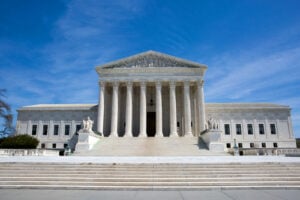
United States Supreme Court Building in Washington, D.C. Photo: Steven Frame / Shutterstock
New York has produced fourteen justices of the Supreme Court of the United States, from the nation’s first Chief Justice, John Jay, to three members of the current Court. Their birthplaces stretch from New York City and the Hudson Valley to the North Country, Central New York, and Western New York.
Their careers span the Supreme Court’s history. Some helped define the federal judiciary’s authority in the early republic, while others wrote or joined major decisions on federalism, civil rights, economic regulation, freedom of the press, equal protection, and the powers of Congress. Here are the fourteen U.S. Supreme Court justices born in New York.
1. John Jay
- Birthplace: New York City (present-day Manhattan).
- Birth Date: December 12, 1745.
- Education: King’s College, now Columbia University, Class of 1764; read law under Benjamin Kissam.
- Supreme Court Tenure: First Chief Justice of the United States, 1789–1795.
- Appointed By: George Washington.
- The Background: Jay was a Founding-era diplomat, co-author of The Federalist Papers, one of the principal drafters of New York’s 1777 Constitution, and the first Chief Justice of the New York Supreme Court of Judicature. Washington nominated him as the first Chief Justice of the United States after Congress created the federal judiciary in 1789.
- Notable Case: Chisholm v. Georgia (1793). The Court held that Article III permitted a citizen of one state to sue another state in federal court. The decision helped prompt adoption of the Eleventh Amendment, which limited federal judicial power over suits against states.
2. Henry Brockholst Livingston
- Birthplace: New York City (present-day Manhattan).
- Birth Date: November 25, 1757.
- Education: College of New Jersey, now Princeton University, Class of 1774; read law.
- Supreme Court Tenure: Associate Justice, 1807–1823.
- Appointed By: Thomas Jefferson.
- The Background: Livingston served in the Continental Army, later worked as private secretary to John Jay during Jay’s diplomatic mission to Spain, practiced law in New York City, and served on the New York Supreme Court of Judicature before joining the U.S. Supreme Court.
- Notable Judicial Work: While riding circuit in United States v. Hoxie (1807), Livingston gave an early interpretation of the Constitution’s definition of treason, distinguishing violence committed for private purposes from the constitutional offense of levying war against the United States.
3. Smith Thompson
- Birthplace: Amenia (Dutchess County).
- Birth Date: January 17, 1768.
- Education: College of New Jersey, now Princeton University, Class of 1788; read law.
- Supreme Court Tenure: Associate Justice, 1823–1843.
- Appointed By: James Monroe.
- The Background: Thompson practiced law in Troy and Poughkeepsie, served on the New York Supreme Court of Judicature from 1802 to 1818, including four years as chief justice, and served as U.S. Secretary of the Navy before joining the Supreme Court. While still a justice, he ran unsuccessfully for Governor of New York in 1828.
- Notable Case: Cherokee Nation v. Georgia (1831). Thompson dissented from the Court’s dismissal of the Cherokee Nation’s suit, concluding that the Cherokee Nation qualified as a foreign state for purposes of the Court’s original jurisdiction.
4. Samuel Nelson
- Birthplace: Hebron (Washington County).
- Birth Date: November 10, 1792.
- Education: Middlebury College, Class of 1813; read law.
- Supreme Court Tenure: Associate Justice, 1845–1872.
- Appointed By: John Tyler.
- The Background: Nelson practiced law in New York and served on the state’s highest court, becoming Chief Justice of the New York Supreme Court of Judicature before his appointment to the U.S. Supreme Court.
- Notable Cases: In Dred Scott v. Sandford (1857), Nelson agreed that the lower-court judgment should be affirmed but wrote a separate opinion focused on Missouri law governing Scott’s legal status rather than joining all of Chief Justice Roger Taney’s reasoning. In the Prize Cases (1863), Nelson dissented from the Court’s decision upholding President Abraham Lincoln’s Civil War blockade of Confederate ports.
5. Ward Hunt
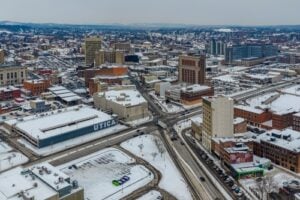
- Birthplace: Utica (Oneida County).
- Birth Date: June 14, 1810.
- Education: Union College, Class of 1828; Litchfield Law School; read law.
- Supreme Court Tenure: Associate Justice, 1873–1882.
- Appointed By: Ulysses S. Grant.
- The Background: Hunt practiced law in Utica, served in the New York State Assembly, was Mayor of Utica, and became Chief Judge of the New York Court of Appeals before his appointment to the Supreme Court.
- Notable Judicial Action: While serving as a Supreme Court justice assigned to the Second Circuit, Hunt presided over United States v. Anthony (1873), the federal criminal trial of Susan B. Anthony for voting in the 1872 election. Hunt directed the jury to return a guilty verdict. Anthony was fined $100, which she refused to pay.
6. Joseph P. Bradley
- Birthplace: Berne (Albany County).
- Birth Date: March 14, 1813.
- Education: Rutgers College, Class of 1836; read law.
- Supreme Court Tenure: Associate Justice, 1870–1892.
- Appointed By: Ulysses S. Grant.
- The Background: Bradley was born in the Helderberg region of Albany County and built a commercial law practice in Newark, New Jersey, before joining the Supreme Court. He also served on the fifteen-member Electoral Commission created by Congress to resolve disputed electoral votes following the 1876 presidential election.
- Notable Case: Civil Rights Cases (1883). Bradley wrote the Court’s opinion holding that the Fourteenth Amendment restricted discriminatory state action but did not give Congress authority under that amendment to prohibit racial discrimination by private individuals and businesses covered by the Civil Rights Act of 1875.
7. Samuel Blatchford
- Birthplace: New York City (present-day Manhattan).
- Birth Date: March 9, 1820.
- Education: Columbia College, Class of 1837; read law.
- Supreme Court Tenure: Associate Justice, 1882–1893.
- Appointed By: Chester A. Arthur.
- The Background: Blatchford worked for Governor William H. Seward, practiced law in Auburn and New York City, and later served successively as a federal district judge, a U.S. circuit judge, and a Supreme Court justice.
- Notable Case: Counselman v. Hitchcock (1892). Blatchford wrote the Court’s opinion holding that a federal immunity statute did not provide protection broad enough to replace the Fifth Amendment privilege against self-incrimination because the compelled witness could still face prosecution based on evidence derived from his testimony.
8. Rufus W. Peckham
- Birthplace: Albany (Albany County).
- Birth Date: November 8, 1838.
- Education: The Albany Academy; read law.
- Supreme Court Tenure: Associate Justice, 1896–1909.
- Appointed By: Grover Cleveland.
- The Background: Peckham practiced law in Albany, served as Albany County District Attorney and Albany corporation counsel, and later served on the New York Supreme Court and New York Court of Appeals.
- Notable Case: Lochner v. New York (1905). Peckham wrote the majority opinion striking down a New York law limiting bakery employees to ten hours of work per day and sixty hours per week. The decision became the namesake for the period of constitutional law commonly called the Lochner era.
9. Charles Evans Hughes
- Birthplace: Glens Falls (Warren County).
- Birth Date: April 11, 1862.
- Education: Brown University, Class of 1881; Columbia Law School, Class of 1884.
- Supreme Court Tenure: Associate Justice, 1910–1916; Chief Justice, 1930–1941.
- Appointed By: William Howard Taft as Associate Justice; Herbert Hoover as Chief Justice.
- The Background: Hughes served two terms as Governor of New York before joining the Supreme Court in 1910. He resigned in 1916 after becoming the Republican presidential nominee and returned to the Court as Chief Justice in 1930.
- Notable Cases: Hughes wrote the majority opinion in Near v. Minnesota (1931), an important decision restricting government prior restraint of the press. He also wrote the majority opinion in West Coast Hotel Co. v. Parrish (1937), which upheld a state minimum-wage law and helped mark the Court’s movement away from the constitutional approach associated with Lochner.
10. Benjamin N. Cardozo
- Birthplace: New York City (present-day Manhattan).
- Birth Date: May 24, 1870.
- Education: Columbia College, Class of 1889; Columbia Law School.
- Supreme Court Tenure: Associate Justice, 1932–1938.
- Appointed By: Herbert Hoover.
- The Background: Cardozo spent most of his judicial career in New York and served as Chief Judge of the New York Court of Appeals before his appointment to the U.S. Supreme Court. His New York decisions in cases including MacPherson v. Buick Motor Co. and Palsgraf v. Long Island Railroad Co. became important authorities in American tort law.
- Notable Cases: Cardozo wrote the Court’s opinions in Helvering v. Davis (1937) and Steward Machine Co. v. Davis (1937), decisions upholding major provisions of the Social Security Act.
11. Ruth Bader Ginsburg
- Birthplace: Brooklyn (Kings County).
- Birth Date: March 15, 1933.
- Education: Cornell University, Class of 1954; Harvard Law School; Columbia Law School, Class of 1959.
- Supreme Court Tenure: Associate Justice, 1993–2020.
- Appointed By: Bill Clinton.
- The Background: Ginsburg grew up in Brooklyn, later taught at Rutgers and Columbia law schools, and worked with the ACLU Women’s Rights Project on litigation involving sex-based classifications under the Constitution. She served on the U.S. Court of Appeals for the District of Columbia Circuit before joining the Supreme Court.
- Notable Case: United States v. Virginia (1996). Ginsburg wrote the majority opinion holding that Virginia had not provided the constitutionally required justification for excluding women from the Virginia Military Institute.
12. John G. Roberts Jr.
- Birthplace: Buffalo (Erie County).
- Birth Date: January 27, 1955.
- Education: Harvard College, Class of 1976; Harvard Law School, Class of 1979.
- Supreme Court Tenure: Chief Justice of the United States, 2005–present.
- Appointed By: George W. Bush.
- The Background: Roberts was born in Buffalo and later moved with his family to Indiana. He clerked for Judge Henry Friendly on the Second Circuit and then-Justice William Rehnquist, served in the executive branch, practiced appellate law, and served on the U.S. Court of Appeals for the District of Columbia Circuit before becoming Chief Justice.
- Notable Case: National Federation of Independent Business v. Sebelius (2012). Roberts wrote the controlling opinion concluding that the Affordable Care Act’s individual mandate could not be sustained under the Commerce Clause but could be upheld as an exercise of Congress’s taxing power.
13. Sonia Sotomayor
- Birthplace: The Bronx (Bronx County).
- Birth Date: June 25, 1954.
- Education: Princeton University, Class of 1976; Yale Law School, Class of 1979.
- Supreme Court Tenure: Associate Justice, 2009–present.
- Appointed By: Barack Obama.
- The Background: Sotomayor was born and raised in the Bronx. She worked as an assistant district attorney in Manhattan and in private practice before serving on the U.S. District Court for the Southern District of New York and the U.S. Court of Appeals for the Second Circuit. She became the first Hispanic justice on the Supreme Court in 2009.
- Notable Opinions: In United States v. Jones (2012), Sotomayor wrote a concurrence discussing the constitutional implications of long-term GPS monitoring. In Utah v. Strieff (2016), she wrote a dissent addressing the Fourth Amendment consequences of unlawful police stops.
14. Elena Kagan
- Birthplace: New York City (Manhattan).
- Birth Date: April 28, 1960.
- Education: Princeton University, Class of 1981; Worcester College, Oxford; Harvard Law School, Class of 1986.
- Supreme Court Tenure: Associate Justice, 2010–present.
- Appointed By: Barack Obama.
- The Background: Kagan grew up on Manhattan’s Upper West Side. She taught at the University of Chicago and Harvard law schools, served in the Clinton administration, became Dean of Harvard Law School, and served as the first woman Solicitor General of the United States before joining the Supreme Court.
- Notable Opinions: Kagan wrote the majority opinion in Kimble v. Marvel Entertainment, LLC (2015), applying principles of stare decisis to patent-royalty law. She also wrote the principal dissent in Rucho v. Common Cause (2019), which concerned federal-court review of partisan gerrymandering claims.
Two Supreme Court Justices Born Elsewhere with Deep New York Ties
Antonin Scalia was born in Trenton, New Jersey, in 1936 and grew up in Elmhurst, Queens. He attended Xavier High School in Manhattan before Georgetown University and Harvard Law School. Scalia served on the Supreme Court from 1986 until his death in 2016 and became a prominent proponent of originalism in constitutional interpretation and textualism in statutory interpretation.
Robert H. Jackson was born in Spring Creek, Pennsylvania, in 1892 but grew up in Frewsburg and Jamestown in Western New York. He attended Albany Law School for one year, read law, and built his legal career in Jamestown and Buffalo. Jackson served as U.S. Solicitor General, U.S. Attorney General, a Supreme Court justice from 1941 to 1954, and chief U.S. prosecutor at the Nuremberg trials. His Supreme Court opinions included the majority opinion in West Virginia State Board of Education v. Barnette (1943) and an influential concurrence in Youngstown Sheet & Tube Co. v. Sawyer (1952).
Quick Reference: 14 U.S. Supreme Court Justices Born in New York
| Justice | New York Birthplace | Supreme Court Tenure | Appointing President |
|---|---|---|---|
| John Jay | New York City | 1789–1795 | George Washington |
| Henry Brockholst Livingston | New York City | 1807–1823 | Thomas Jefferson |
| Smith Thompson | Amenia | 1823–1843 | James Monroe |
| Samuel Nelson | Hebron | 1845–1872 | John Tyler |
| Ward Hunt | Utica | 1873–1882 | Ulysses S. Grant |
| Joseph P. Bradley | Berne | 1870–1892 | Ulysses S. Grant |
| Samuel Blatchford | New York City | 1882–1893 | Chester A. Arthur |
| Rufus W. Peckham | Albany | 1896–1909 | Grover Cleveland |
| Charles Evans Hughes | Glens Falls | 1910–1916; 1930–1941 | William Howard Taft / Herbert Hoover |
| Benjamin N. Cardozo | New York City | 1932–1938 | Herbert Hoover |
| Ruth Bader Ginsburg | Brooklyn | 1993–2020 | Bill Clinton |
| John G. Roberts Jr. | Buffalo | 2005–present | George W. Bush |
| Sonia Sotomayor | The Bronx | 2009–present | Barack Obama |
| Elena Kagan | New York City | 2010–present | Barack Obama |
For more New York government and civic history, read How New York City Once Served as the Capital of the United States and our History of New York’s City Hall.