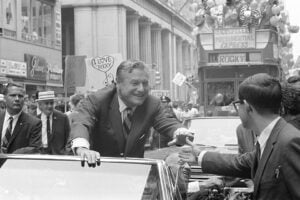
New York Governor Nelson Rockefeller campaigns for president in 1968. Photo: Warren K. Leffler / U.S. News & World Report Collection, Public Domain, via Wikimedia Commons
New York governors have repeatedly moved from state politics into presidential politics. Four governors on this list were later elected president: Martin Van Buren, Grover Cleveland, Theodore Roosevelt, and Franklin D. Roosevelt. Others won major-party presidential nominations or sought those nominations at national conventions and in primary campaigns.
This list focuses on fifteen New York governors who mounted documented campaigns for the presidency or sought a major-party presidential nomination. In several cases, the presidential campaign came before or after the candidate’s years in Albany rather than during the governorship itself.
1. George Clinton
- Years as Governor: 1777–1795, 1801–1804
- Presidential Campaign: 1808
- The Campaign: New York’s first governor later served as vice president under Thomas Jefferson. In 1808, while still vice president, Clinton sought the presidency as James Madison emerged as the leading Democratic-Republican candidate. Madison won the election, while six New York electors cast presidential votes for Clinton. Clinton was simultaneously reelected vice president and served under Madison until his death in 1812.
2. DeWitt Clinton
- Years as Governor: 1817–1822, 1825–1828
- Presidential Campaign: 1812
- The Campaign: DeWitt Clinton, a nephew of George Clinton and later one of the principal political figures associated with the Erie Canal, challenged President James Madison in 1812. Clinton received support from an unusual coalition that included northern Democratic-Republicans opposed to Madison and much of the Federalist Party. Madison won reelection with 128 electoral votes to Clinton’s 89.
3. Martin Van Buren
- Years as Governor: January 1, 1829–March 5, 1829
- Presidential Campaigns: 1836, 1840, 1844, 1848
- The Campaign: Van Buren left the governorship after a short tenure to become Andrew Jackson’s secretary of state and later vice president. He won the presidency in 1836 with 170 electoral votes, but lost his reelection campaign to William Henry Harrison in 1840. Van Buren sought the Democratic nomination again in 1844 but did not win it. In 1848, he returned as the presidential nominee of the Free Soil Party and received nearly 300,000 popular votes without winning an electoral vote.
4. Horatio Seymour
- Years as Governor: 1853–1854, 1863–1864
- Presidential Campaign: 1868
- The Campaign: Seymour served two nonconsecutive terms as governor and was a prominent Democrat during the Civil War era. He chaired the 1868 Democratic National Convention and initially resisted efforts to nominate him, but the convention selected him on the twenty-second ballot. Republican Ulysses S. Grant won the general election with 214 electoral votes to Seymour’s 80, while the national popular vote was considerably closer.
5. Samuel J. Tilden
- Years as Governor: 1875–1876
- Presidential Campaign: 1876
- The Campaign: Tilden built a national reputation through reform efforts in New York, including his role in opposing the Tweed Ring and the state’s Canal Ring. As the Democratic presidential nominee in 1876, he received about 255,000 more popular votes than Republican Rutherford B. Hayes. Electoral votes from four states were disputed. A congressional Electoral Commission awarded the disputed votes to Hayes, who won the Electoral College 185 to 184.
6. Grover Cleveland
- Years as Governor: 1883–1885
- Presidential Campaigns: 1884, 1888, 1892
- The Campaign: Cleveland moved rapidly from Mayor of Buffalo to Governor of New York and then to the Democratic presidential nomination. He won the presidency in 1884. In 1888, Cleveland received more popular votes than Republican Benjamin Harrison but lost the Electoral College. He returned in 1892 and defeated Harrison, becoming the first president to win two nonconsecutive terms.
7. David B. Hill
- Years as Governor: 1885–1891
- Presidential Campaign: 1892
- The Campaign: Hill succeeded Cleveland as governor and later served in the U.S. Senate. In 1892, he sought the Democratic presidential nomination and had the support of New York’s delegation at the national convention. Former President Grover Cleveland ultimately won the nomination and then the general election.
8. Theodore Roosevelt
- Years as Governor: 1899–1900
- Presidential Campaigns: 1904, 1912
- The Campaign: Roosevelt became vice president after his term as governor and assumed the presidency following William McKinley’s assassination in Buffalo in 1901. In 1904, Roosevelt won election to a full presidential term with 336 electoral votes. In 1912, after unsuccessfully challenging President William Howard Taft for the Republican nomination, Roosevelt ran as the Progressive Party candidate. He finished second in the general election with 88 electoral votes, ahead of Taft’s eight.
9. Charles Evans Hughes
- Years as Governor: 1907–1910
- Presidential Campaign: 1916
- The Campaign: Hughes left the governorship after President William Howard Taft appointed him to the U.S. Supreme Court. He resigned from the Court in 1916 after winning the Republican presidential nomination. President Woodrow Wilson won reelection with 277 electoral votes to Hughes’s 254. California proved decisive, with Wilson carrying the state by 3,420 votes.
10. Al Smith
- Years as Governor: 1919–1920, 1923–1928
- Presidential Campaigns: 1924, 1928, 1932
- The Campaign: Smith sought the Democratic nomination in 1924 during a convention that required 103 ballots before John W. Davis was selected. Four years later, Smith won the Democratic nomination and became the first Roman Catholic nominated for president by a major American political party. Republican Herbert Hoover defeated him in the 1928 general election. Smith again competed for the Democratic nomination in 1932, when Franklin D. Roosevelt won the nomination on the fourth ballot.
11. Franklin D. Roosevelt
- Years as Governor: 1929–1932
- Presidential Campaigns: 1932, 1936, 1940, 1944
- The Campaign: Roosevelt served two terms as governor as New York expanded unemployment relief and other responses to the Great Depression. He won the Democratic presidential nomination in 1932 and defeated President Herbert Hoover. Roosevelt then won reelection in 1936, 1940, and 1944, becoming the only U.S. president elected to four terms.
12. Thomas E. Dewey
- Years as Governor: 1943–1954
- Presidential Campaigns: 1940, 1944, 1948
- The Campaign: Dewey first sought the Republican presidential nomination in 1940 before becoming governor. He won the Republican nomination in 1944 and lost the general election to Franklin D. Roosevelt. The party nominated Dewey again in 1948, when President Harry S. Truman won 303 electoral votes to Dewey’s 189. The election became especially well known because the Chicago Daily Tribune prematurely printed the headline “Dewey Defeats Truman.”
13. W. Averell Harriman
- Years as Governor: 1955–1958
- Presidential Campaigns: 1952, 1956
- The Campaign: Harriman had already served as a diplomat and senior federal official when he sought the Democratic presidential nomination in 1952. After becoming governor of New York, he mounted another nomination campaign in 1956. Former Illinois Governor Adlai Stevenson won the Democratic nomination both years.
14. Nelson Rockefeller
- Years as Governor: 1959–1973
- Presidential Campaigns: 1960, 1964, 1968
- The Campaign: Rockefeller served nearly fifteen years as governor and became a prominent national Republican. He sought the Republican presidential nomination in 1960, 1964, and 1968 but did not win the nomination. In 1974, President Gerald Ford nominated Rockefeller to become vice president, and he served in that office until 1977.
15. George Pataki
- Years as Governor: 1995–2006
- Presidential Campaign: 2016
- The Campaign: Pataki served three terms as governor after defeating incumbent Governor Mario Cuomo in 1994. In May 2015, he announced a campaign for the 2016 Republican presidential nomination. Pataki participated in the campaign and debate process during 2015 but ended his candidacy in December, before the first caucuses and primaries were held.
Quick Reference: New York Governors and Presidential Campaigns
| Governor | Years as New York Governor | Presidential Campaigns | Result |
|---|---|---|---|
| George Clinton | 1777–1795, 1801–1804 | 1808 | Received 6 presidential electoral votes; reelected vice president |
| DeWitt Clinton | 1817–1822, 1825–1828 | 1812 | General-election nominee; 89 electoral votes |
| Martin Van Buren | 1829 | 1836, 1840, 1844, 1848 | Elected president in 1836; later Democratic and Free Soil campaigns |
| Horatio Seymour | 1853–1854, 1863–1864 | 1868 | Democratic nominee; 80 electoral votes |
| Samuel J. Tilden | 1875–1876 | 1876 | Democratic nominee; won popular vote, lost Electoral College 185–184 |
| Grover Cleveland | 1883–1885 | 1884, 1888, 1892 | Elected president in 1884 and 1892 |
| David B. Hill | 1885–1891 | 1892 | Sought Democratic nomination |
| Theodore Roosevelt | 1899–1900 | 1904, 1912 | Elected in 1904; Progressive nominee in 1912 |
| Charles Evans Hughes | 1907–1910 | 1916 | Republican nominee; 254 electoral votes |
| Al Smith | 1919–1920, 1923–1928 | 1924, 1928, 1932 | Democratic nominee in 1928 |
| Franklin D. Roosevelt | 1929–1932 | 1932, 1936, 1940, 1944 | Elected president four times |
| Thomas E. Dewey | 1943–1954 | 1940, 1944, 1948 | Republican nominee in 1944 and 1948 |
| W. Averell Harriman | 1955–1958 | 1952, 1956 | Sought Democratic nomination twice |
| Nelson Rockefeller | 1959–1973 | 1960, 1964, 1968 | Sought Republican nomination three times |
| George Pataki | 1995–2006 | 2016 | Sought Republican nomination; ended campaign before primary voting |
For more New York government history, read How New York City Once Served as the Capital of the United States and our History of New York’s City Hall.