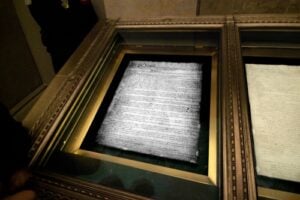
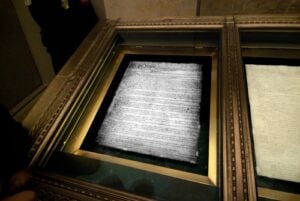
Original copies of the Declaration of Independence and U.S. Constitution displayed in the National Archives Rotunda in Washington, D.C. Photo: Dennis MacDonald / Shutterstock
New York was represented by four signers of the Declaration of Independence in 1776 and by one signer of the United States Constitution in 1787. Together, William Floyd, Philip Livingston, Francis Lewis, Lewis Morris, and Alexander Hamilton connected New York directly to two of the nation’s most important founding documents.
New York’s path to independence was complicated. On July 2, 1776, the colony did not vote on Richard Henry Lee’s independence resolution because its delegates were still waiting for new instructions. The New York Provincial Congress approved independence on July 9. Most delegates signed the engrossed Declaration on August 2, although some signatures were added later.
Eleven years later, New York sent Alexander Hamilton, Robert Yates, and John Lansing Jr. to the Constitutional Convention in Philadelphia. Yates and Lansing opposed replacing the Articles of Confederation with a stronger national framework and left the convention before it ended. Hamilton became the only New York delegate to sign the Constitution.
1. William Floyd
- Document Signed: Declaration of Independence.
- Birth: December 17, 1734, Brookhaven, Long Island.
- New York Connection: Mastic, Suffolk County; later Westernville, Oneida County.
- The Background: Floyd inherited the family’s large Mastic estate and became active in Suffolk County politics and the militia before representing New York in the First and Second Continental Congresses. The National Park Service notes that the Floyd estate was operated with enslaved, indentured, and free labor.
- Revolutionary War Impact: As British forces took control of Long Island in 1776, Floyd and his family were forced to leave the estate. British troops quartered in the Old Mastic House during the war, and Floyd remained in exile for years before returning after the British evacuation.
- Later Service: Floyd served in the New York State Senate, represented New York in the First United States Congress, and later lived in Westernville, Oneida County, where he died in 1821.
2. Philip Livingston
- Document Signed: Declaration of Independence.
- Birth: January 15, 1716, Albany.
- New York Connection: Albany and New York City.
- The Background: Livingston came from one of colonial New York’s most prominent families and built a successful mercantile career in New York City. He served in the Stamp Act Congress, the First Continental Congress, and the Second Continental Congress and was president of the New York Provincial Convention in 1775.
- Revolutionary War Service: Livingston remained active in the Continental Congress during the war and also served in the New York State Senate. His commercial experience made him an important figure in congressional committees dealing with finance, trade, and wartime supply.
- Wartime Fate: Livingston died on June 12, 1778, while attending the Continental Congress in York, Pennsylvania. Congress attended his funeral as a body, and he was buried in York.
3. Francis Lewis
- Document Signed: Declaration of Independence.
- Birth: March 21, 1713, Llandaff, Wales.
- New York Connection: New York City and Whitestone, Queens.
- The Background: Lewis immigrated to America as a young merchant and established businesses in New York and Philadelphia. During the French and Indian War, he was captured at Oswego and taken to France. He later represented New York in the Stamp Act Congress and the Continental Congress.
- Revolutionary War Impact: Historical accounts record that Lewis’s property on Long Island was destroyed during the war and that his wife, Elizabeth, was imprisoned by the British for several months. Her health declined after her confinement, and she died during the war.
- Later Service: Lewis remained in the Continental Congress through 1779 and served on committees dealing with naval and wartime affairs. He died in New York City in 1802.
4. Lewis Morris
- Document Signed: Declaration of Independence.
- Birth: April 8, 1726, Morrisania, then in Westchester County and now part of the Bronx.
- New York Connection: Morrisania and Westchester County.
- The Background: Morris was a wealthy landowner and Yale graduate who served in the New York colonial assembly, the New York Provincial Congress, and the Second Continental Congress. He signed the Declaration as a New York delegate in 1776.
- Revolutionary War Impact: Morrisania lay in a heavily contested part of the New York region during the war, and Morris’s estate suffered during the British occupation. The well-known line “Damn the consequences, give me the pen” has long been attributed to Morris when he was warned about the risks of signing, although the quotation comes from later historical tradition rather than a contemporary record.
- Later Service: Morris served in the New York State Senate, on the state’s Board of Regents, and as a delegate to the 1788 New York convention that ratified the U.S. Constitution.
5. Alexander Hamilton
- Document Signed: United States Constitution.
- Birth: January 11, 1755 or 1757, Nevis in the British West Indies.
- New York Connection: New York City and Albany.
- The Background: Hamilton came to New York as a teenager, attended King’s College, served in the Continental Army, and became one of George Washington’s aides-de-camp. He later commanded troops during the successful assault on Redoubt 10 at Yorktown.
- Constitutional Role: New York appointed Hamilton, Robert Yates, and John Lansing Jr. to the Constitutional Convention. Yates and Lansing left after concluding that the convention was creating an entirely new national government rather than simply revising the Articles of Confederation. Hamilton remained New York’s only signer of the finished Constitution on September 17, 1787.
- Ratification and National Service: Hamilton, James Madison, and John Jay wrote the 85 essays known as The Federalist to argue for ratification. Hamilton is credited with 51 of them. New York ratified the Constitution at its Poughkeepsie convention by a vote of 30 to 27. In 1789, President George Washington appointed Hamilton the first Secretary of the Treasury.
Two Important New Yorkers Who Do Not Count Among the Five
Robert R. Livingston represented New York in the Second Continental Congress and was one of the five members appointed to draft the Declaration of Independence. He returned to New York before the engrossed Declaration was signed and therefore does not appear among its signers. Livingston later became New York’s first chancellor and administered the presidential oath to George Washington in New York City in 1789.
Gouverneur Morris was born at Morrisania in what is now the Bronx and played an important role in New York’s Revolutionary government. By the time of the Constitutional Convention, however, he had moved to Pennsylvania and represented that state in Philadelphia. Morris served on the Committee of Style, and historical evidence credits him with much of the Constitution’s final wording, including the opening phrase “We the People of the United States.” He signed the Constitution as a Pennsylvania delegate, not as a New York delegate.
Quick Reference: New York Signers of the Declaration and Constitution
| Signer | Document | New York Connection | Historic Distinction |
|---|---|---|---|
| William Floyd | Declaration of Independence | Mastic, Suffolk County | Long Island estate occupied by British troops; later served in the First U.S. Congress |
| Philip Livingston | Declaration of Independence | Albany and New York City | Merchant and Continental Congress delegate; died while Congress met in York, Pennsylvania |
| Francis Lewis | Declaration of Independence | Whitestone, Queens | Merchant and Continental Congress delegate; family suffered during British occupation |
| Lewis Morris | Declaration of Independence | Morrisania, now the Bronx | New York legislator and delegate to the state’s 1788 ratification convention |
| Alexander Hamilton | U.S. Constitution | New York City and Albany | Only New York delegate to sign the Constitution; first Secretary of the Treasury |
For more New York Revolutionary history, read How the Taverns of New York City Stirred the American Revolution and our History of New York’s Fraunces Tavern. For the story of New York’s later role in the new federal government, see How New York City Once Served as the Capital of the United States.