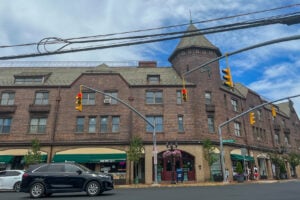

Middle Neck Road in Great Neck Plaza, Long Island. Photo: AITFFan1 / Wikimedia Commons, CC BY-SA 4.0.
Great Neck has occupied an unusual place in the story of Long Island. Its peninsula stretches toward Long Island Sound just east of the Queens border, close enough to Manhattan for a daily commute but with villages, residential streets and a waterfront identity of its own. In the 1920s, F. Scott Fitzgerald lived in Great Neck and drew on the area when he imagined West Egg in The Great Gatsby. By the middle of the century, its public schools had become another important part of the community’s reputation.
What makes Great Neck particularly fascinating is the extraordinary range of people who came out of those schools and neighborhoods. Francis Ford Coppola and his sister Talia Shire attended local high schools. Andy Kaufman was entertaining other children long before he became one of comedy’s most unpredictable performers. Future Olympic champion Sarah Hughes practiced on a rink her father built at home. A school cafeteria helped launch David Yurman’s career in jewelry design, while other Great Neck graduates went into medicine, journalism, finance and space exploration.
The name Great Neck can refer to the incorporated village, the broader peninsula or the communities served by the Great Neck public school district. For this article, the connection must be real: birth in the area, a meaningful childhood or documented schooling there. Some people spent their formative years in Great Neck; others were born nearby and left when young. We explain those differences rather than treating every connection as the same.
From two Olympic figure skaters and a Nobel Prize-winning scientist to movie stars, entrepreneurs and a pioneer of artificial intelligence, these are 25 famous people whose lives connect to Great Neck, Long Island.
1. Francis Ford Coppola
Francis Ford Coppola spent important years of his childhood and adolescence in Great Neck, where illness gave him an early reason to turn inward toward storytelling. After contracting polio as a boy, he occupied himself with puppets, recordings and homemade theatrical productions. The family’s musical background also shaped his imagination: his father, Carmine Coppola, was a professional musician and composer. The future filmmaker eventually began experimenting with cameras and home movies.
Coppola graduated in 1956 from Great Neck High School, the institution later identified as Great Neck North. He continued to Hofstra University and then the University of California, Los Angeles, where he studied filmmaking. In the early 1970s, he emerged as a central figure in a generation of American directors who brought personal artistic ambitions into major studio productions.
His direction of The Godfather and The Godfather Part II transformed the gangster film, while The Conversation and Apocalypse Now demonstrated his range and willingness to take extraordinary risks. He has won five Academy Awards. Behind the reputation of a Hollywood visionary is a young filmmaker who began learning to tell stories in the homes and classrooms of Great Neck.
2. Talia Shire
Talia Shire was born Talia Rose Coppola in Lake Success and grew up in the Great Neck area with her brother Francis. The Coppola household was filled with music and creative interests, but her own path into acting took shape through school and formal theatrical training. She graduated from Great Neck South High School in 1964 and attended Yale’s School of Drama on a scholarship.
Shire became internationally recognized through two of the most successful film series in American history. She portrayed Connie Corleone in The Godfather films, bringing emotional complexity to a character living within a powerful and often destructive family. Her performance in The Godfather Part II earned an Academy Award nomination for Best Supporting Actress.
She followed that achievement with the role of Adrian in Rocky, playing a quiet woman whose growing confidence helped anchor the film’s love story. That performance earned her a second Oscar nomination, this time for Best Actress. Great Neck’s connection to the Coppola family is particularly unusual: two siblings who attended its schools became central figures in some of the most enduring films of the 1970s.
3. Andy Kaufman
Andy Kaufman grew up in Great Neck, attending Saddle Rock and Baker elementary schools before graduating from Great Neck North High School in 1967. As a child, he staged performances at home and entertained other youngsters, developing an early fascination with the relationship between a performer and an audience. What interested him was not simply telling jokes but discovering what people would believe, question or find uncomfortable.
After college, Kaufman developed a nightclub act that moved between awkward sincerity, elaborate parody and astonishing impersonations. His performances on Saturday Night Live included the now-famous lip-synching routine to the Mighty Mouse theme. He became widely known as Latka Gravas on the television series Taxi, yet he remained determined not to be confined by a conventional sitcom identity.
His invented lounge singer Tony Clifton and his provocative wrestling appearances blurred the boundary between reality and performance. Some audiences were delighted; others had no idea what to make of him. Kaufman died of lung cancer in 1984 at just 35, but his influence continues in experimental comedy and performance art. The beginnings of that unconventional career can be traced to a Great Neck boy putting on shows for anyone willing to watch.
4. George Segal
George Segal grew up in Great Neck and developed an early interest in entertaining people. Music was part of his life as well as acting, and he became an accomplished banjo player who continued performing throughout his career. After military service and college, Segal worked in New York theater before receiving film roles during the early 1960s.
His breakthrough came with a memorable performance opposite Elizabeth Taylor and Richard Burton in Who’s Afraid of Virginia Woolf?, which earned him an Academy Award nomination for Best Supporting Actor. He then moved comfortably between dramatic parts and comedies, appearing in A Touch of Class, California Split and Fun with Dick and Jane.
Later generations recognized him from television, especially Just Shoot Me! and The Goldbergs, where he played the warmhearted grandfather Albert Solomon. Segal died in 2021 after a career spanning more than half a century. His mixture of humor, vulnerability and musical enthusiasm made him a particularly distinctive screen personality with roots on Long Island’s North Shore.
5. Sarah Hughes
Sarah Hughes was raised in Great Neck in a family that supported her passion for figure skating. She began skating at three years old on a backyard rink built by her father, an unusually personal starting point for an athlete who would eventually compete before millions of television viewers. As she improved, her schedule became a demanding balance of school, training and national competitions.
At the 2002 Winter Olympics in Salt Lake City, Hughes entered the final round behind several competitors who had received more attention as likely gold medalists. Her extraordinary free-skating performance brought her the Olympic championship at just sixteen. The victory made her a national celebrity and prompted an enthusiastic hometown celebration in Great Neck.
Hughes continued her education, graduating from Great Neck North High School in 2003 and earning a degree from Yale University in 2009. She also became involved in charitable and sports-related activities. Her Olympic achievement remains one of the most celebrated moments in Nassau County sports history, made all the more memorable by the fact that another member of the Hughes family would soon reach the Olympics.
6. Sarah Sherman
Comedian Sarah Sherman grew up in Great Neck and attended Great Neck South High School, graduating in 2011. Her early interest in comedy was nurtured partly through school improvisation and performances at Levels, the youth center connected with the Great Neck Library. She was drawn to unusual, sometimes deliberately grotesque humor rather than the safer routines expected of a conventional young comic.
After studying theater and art history at Northwestern University, Sherman developed her act in Chicago’s experimental comedy scene. Performing as Sarah Squirm, she mixed stand-up, absurdist sketches, unsettling visual effects and inventive theatrical staging. Her work stood out precisely because it challenged the expected structure of a comedy performance.
In 2021, she joined the cast of Saturday Night Live and later became a repertory player. Her appearances on Weekend Update and her willingness to take a sketch in an unexpected direction introduced a national audience to the sensibility she had begun developing as a Great Neck teenager. Her success also demonstrates that the community’s tradition of original comedy did not end with Andy Kaufman.
7. Natasha Lyonne
Natasha Lyonne spent much of her earliest childhood in Great Neck before her family moved to Israel when she was about eight. Her upbringing was not confined to one place: after returning to New York, she spent important years in Manhattan. Still, Great Neck was the setting for the first part of her life, before childhood acting and a series of moves made her experiences very different from those of many suburban children.
Lyonne gained notice in films including Slums of Beverly Hills, But I’m a Cheerleader and American Pie. Her recognizable voice and unconventional screen presence helped her create characters who rarely fit neatly into traditional Hollywood categories. After a difficult period in her personal life, she returned to major prominence as Nicky Nichols in Orange Is the New Black.
She later co-created and starred in Russian Doll, a series built around repeating experiences, identity and the consequences of personal choices. She also starred in the mystery series Poker Face. Lyonne’s Great Neck connection belongs specifically to early childhood, but her subsequent career has made her one of the most distinctive New York personalities on contemporary television.
8. Steve Cohen
Steve Cohen grew up in Great Neck as one of eight children in a family that lived on Lawson Lane. He attended Great Neck North High School, graduating in 1974, and was already a dedicated New York Mets fan. He later studied economics at the Wharton School of the University of Pennsylvania, preparing for a career that would make him one of the most prominent figures in the hedge-fund industry.
Cohen founded S.A.C. Capital Advisors and later Point72 Asset Management, building a substantial financial business. His firms also became subjects of intense scrutiny over trading practices, and S.A.C. Capital pleaded guilty to criminal insider-trading charges in 2013. That history forms an important part of his financial career alongside his considerable business success.
In 2020, Cohen purchased a controlling interest in the New York Mets, returning his name to the attention of baseball fans who might never have followed Wall Street. For a man who had grown up supporting the team from Great Neck, ownership created an unusual connection between childhood loyalty and professional ambition. His career spans two very different New York worlds: finance and baseball.
9. Kenneth Cole
Fashion entrepreneur Kenneth Cole grew up in Great Neck and graduated from Great Neck North High School in 1972. His father worked in the footwear business, giving him an early view of an industry in which design, pricing and presentation all mattered. After attending Emory University, Cole developed his own ideas about how to introduce a new shoe line in a highly competitive New York market.
In 1982, he launched Kenneth Cole Productions with an inventive publicity maneuver involving a truck near a major Manhattan hotel. The promotion allowed him to show his footwear collection without paying the high costs normally associated with a showroom. What began as a relatively small footwear business expanded into clothing, accessories and a nationally recognized fashion label.
Cole also became known for advertising campaigns that addressed issues including AIDS awareness and homelessness, bringing social commentary into commercial fashion marketing. His company’s growth and his willingness to challenge conventional advertising made him influential beyond shoe design. The foundations of that business education began in the Great Neck community where he went to school.
10. David Yurman
David Yurman’s interest in making things was already evident while he attended Great Neck South High School. He graduated in 1960, and the school district’s alumni archive recalls that he sold small sculptures in the school cafeteria. What might have appeared to classmates as a teenager’s creative hobby was actually an early glimpse of the artist and entrepreneur he would become.
Yurman continued working with sculpture, traveled to California and eventually returned to New York, where he met artist Sybil Kleinrock. The two developed a creative and business partnership that became central to his career. They established the David Yurman company in 1980, combining fine-art techniques with jewelry that could be worn as part of everyday life.
The brand’s signature cable bracelet, with its twisted metal form, became one of the most recognizable designs in American luxury jewelry. Yurman’s work helped blur the traditional boundaries between sculpture, craft and fashion. Great Neck’s claim to his story is especially memorable because his first commercial experiments took place not in a Manhattan boutique but inside a high school cafeteria.
11. Burt Shavitz
Burt Shavitz was raised in Great Neck under the name Ingram Berg Shavitz and changed his name after finishing high school in 1953. His later appearance, with a long beard and a simple life in rural Maine, hardly suggested a childhood on suburban Long Island. But the contrast between those two settings became one of the most interesting parts of his personal story.
After military service, Shavitz worked as a photojournalist in New York, selling photographs to publications before leaving the city. He moved to Maine and began keeping bees and selling honey. In the 1980s, he met Roxanne Quimby, and the two developed products from beeswax that would become the foundation of Burt’s Bees.
The company grew from a modest enterprise into a major personal-care brand, famous for lip balm and products emphasizing natural ingredients. It was eventually acquired by Clorox in a deal valued at more than $900 million. Shavitz died in 2015. His journey from Great Neck to a Maine cabin, and then onto the labels of products sold around the world, remains one of the more unexpected business stories connected to the community.
12. Jon Taffer
Jon Taffer grew up in Great Neck and graduated from Great Neck South High School in 1972. After a short period at the University of Denver, he headed west and began working in the hospitality business. His early professional experiences involved learning how bars, restaurants and entertainment venues operated, particularly the relationship between customer behavior and a business’s financial performance.
Taffer developed a reputation as a consultant and executive in the nightclub industry. He also participated in the development of the NFL Sunday Ticket concept, which enabled fans to watch out-of-market football games. His work brought together marketing, entertainment and the economics of attracting customers to bars and other venues.
He became widely known through Bar Rescue, the television series in which he and his team attempted to improve struggling establishments. His confrontational screen personality became a defining part of the show’s identity. Long before the cameras and dramatic confrontations, however, Taffer was a Great Neck student preparing for a career built around understanding how businesses serve their customers.
13. Christopher Lambert
Christopher Lambert’s connection to Great Neck is a brief one, but it is an intriguing part of his biography. Born in 1957 on Nassau County’s North Shore, his birthplace is identified as Great Neck in some reference works and as nearby Manhasset in others. His father was a French diplomat working in connection with the United Nations, and the family left the United States while Lambert was still very young. He grew up principally in Europe.
Lambert established himself as an actor in French cinema, gaining critical recognition for his leading role in Subway, for which he received the César Award for Best Actor. He then reached an international audience with Highlander, playing the immortal Connor MacLeod in a fantasy film that became a cult favorite.
His subsequent work included Mortal Kombat and many other international productions. Lambert was not educated in Great Neck and should not be described as having spent his formative years there. His inclusion reflects a reported birthplace in the Great Neck-Manhasset area, rather than the more substantial hometown connections held by most people on this list.
14. Nikki Blonsky
Nikki Blonsky grew up in Great Neck and was active in local musical theater before reaching national fame. She attended schools in the Great Neck district and graduated from the Village School in 2006. Her early performances included community productions, and she developed a passion for singing and acting long before she had professional opportunities.
While working at a Cold Stone Creamery, Blonsky auditioned for the film adaptation of the musical Hairspray. She won the role of Tracy Turnblad and appeared in the 2007 movie alongside John Travolta, Michelle Pfeiffer and Christopher Walken. The casting was a dramatic change in fortune for a young Long Island performer who had been pursuing her ambitions through local theater.
The film brought Blonsky critical recognition, including a Golden Globe nomination, and introduced her to an international audience. She later appeared in television and independent films, continuing a career that began with a remarkable breakthrough. Great Neck’s schools and community stages played an essential part in the story of how she reached the screen.
15. Helen Slater
Helen Slater was born on Long Island and spent part of her school years at Great Neck South High School. She later transferred to Manhattan’s High School of Performing Arts, where she graduated in 1982. Her local connection is therefore through her upbringing and education in the Great Neck area, rather than a claim that she completed her studies at Great Neck South.
At twenty, Slater won the title role in the 1984 film Supergirl, bringing a well-known comic-book character to the big screen. She followed it with performances in The Legend of Billie Jean, Ruthless People and other films. Her screen work displayed a combination of dramatic ability and the musical interests that had shaped her earlier training.
Slater later returned to the superhero world through television appearances in Smallville and Supergirl, introducing her to viewers who had not seen the original movie. She also pursued songwriting and recording. Her story illustrates how a young performer could begin in Great Neck’s schools, complete specialized arts training in Manhattan and enter the film industry at an unusually early age.
16. Bruce Paltrow
Bruce Paltrow was born in Brooklyn but grew up in Great Neck, graduating from Great Neck South High School in 1961. He later attended Tulane University and developed a career in television during a period when American dramas were becoming more ambitious in subject matter and storytelling. His early years on Long Island preceded a career that helped redefine what a weekly network series could attempt.
Paltrow created The White Shadow, a basketball drama that explored the experiences of high school students and their coach. He also became a major creative force behind St. Elsewhere, the critically acclaimed hospital drama known for its large cast, complex characters and unusually layered storylines. Both shows influenced later television writers and producers.
He was married to actress Blythe Danner and was the father of Gwyneth Paltrow and director Jake Paltrow, but his professional achievements deserve recognition in their own right. Bruce Paltrow died in 2002. His career connects a Great Neck public-school education to some of the most distinctive American television dramas of the late twentieth century.
17. Andrew Watt
Andrew Wotman, professionally known as Andrew Watt, grew up in Great Neck in a household where rock and soul records were part of everyday life. He graduated from Great Neck North High School in 2008. As a teenager, he played guitar and spent time traveling into Manhattan to watch experienced musicians perform, gradually learning how the music he loved was assembled.
Watt developed into a songwriter, guitarist and producer whose projects crossed pop, hip-hop and rock music. He worked with artists including Post Malone, Dua Lipa, Justin Bieber and Ozzy Osbourne, earning the Grammy Award for Producer of the Year, Non-Classical, in 2021. His approach emphasized the sound and personalities of the artists he worked with rather than confining him to one genre.
His later collaborations included the Rolling Stones and Pearl Jam, the latter a band he had admired during his youth. Those sessions brought him full circle to the classic rock recordings that had helped shape his musical ambitions in Great Neck. His career is another example of the community producing creative people whose influence reaches audiences far beyond Long Island.
18. David Baltimore
David Baltimore grew up in Great Neck and graduated from Great Neck High School in 1956. An early interest in science was encouraged by educational opportunities, including a summer biology program that helped deepen his commitment to research. He went on to Swarthmore College and Rockefeller University, studying biology during an era of important discoveries about viruses and the workings of cells.
In 1970, Baltimore independently identified reverse transcriptase, an enzyme that allows certain viruses to make DNA from an RNA template. The discovery challenged prevailing assumptions about the flow of genetic information and helped transform molecular biology. He shared the 1975 Nobel Prize in Physiology or Medicine with Howard Temin and Renato Dulbecco for research concerning the interaction of tumor viruses with the genetic material of cells.
Baltimore’s later career included leading major research institutions, among them Rockefeller University and the California Institute of Technology. His work helped inform the study of retroviruses, cancer and the immune system. For a community celebrated for its schools, Baltimore offers one of the clearest examples of a Great Neck education preceding a contribution of worldwide scientific importance.
19. David Seidler
David Seidler came to the United States as a child after his family escaped wartime Europe. They eventually settled in Great Neck, and he graduated from Great Neck High School in 1955. He had struggled with a stutter, and stories about King George VI’s efforts to overcome a similar speech difficulty left a lasting impression on him.
Seidler pursued writing and worked in film, television and theater for decades. The story of the British monarch remained a personal project, eventually becoming The King’s Speech. The 2010 film followed the relationship between George VI and speech therapist Lionel Logue, turning a historical episode into an intimate drama about fear, responsibility and the struggle to communicate.
Seidler won the Academy Award for Best Original Screenplay in 2011 and died in 2024. The success of the film was especially meaningful because its central subject touched on a problem he had known firsthand. His connection to Great Neck was not merely a passing residence: he was a documented graduate of its high school, years before his most celebrated screenplay reached movie theaters.
20. Dawn Steel
Dawn Steel grew up in Great Neck and graduated from Great Neck South High School in 1964, the same class as Talia Shire. Her interest in business and entertainment took her from Long Island into the worlds of publishing, merchandising and eventually Hollywood. She developed a reputation for understanding both the artistic appeal of a film and the practical decisions necessary to bring it to audiences.
Steel entered Paramount Pictures in the late 1970s and rose rapidly through its executive ranks. She was associated with commercial successes such as Flashdance and Top Gun. In 1987, she became president of Columbia Pictures, making her the first woman to lead a major Hollywood movie studio. Her appointment was a landmark in an industry where the highest executive positions had long been dominated by men.
Steel continued producing films and supporting projects until her death in 1997 at the age of 51. Her career changed expectations about who could direct the business affairs of a major studio. Great Neck South’s alumni include many performers, but Steel’s achievements show that the community also produced people who influenced what movies were made and how they reached the public.
21. Bob Simon
Bob Simon was born in the Bronx in 1941 and grew up in Great Neck. He graduated in 1958 from Great Neck High School, before the later distinction between the district’s North and South schools became part of its modern alumni identity. He studied history at Brandeis University, graduating with honors, and pursued further studies in France before entering broadcast journalism.
Simon joined CBS News in 1967 and became one of the network’s most respected foreign correspondents. His reporting took him to Vietnam, the Middle East and many other regions experiencing war or political upheaval. During the 1991 Gulf War, he and members of his television crew were captured by Iraqi forces and held for forty days, an ordeal that underscored the risks he repeatedly accepted in his work.
He later became a familiar correspondent on 60 Minutes and received 27 Emmy Awards and four Peabody Awards during his career. Simon died in a New York City car crash in 2015. His life traced an extraordinary route from the classrooms of Great Neck to some of the world’s most dangerous places, always grounded in the work of explaining international events to American viewers.
22. John Schulman
Computer scientist John Schulman attended Great Neck South High School, where he showed exceptional talent in physics. The American Association of Physics Teachers listed him as a Great Neck South student in its 2004 Physics Olympiad program. He went on to study physics at the California Institute of Technology before earning a doctorate in electrical engineering and computer sciences at the University of California, Berkeley.
Schulman became a co-founder of OpenAI in 2015 and made important contributions to reinforcement learning, including work on algorithms used in training advanced artificial intelligence systems. His research and leadership helped shape the development of ChatGPT and the techniques used to make conversational AI systems better able to follow instructions and respond usefully.
After leaving OpenAI in 2024, he worked briefly at Anthropic and subsequently joined Thinking Machines Lab as chief scientist. Artificial intelligence has become one of the defining technological fields of the twenty-first century, and Schulman’s path into it began with a strong scientific education in Great Neck. His career is a striking modern addition to the community’s list of accomplished graduates.
23. Mary L. Cleave
Mary L. Cleave was born in Southampton, New York, and grew up in Great Neck, where she graduated from Great Neck North High School in 1965. Her interest in science eventually led her to study biology, microbial ecology and environmental engineering. She earned a doctorate from Utah State University before NASA selected her as an astronaut in 1980.
Cleave flew aboard two Space Shuttle missions. Her first flight, STS-61-B in 1985, involved scientific experiments and the deployment of communications satellites. On STS-30 in 1989, she helped deploy the Magellan spacecraft, which traveled to Venus and provided detailed information about the planet’s surface. Her work connected the practical engineering of spaceflight with the broader scientific goal of understanding the solar system.
After her astronaut career, Cleave continued serving NASA in scientific and administrative positions and became the first woman to lead its Science Mission Directorate. She died in 2023. For Great Neck students interested in science, her life offered an example of someone whose education led not merely to working in space research but to traveling beyond Earth herself.
24. Jordan Rudess
Jordan Rudess grew up in Great Neck and showed exceptional musical ability while still very young. At nine years old, he entered the Pre-College Division of the Juilliard School to study classical piano. The training gave him the technical foundation of a concert performer, but his musical interests eventually expanded beyond the traditional classical repertoire.
Rudess became increasingly fascinated with synthesizers and the possibilities of electronic keyboards. His ability to combine classical technique, complex rhythms and modern sound design made him a sought-after musician. In 1999, he joined the progressive-metal band Dream Theater, contributing to albums and tours that placed demanding instrumental performances at the center of the group’s identity.
Dream Theater later won a Grammy Award, and Rudess became known not only as a performer but also as an enthusiast for music technology and new electronic instruments. His career is an unusual combination of childhood conservatory training and the experimental possibilities of rock music. Great Neck was the starting point for a pianist whose ambitions ultimately led him from classical study to international progressive-rock stages.
25. Emily Hughes
Emily Hughes grew up in Great Neck in the same skating family that had already produced Olympic champion Sarah Hughes. Rather than simply following her older sister, Emily developed her own competitive career, training intensively while continuing her studies at Great Neck North High School. She graduated in 2007, balancing the demands of academics with international sports competition.
Her most dramatic opportunity came at the 2006 Winter Olympics in Turin, Italy. Originally an alternate for the United States team, Emily entered the competition after Michelle Kwan withdrew because of injury. She finished seventh, an impressive result for an athlete who had been called into the Olympic field under such unexpected circumstances. She also won a silver medal at the 2007 United States Figure Skating Championships.
Emily continued her education at Harvard University and later worked in business and other professional roles. Together, the Hughes sisters gave Great Neck a remarkable place in Olympic figure-skating history. Their accomplishments demonstrate how a community’s schools, families and athletic organizations can help support more than one extraordinary career within the same household.
The achievements of these 25 people reflect a community whose influence extends far beyond its position on Long Island’s North Shore. Great Neck has been home to filmmakers, inventors, athletes, writers, scientists and performers whose names became known across the country and around the world. Their careers took very different paths, but the neighborhood and its schools provided a meaningful starting point for many of them.
For more stories about the people who have shaped Long Island, explore our 25 Famous People You Didn’t Know Were From the Town of North Hempstead, New York and 25 Famous People You Didn’t Know Were From Nassau County, New York. You can also read our 25 Famous New Yorkers You Didn’t Know Graduated From Yale University, featuring another group of New Yorkers whose education helped shape distinguished careers.