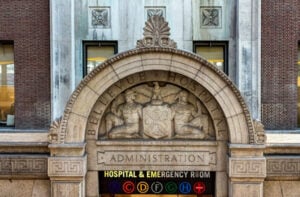
Bellevue Hospital in Manhattan, New York City, photographed March 21, 2023. Photo by Felix Lipov / Shutterstock.com.
For generations of New Yorkers, the name Bellevue has carried an unusual double meaning. On television and in everyday conversation, it became shorthand for psychiatric treatment, sometimes used carelessly as a joke. Yet the hospital on Manhattan’s East Side is far more than the institution suggested by that popular image. It is America’s oldest continuously operating public hospital, tracing its beginning to a six-bed infirmary established in 1736, forty years before the Declaration of Independence.
Over nearly three centuries, Bellevue has treated people whose lives might otherwise never have crossed paths: newly arrived immigrants, laborers injured on city streets, patients suffering through devastating epidemics, and visiting presidents or foreign dignitaries requiring emergency medical attention. It has trained physicians and nurses, built pioneering ambulance and emergency services, cared for people experiencing psychiatric crises, and contributed to research that won the Nobel Prize in Medicine.
The most important thread running through Bellevue’s history is the idea that New York City has a responsibility to care for people who need medical help, regardless of their income or social position. The hospital did not always live up to that ideal, and its history includes overcrowding, prejudice and difficult conditions. But its survival from a colonial almshouse to a major modern medical center reveals how public medicine grew alongside New York itself.
1736: Bellevue Begins in the New York City Almshouse
Bellevue’s story begins not on the East River but on the city common, near the site occupied today by New York’s City Hall. On March 31, 1736, the city’s Publick Workhouse and House of Correction opened with a small infirmary on its second floor. Six beds were set aside for sick people who depended on public assistance, and Dr. John Van Beuren was the first medical officer associated with the institution.
Colonial hospitals did not resemble the modern facilities New Yorkers know today. Wealthier families generally arranged for medical attention in their own homes. An almshouse infirmary cared for people who could not pay for private treatment, and medical practice offered only limited relief from many diseases. The institution existed within a system that treated poverty, illness and confinement as closely connected public concerns.
As the city grew after the American Revolution, the need for a larger and more specialized medical facility became impossible to ignore. The crowded streets of Lower Manhattan were vulnerable to infectious disease, and officials needed room to separate people suffering from epidemics from the wider population.
Yellow Fever and the Move to the East River
Yellow fever helped shape the hospital’s location and eventually its name. In 1794, as city officials prepared for another feared outbreak, they leased property on the East River known as Belle Vue Farm, part of the older Kips Bay landscape. The city established a fever hospital there, and the name Belle Vue was already associated with the site before the permanent hospital complex opened.
The following year, yellow fever struck the city. The fever facility was used during the epidemics of the 1790s, and the city purchased the property in 1798. The need for an isolated hospital reflected the medical understanding of the period, when physicians and officials were still debating how epidemic illnesses spread. It also reflected a practical reality: Manhattan’s population was expanding, and a crowded city could not manage repeated disease outbreaks without a more substantial public health system.
In 1811, New York purchased additional East River land and began building a new almshouse and hospital pavilions. The Bellevue Establishment opened on April 29, 1816, on the waterfront that would become the hospital’s permanent home. A larger hospital for patients with fever and smallpox followed in 1825, when the name Bellevue Hospital received formal municipal recognition.
The move did not end Bellevue’s role in epidemic care. During the devastating cholera outbreak of 1832, the hospital admitted hundreds of patients within days. By the end of that crisis, it had treated approximately 2,000 cholera cases, with hundreds of deaths. Such experiences made the hospital both a refuge for the desperately ill and a place where physicians confronted the limits of nineteenth-century medicine.
The Medical College and Bellevue’s Growing Influence
During the nineteenth century, Bellevue gradually changed from an almshouse-connected institution into one of the country’s most important centers of medical education. Hospital reformers believed that treating large numbers of patients could improve medical training, particularly if students observed diagnoses, operations and the progress of disease firsthand. The hospital’s patients were often poor, and this teaching mission also raised questions about power and dignity in the medical care of vulnerable people.
Bellevue separated its medical administration from the almshouse authority in 1847. In 1861, Bellevue Hospital Medical College opened on the grounds, establishing one of the country’s pioneering arrangements linking a medical college directly to a hospital. Its faculty included prominent surgeons and physicians, and the college trained doctors during the Civil War. Some faculty members also contributed to military medical instruction and New York’s developing sanitary reforms.
One graduate became connected to a national tragedy almost immediately after leaving the school. Dr. Charles A. Leale had recently graduated when he attended Ford’s Theatre in Washington on April 14, 1865. Following the shooting of President Abraham Lincoln, Leale was the first physician to reach the presidential box and examine the wounded president. His efforts could not save Lincoln, but his role connected Bellevue’s early medical training to one of the defining moments in American history.
The college eventually merged with the University Medical College of New York University in 1898. Bellevue’s teaching role continued, and its long academic association with NYU remains central to its identity today.
From Maternity Care to Horse-Drawn Ambulances
Bellevue’s contributions to modern medicine were not confined to medical education. In 1799, Dr. Valentine Seaman established a maternity ward within the hospital’s institutional predecessor, an early milestone in organized obstetrical care in the United States. Later generations of physicians developed services for children, people with infectious diseases and patients who needed emergency surgery.
In June 1869, Bellevue began a pioneering municipal ambulance service. Instead of depending entirely on bystanders or improvised transportation, injured or seriously ill New Yorkers could be reached by horse-drawn vehicles equipped for medical assistance. Surgeons and attendants were part of the system, which helped establish the idea that treatment could begin before a patient arrived at a hospital.
The ambulance service was joined by additional improvements. Bellevue opened an emergency pavilion in 1876, giving urgent cases a more defined place in the hospital. Although the emergency departments familiar today developed over many decades, these innovations helped create the model of organized hospital emergency response.
Nursing education was another major achievement. In 1873, the Bellevue Training School for Nurses opened, following organizational principles associated with Florence Nightingale. Its students learned that nursing required disciplined training and clinical skill, not merely a willingness to assist doctors. The first graduates received their diplomas in 1875, and in 1888 Bellevue opened the Mills Training School for Male Nurses. These developments helped professionalize hospital care at a time when nursing was undergoing enormous change.
Laboratories, Public Health and the Battle Against Disease
By the late nineteenth century, medical science was changing rapidly as physicians learned more about bacteria, infection and the causes of disease. Bellevue became part of that transformation. In 1884, a major gift from Andrew Carnegie supported the establishment of the Carnegie Laboratory at Bellevue Hospital Medical College, devoted to teaching and investigating bacteriology and pathology. Laboratory medicine would become increasingly important to diagnosis and public health.
Physicians associated with Bellevue also helped shape the city’s sanitation policies. Their research and public health advocacy contributed to the development of more systematic approaches to disease surveillance, health regulations and the prevention of epidemics. The hospital’s history therefore extends well beyond beds and operating rooms: medical knowledge developed there influenced the way New York governed its streets, water, housing and public health institutions.
One particularly visible step came in 1918, when Bellevue pathologist Dr. Charles Norris became New York City’s first chief medical examiner. The position marked a shift toward the scientific investigation of deaths, replacing older practices associated with the coroner system. That same year, the influenza pandemic overwhelmed medical facilities across the city, and Bellevue treated thousands of patients.
The hospital also reflected the racial barriers of American medicine. In 1918, Dr. Ubert Conrad Vincent became Bellevue’s first African American medical resident, a significant breakthrough at a time when Black physicians were routinely excluded from many hospitals and training programs. His appointment did not erase discrimination, but it marked an important change in access to professional opportunities.
How Bellevue Became Associated With Psychiatric Care
For many New Yorkers, Bellevue’s best-known historical identity is psychiatric. That reputation has roots in the nineteenth century, when city officials were struggling to decide how to care for people experiencing serious mental illness. In 1870, the hospital created a separate division for psychiatric patients, and in 1879 a dedicated pavilion opened on the grounds. The effort reflected an increasing recognition that mental illness required medical attention, although the methods used at the time often differed sharply from present-day standards.
Dr. Menas Gregory, who became director of Bellevue’s psychiatric division in 1904, wanted to transform its image and facilities. He encouraged more humane surroundings and reduced some practices associated with confinement. A new psychiatric hospital on First Avenue, designed by Charles B. Meyers, began admitting patients in 1933. The large brick building offered space for examinations, research, recreation and treatment, with separate areas for different groups of patients. Its construction and opening took place in stages during the early 1930s.
Bellevue also developed programs for children and adolescents. Public School 106 opened at the hospital in 1935 for children receiving psychiatric care, and a dedicated adolescent inpatient service followed in 1937. The terminology and treatment approaches of that era have changed substantially, but these programs were part of the development of psychiatric services within a general public hospital.
The name Bellevue nevertheless became a popular shorthand for severe mental illness. It appeared in comedy routines, films, television programs and ordinary New York conversation, often without sensitivity toward the people receiving care. That reputation obscured an important fact: psychiatric services were one part of a large public hospital that also performed surgery, treated children, responded to injuries and conducted internationally respected medical research.
The Nobel Prize and Bellevue’s Cardiac Research
One of Bellevue’s most consequential scientific achievements emerged from work involving the heart and circulatory system. Physicians André Frédéric Cournand and Dickinson W. Richards helped develop and refine methods for cardiac catheterization, allowing doctors to study pressures and blood flow inside the heart with a level of precision previously unavailable in clinical practice.
In 1956, Cournand and Richards shared the Nobel Prize in Physiology or Medicine with German physician Werner Forssmann, whose earlier work had been important to the development of the procedure. The two Bellevue researchers were recognized for studies that transformed the understanding of cardiovascular and pulmonary disease. Their work contributed to diagnostic techniques that became central to modern cardiology.
The research was one of many examples of Bellevue’s role in medical science during the twentieth century. Its doctors investigated tuberculosis, heart failure, rehabilitation and other complex conditions. The hospital also served as a training ground for physicians who carried its methods into institutions throughout the country.
The Modern Hospital, Presidents and the 25-Story Tower
By the middle of the twentieth century, Bellevue’s collection of older hospital buildings no longer matched all the demands of a large modern medical center. The city undertook a major rebuilding program that would reshape the East River campus. In 1973, construction was completed on a 25-story hospital tower, bringing much of the institution’s work together in a large modern facility.
The new building reflected the expanding requirements of intensive care, surgery, diagnostic services and medical education. It also changed the view of the Bellevue campus from the surrounding neighborhood and the Franklin D. Roosevelt East River Drive. The older brick buildings had represented generations of institutional growth; the new tower announced a hospital trying to meet the needs of a rapidly changing city.
Bellevue’s responsibilities also extended to unusual emergencies. In 1964, the hospital received a formal designation as a standby medical facility for visiting United States presidents, foreign dignitaries and United Nations diplomats. It continued to serve New Yorkers regardless of their ability to pay, even as it became the designated emergency medical destination for some of the world’s most closely protected public figures.
In 1970, Bellevue became a flagship institution of the newly formed New York City Health and Hospitals Corporation, the public system now known as NYC Health + Hospitals. Its ongoing affiliation with New York University’s medical school remained an important part of its clinical and educational role.
AIDS, September 11 and Hurricane Sandy
During the AIDS crisis of the 1980s, Bellevue again found itself at the center of an urgent public health emergency. In 1985, it opened the first AIDS program in a New York City public hospital. Doctors, nurses and social workers cared for patients during a period marked by fear, inadequate treatments and widespread stigma. The hospital’s work was part of a larger struggle to provide appropriate care as medical understanding of HIV developed.
After the September 11, 2001, terrorist attacks, Bellevue treated patients and participated in the city’s emergency response. The hospital later established a World Trade Center Environmental Health Center to address health problems associated with exposure to dust and other contaminants from the disaster. The work reflected the continuing medical consequences of an event that affected New Yorkers long after the immediate emergency had ended.
Hurricane Sandy delivered a very different kind of challenge in October 2012. Stormwater flooded the hospital’s basement and damaged essential mechanical and electrical systems. With elevators disabled and emergency operations severely compromised, staff and emergency responders had to evacuate hundreds of patients. The evacuation was unprecedented in Bellevue’s long history and required extraordinary coordination with other New York hospitals.
The storm exposed the vulnerability of important public medical facilities built near the waterfront. Bellevue gradually reopened services after the emergency, while the city and health system developed projects to protect equipment, improve backup systems and reduce the danger from future flooding. The episode demonstrated that even an institution with nearly three centuries of experience could face new threats from a changing urban environment.
Ebola in 2014 and Bellevue’s Continuing Mission
In October 2014, Bellevue received Dr. Craig Spencer, a physician who had returned to New York after treating Ebola patients in West Africa. He became the city’s first confirmed Ebola patient. Bellevue’s specialized infectious-disease team cared for him in isolation, and he recovered and was discharged in November. The successful treatment was an important test of the hospital’s preparedness for dangerous infectious diseases.
The experience informed later work on preparing for major outbreaks, including the COVID-19 pandemic. Bellevue’s history of responding to medical emergencies had already stretched across yellow fever, cholera, influenza, tuberculosis and HIV. Each new crisis demanded different scientific tools, but the underlying responsibility was familiar: care for patients while helping protect the wider city.
Today, operating as NYC Health + Hospitals/Bellevue and affiliated with NYU’s medical school, Bellevue provides emergency and trauma services, surgery, inpatient and outpatient care, psychiatric treatment and many medical specialties. It remains a Level I trauma center and an essential part of the city’s public hospital system. Its care for patients with limited resources is not a secondary role; it is part of the reason the institution exists.
Bellevue began with six beds in a colonial almshouse, long before anyone could imagine ambulances, intensive care units or the laboratory discoveries that transformed modern medicine. Its buildings, patients and medical practices have changed enormously, but the central idea has endured: New York City needs a hospital prepared to care for people when they have nowhere else to turn. That is a far more meaningful legacy than the psychiatric shorthand that made Bellevue’s name famous in popular culture.
For more about the development of medical care and public health in New York, read our 10 Lost New York City Hospitals and Medical Institutions and What Happened to Them and 7 Major Disease Outbreaks That Changed New York City History. The hospital’s earliest location also connects with our History of New York’s City Hall, tracing another landmark on ground that helped shape the city’s earliest institutions.