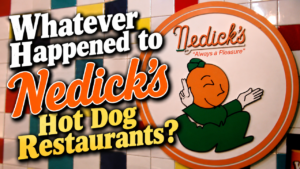
Photo by Jerry Paffendorf / Wikimedia Commons, licensed under Creative Commons Attribution 2.0. Added text by Brian Kachejian
Long before Starbucks became a familiar sight on Manhattan streets and national fast-food chains dominated Midtown, New York City had Nedick’s. For generations, its orange-and-white signs marked places where people could stop for a quick, inexpensive bite. Commuters, ballgame crowds, theatergoers, and shoppers knew the combination: a hot dog on a toasted bun and a cup of the chain’s unmistakable orange drink. You did not have to make an evening of it. You could walk up to the counter, get something to eat, and be on your way.
Nedick’s belonged to an older New York, when a modest food stand at a busy corner could become a citywide institution. Its locations served as meeting places as much as lunch counters. They appeared near transportation hubs, entertainment districts, and the everyday routes people followed through the city. Even New Yorkers who had never studied the company’s history recognized the name.
So whatever happened to Nedick’s? The original chain declined as ownership changed and national fast-food competitors reshaped the business. Its familiar counters disappeared by the early 1980s. A New York restaurant operator brought the name back in 2003, complete with hot dogs and orange drink, but that revival also ended. The story behind those closures begins in 1913, with an orange-drink stand near Madison Square.
How Nedick’s Began at Broadway and 23rd Street in 1913
The Nedick’s story began at the Bartholdi Hotel, near the intersection of Broadway and East 23rd Street in Manhattan. Robert T. Neely, a real estate investor involved with the property, joined forces with Orville A. Dickinson, who operated a store in the hotel building. Together they took over a small orange-drink stand and, in 1913, began building the business that would become Nedick’s.
The name combined their surnames: the beginning of Neely joined with the beginning of Dickinson. No actual Mr. Nedick stood behind the counter. A 1928 profile in The New Yorker explained that the concept was inspired by orange-drink stands associated with a man named Clements in Atlantic City. The idea was uncomplicated: sell a refreshing drink at a convenient location, serve customers quickly, and repeat the formula wherever the crowds were.
Neely brought experience in real estate and a willingness to take risks. The partnership grew far beyond its first location. By 1917, Nedick’s had thirteen stands. During the 1920s, the company spread through New York and other eastern cities, including locations serving the crowds at Coney Island. A contemporary New Yorker account reported 124 stands in 1928. What had started as one small storefront had become a recognizable regional chain before most Americans had encountered the fast-food franchises that would later dominate the country.
The Orange Drink and Hot Dogs That Made Nedick’s Famous
The orange drink was the original attraction. It was a sweet, refreshing, noncarbonated beverage associated so closely with the chain that an orange-and-white storefront practically advertised its contents without needing to spell out the menu. Nedick’s later sold coffee, doughnuts, and more substantial food, but customers continued to associate the brand with that particular drink.
Then came the hot dogs. Nedick’s became known for frankfurters served in toasted, buttered rolls, with mustard and relish available to complete the meal. The appeal was not elaborate cooking. It was the reliability of a quick lunch and the pleasure of knowing what you were going to get, whether you stopped near Times Square or at a counter closer to home.
The combination fitted the city particularly well. New York had no shortage of restaurants, but a traveler changing trains or a fan headed toward Madison Square Garden did not necessarily want a dining room and a waiter. A Nedick’s counter provided an alternative: familiar food, quick service, and prices intended to make an ordinary stop affordable. It helped establish a form of everyday urban eating that later chains would pursue on a national scale.
The Great Depression Nearly Ended Nedick’s
The chain’s rapid expansion did not protect it from the Great Depression. After growing into a business with well over one hundred locations, Nedick’s contracted sharply as the economic crisis affected customers, landlords, and the company itself. By 1934, accounts of the business placed the surviving operation at approximately forty stands.
That year, Robert Neely lost control of the company. A group of investors acquired Nedick’s assets at an April 1934 auction for a reported $48,000. The sale was a dramatic reversal for a business that had seemed to be everywhere only a few years earlier. It also meant that the name could survive even though the ownership behind it had changed.
The new management worked to rebuild sales. Radio advertising became part of the strategy, and campaigns promoted the addition of vitamin B1 to Nedick’s orange drink. The company also used inexpensive breakfast offerings to encourage customers to come through the door. These promotions belonged to a period when radio could carry a restaurant’s name into thousands of homes at once. The recovery would make Nedick’s a familiar presence to another generation of New Yorkers.
New Owners and a Mid-Century Comeback
Nedick’s history was not a straight line from its 1930s troubles to its eventual disappearance. By the early 1950s, the company had regained a substantial place in the metropolitan food business. Walter S. Mack Jr., a former Pepsi-Cola executive, became its president. A 1952 New Yorker account described his public introduction of a revised orange drink and a new dispenser, a reminder that the company was still experimenting with the product that had made its reputation.
Another major transition came in 1956, when businessman Peter Sando arranged to purchase the chain from Mack’s organization. Sando had worked his way up from the restaurant business, and he believed Nedick’s could attract customers by improving its food rather than competing on low prices alone. He emphasized a better frankfurter in a toasted, buttered bun, brought back a version of the traditional orange drink, and offered a more substantial hamburger.
The scale of the operation was still impressive. Its reach extended beyond New York City into other northeastern markets, including Newark, Albany, Boston, Philadelphia, Baltimore, and Washington, D.C. At the time of Sando’s purchase, The New Yorker reported approximately 110 establishments, about 800 employees, and annual business of roughly $9 million. Those figures help explain why Nedick’s occupied such a large place in the memories of mid-century New Yorkers. It was not one famous stand that survived through good publicity. It was a functioning restaurant chain employing hundreds of people and serving customers day after day.
Nedick’s in Times Square, Madison Square Garden, and New York Sports
For many New Yorkers, particular Nedick’s locations were landmarks. The Times Square area had its bright signs and hurried sidewalk traffic. Penn Station brought travelers who needed food between trains. Madison Square Garden, when it stood at Eighth Avenue and 49th Street, gave Nedick’s access to people arriving for basketball games, hockey games, and other events. The stands were part of the movement of the city.
The name also became inseparable from New York basketball. Nedick’s sponsored broadcasts of the New York Knicks, and legendary announcer Marty Glickman worked the restaurant into one of his signature calls. When a Knicks player scored, fans heard the phrase “Good like Nedick’s!” The advertising worked because listeners already knew the product. A restaurant chain had become part of the language of New York sports.
Its presence extended into the city’s visual culture. A Nedick’s sign can be seen in Martin Scorsese’s 1976 film Taxi Driver, while artist Richard Estes made a Nedick’s storefront the subject of a photorealist painting in 1970. That painting is now associated with the Museo Nacional Thyssen-Bornemisza in Madrid. The fact that the chain turned up in film and painting says something about how ordinary its storefronts once seemed. Artists documenting New York streets naturally found Nedick’s already there.
For customers, however, the appeal was usually less grand. The familiar orange lettering told them where to meet someone or grab a bite before heading somewhere else. Those practical associations are part of the reason the name stayed in New York’s memory long after the counters disappeared.
Why Did the Original Nedick’s Restaurants Close?
In 1965, ABC Consolidated Corporation acquired Nedick’s, and plans were announced to modernize the chain and expand its reach. It was another moment when new ownership saw possibilities in an established name. Yet the food business was changing quickly, and the years ahead would prove difficult for many older urban chains.
Nedick’s had grown around walk-up counters, busy sidewalks, and customers looking for a fast meal in the middle of the city. During the 1960s and 1970s, nationally organized competitors such as McDonald’s, Burger King, and Dunkin’ Donuts expanded with increasingly recognizable menus, store designs, and advertising. Their business models could be repeated across suburbs and highways as well as downtowns. An older chain with a large concentration of traditional city locations faced a very different competitive environment.
It is tempting to blame Nedick’s disappearance on one bad management decision or a particular rival, but the available history does not support such a neat explanation. Ownership changes, shifting customer habits, the growth of larger competitors, and the difficulty of keeping an aging restaurant format competitive all formed part of the broader setting. The original Nedick’s operation gradually dwindled and disappeared around the early 1980s. There was no single dramatic last day that ended every New Yorker’s relationship with the chain at once.
The 2003 Nedick’s Revival in New York City
By the turn of the twenty-first century, Nedick’s was gone from everyday street life, but hardly forgotten. New Yorkers still remembered the hot dogs, the orange drink, and the locations where they had stopped on the way to work or a game. The Riese Organization, a major Manhattan restaurant operator, obtained the rights to the Nedick’s name in 2001 and set out to revive it.
In 2003, the company reopened Nedick’s in New York City, beginning with a stand at Penn Station. The revived operation eventually had three locations: the station stand, a storefront at 1286 Broadway between West 33rd and West 34th Streets, and another at 416 Eighth Avenue near West 31st Street. The idea was to bring back a recognizable New York institution rather than introduce an unfamiliar restaurant name.
The new menu included the classic hot dog on a butter-toasted bun and a version of Nedick’s famous orange drink. But it also reflected contemporary expectations, offering regional hot-dog variations, more toppings, French fries, breakfast selections, and desserts. In its announcement of the revival, the company leaned heavily on New Yorkers’ memories of the original stands while presenting the updated menu as a reason for a new generation to visit.
Nostalgia could attract attention, but it was not enough to recreate the old chain. The three revived locations eventually closed, and Nedick’s once again disappeared as an operating restaurant brand. The revival remains an interesting chapter because it showed that the name still meant something to New Yorkers two decades after the original business had faded away.
Why New Yorkers Still Remember Nedick’s
What made Nedick’s memorable was not simply its size. It was a restaurant built around the routines of a particular city. The chain sold inexpensive food, but it also offered familiar meeting places and little pauses in a day that was usually moving too quickly. An orange drink before catching a train or a hot dog outside the Garden could become a memory that lasted far longer than the meal itself.
Nedick’s also belongs to the larger history of American fast food. It demonstrated how a simple product, a consistent identity, and convenient locations could support a chain long before interstate highways and suburban drive-throughs transformed the industry. Its later struggles revealed the limits of that older model when national corporations began competing for the same customers.
Today, the original orange-and-white storefronts are gone, and the attempted revival has ended. But Nedick’s remains one of the businesses that helps explain how New Yorkers ate, traveled, and gathered throughout much of the twentieth century. For readers who remember the orange drink and the toasted hot dogs, its history is also a reminder that the most ordinary stops on a city street can become some of its most enduring landmarks.
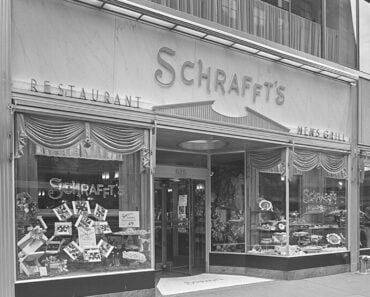
For more stories about restaurants that once defined daily life in New York, read our histories of Schrafft’s Restaurants and Horn & Hardart Automats.