LinkNYC changed the look and function of New York City’s sidewalks by replacing old pay phones with modern communication hubs offering free Wi-Fi, phone calls, charging stations, maps, and city information. For New Yorkers and visitors alike, the program marked another major shift in how technology became part of daily life on the city’s streets.
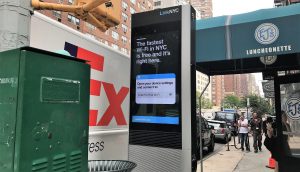
LinkNYC Hub on the Upper East Side of Manhattan. Photo: Brian Kachejian
Sorry, Superman, but the days of old-fashioned phone booths are now completely gone. New York City has begun replacing all its old-fashioned pay phones with free Wi-Fi calling stations. Yes, that’s right, free phone calls and faster-than-a-speeding-bullet Wi-Fi. Sorry, it’s impossible to refrain from referencing Superman when writing about phone booths. In other words, in modern-day technical terms, the New York City Link booths will offer what the city bills as the “fastest Wi-Fi in New York City.” And they are not kidding, as the LinkNYC hubs offer what is termed gigabit speed. The city claims the gigabit speed is 100 times faster than any other available Wi-Fi connection.
Let’s look closely at what LinkNYC really offers. The hubs spread throughout New York City offer anyone with a smartphone, tablet, or computer the opportunity to connect to blazing-fast Wi-Fi. All it takes to connect is a one-time registration utilizing an email address. Any device that is capable of connecting to Wi-Fi can connect to the LinkNYC hubs. There are two options that the Links provide. One option is called “LinkNYC Free Wi-Fi,” which is public-access Wi-Fi similar to what you would find at a Starbucks or other public centers, such as libraries or transit hubs.
The more secure option is called “LinkNYC Private,” which supposedly provides a secure connection between the hub and your Wi-Fi-connected device. Both options are free. The email address you register with will receive simple instructions for connecting to LinkNYC. However, at this time in July 2017, only certain devices will work with the “LinkNYC Private” connection. Those devices are listed as Apple devices that use Hotspot 2.0 technology, which, for the most part, means all iPhones and iPads released in the past three or four years. Sorry, Samsung users, but for now, you are stuck with the unsecured “LinkNYC Free Wi-Fi.” So if you have a non-Apple device, just make sure that the websites you visit employ SSL certificates.
Free Wi-Fi is only half of what the LinkNYC hubs offer. You won’t need a dime anymore to make a phone call. Okay, sorry, we realize it’s not 1967 anymore. Let’s try this again. You won’t need any money to make a phone call with the LinkNYC hubs. One may use the hub’s keypad to make a free domestic phone call. Sorry, no free calls to Russia or Iceland. There is a headphone connection so you can keep your call as private as possible while standing on a street corner surrounded by hundreds of people. The LinkNYC hubs also offer a screen where users can access a wide range of information and directions to destinations in New York City.
The LinkNYC hubs also offer free USB charging stations. The USB connections are only connected to a power source, so there is no concern of data transfer between the devices via USB. The Wi-Fi generated by the hubs has a range of about 150 feet. Each hub is also equipped with cameras. Since there are close to one thousand of these LinkNYC hubs around New York City, the cameras pretty much assure that every street in the city and all that transpires on every New York City street is being videotaped.
New York City claims that no taxpayer money is being used in funding the LinkNYC program. The entire program is funded by advertisements displayed on the LinkNYC kiosks.
With the incredible surge in smartphone use among New Yorkers, the major phone carriers seem to be struggling to meet demand for service. The network carriers built in recent years simply can’t support the level of usage that a city like New York demands. We all get tired of watching that spinning circle. The employment of these LinkNYC kiosks is a great idea that, if kept under control and not abused by the criminal element, is simply a fantastic addition to the city. The ability to make free phone calls is something we never could have imagined during the Dick Tracy days. Sure, there is a concern about privacy, but that’s something that we have given up in a trade-off for safety. So now anyone can enter New York City without a car or phone and use technology like LinkNYC to find directions, make a phone call, and then hop on a Citi Bike to get to their destination.
LinkNYC Will Do Away With These Old-School Phone Booths
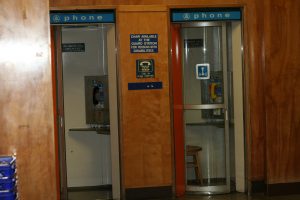
Photo: “Phone booths” by desertdarlene is licensed under CC BY 2.0
Related New York City Articles
If you enjoyed this article, be sure to explore more ClassicNewYorkHistory.com features on the New York Public Library, Citi Bike, New York City technology, transportation, and the ways modern life continues to reshape the city.
Updated: June 27, 2026