The New York Public Library lions, Patience and Fortitude, are two of the most beloved symbols in New York City. Standing proudly outside the library’s main branch on Fifth Avenue and 42nd Street, the marble lions have guarded the entrance for more than a century while welcoming generations of readers, writers, tourists, students, and dreamers into one of the city’s great public institutions.
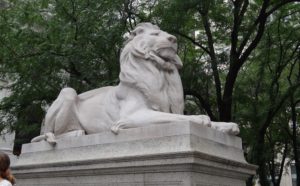
Photo: “New York Public Library – Manhattan NY” by Esther Westerveld is licensed under CC BY 2.0
Many movies filmed in or about New York can’t help but include them, the lions, Patience and Fortitude, who stand guard at the entrance to the New York Public Library’s main branch. Whether it’s Carrie Bradshaw jumping up and down in her designer shoes, saying that the library would be a great place to hold a wedding in Sex and the City, or the Cowardly Lion busting out in song from a “Fortitude” papier-mache mold in The Wiz, the lions of the New York Public Library are icons. They have been the inspiration for books, photos, sketches, and even an avant-garde puppet show.
It’s always a treat to see visitors to the city view the lions for the first time. You can’t miss the pair of mighty beasts as they grandly perch on Fifth Avenue and 42nd Street. No matter what their age, tourists notice, take a good look, and then break into a big smile. These fearsome-looking yet lovable statues invite you to head up the stairs to see all of the cultural treats inside. The third-floor reading room is a favorite haunt for students, writers, and researchers.
You can’t check out books from the main branch; however, you can “call” for any number of titles from the stacks to use while on the premises. Across the street, there is a huge lending library, as well as branches all over the city. Some people visit the main branch just for the feel of it. Even if you are just browsing a volume from the surrounding shelves, the long, sturdy wooden tables topped with green banker shade lights make you feel smart just by sitting there.

Photo: “New York Public Library” by yisris is licensed under CC BY 2.0
Those two magnificently crafted lions were designed by Edward Clark Potter and carved in stone by Attilio, Ferruccio, Furio, Getulio, Masaniello, and Orazio Piccirilli, sons of a Bronx stone carver who set up shop near his brownstone and teamed up with Potter to bring the library lions to life. The pink marble was brought to New York from Tennessee to achieve just the right shine and texture for the pieces. The Piccirilli brothers of the Bronx also created several other major sculptures around the city and, eventually, across the country. Sculptors who had a vision of a stone monument could call upon the Piccirilli brothers to execute it with expert precision.
The lions were completed in time for the library’s official dedication in 1911. They were the crowning touch for a house full of treasures where anyone, no matter how slim their wallet, could go and find information about just about any topic under the sun. Just sitting on the steps, flanked by these two marvels in marble, while having a cup of take-out coffee is good for the soul. Like another grand creation of the age, Grand Central Terminal, the New York Public Library is a people’s palace, open to all.
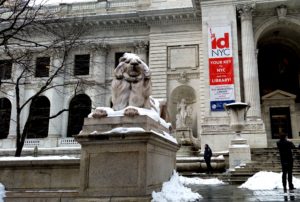
Photo: “New York Public Library” by Terry Ballard is licensed under CC BY 2.0
Their names have changed over the years. After the dedication, the pair were named Leo Astor and Leo Lenox, after the library’s founders, Jacob Astor and James Lenox. Later, folks decided to dress them up in costumes and name them Lady Astor and Lord Lenox. No one seemed to mind the renaming, even though both lions had full male manes. Whether it was top hat and tails or evening gowns and jewels, the lions perched proudly despite the indignity of having to wear such silly outfits. It was all in good fun.
Sports fans would decorate Patience and Fortitude in team gear, including a scarf blazing with one team’s colors, only to have it removed and replaced with another. This became a tradition, particularly around World Series time each year, as New Yorkers have always taken their baseball seriously. Any Red Sox fans who would dare to co-opt the Lions for their team would be dealt with in New York style. That usually meant getting much more than a simple Bronx “cheer.” After all, from their beginning, the New York Public Library’s lions have been the city’s unofficial mascots.
Mayor Fiorello La Guardia, having won the New York mayoral election in 1933, had his hands full with many tasks in his new position. He had to clean up the street crime, deal with the banking industry, and worry about the stock market. It was a political high-wire act for a mayor in a society that feared the ever-growing juxtaposition between the extravagantly wealthy and those living in crippling poverty.
As mayor, La Guardia officially renamed the pair of library lions Patience and Fortitude, which was just what the city needed, as it was still struggling to recover from the 1929 stock market crash and massive unemployment. One of the major hurdles the mayor had to contend with was the image of Italian immigrants. Depicted in films and literature as notorious gangsters, he set out to show the positive side of Italian-American culture. The fact that he named the two gorgeous stone lions crafted by a family of immigrant workers only emphasized his point. Italian-American immigrants were and still are known as excellent stone masons and construction contractors. The Piccirilli family and other such artisans helped make New York what it is today.

Photo: “New York Public Library” by Mike Licht is licensed under CC BY 2.0
The city has changed so much since the lions were placed on their pedestals, but the statues have remained almost the same. By the year 2000, Patience and Fortitude were showing considerable signs of wear, so in 2004 the city undertook a major restoration project to ensure these beautiful sculptures would last many more lifetimes. It took a lot of cleaning and repairs to bring them back to their former glory. In 2006, the curators of the library’s art made the difficult decision that the feline pair were not to be “dressed up” anymore, to help preserve them for posterity.
This ban on costuming Patience and Fortitude was much to the chagrin of many New Yorkers who liked to see what the handsome duo would wear, particularly at Christmas, when they were swaddled in decorative holiday wreaths. No longer dressed up in sports gear, graduation caps, or other frills, the lions remain as nature intended. The lions do not need adornment. In their mighty bare essence, they still serve as a reminder that no matter how small and insignificant a person may feel, they could still be welcomed by these stone kings of the jungle to get their fill of knowledge.
The New York Public Library bookend lions, Patience flanking the south end and Fortitude the north, have lasted through wars, disruptions, protests, crime waves, economic prosperity, and crippling despair. Patience and Fortitude are symbols of everything New York and its people stand for. They are fearless, yet humble in their beauty. Edward Clark Potter could have posed them differently. They could be stalking, or roaring, but no, they are just waiting. Waiting for the next person with a curious mind to pass by, there where 42nd Street meets Fifth Avenue.
Related New York History Articles
If you enjoyed this article, be sure to explore more New York landmark features on ClassicNewYorkHistory.com, including stories on Grand Central Terminal, Fifth Avenue, Bryant Park, New York City architecture, and the public spaces that have helped define Manhattan.
Article updated on June 26, 2026,