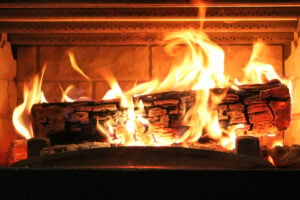
A burning fireplace reminiscent of the beloved WPIX Channel 11 Yule Log that became a New York Christmas television tradition in 1966. Photo: Amelia Martin / Shutterstock.com
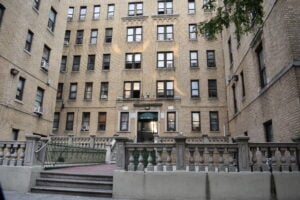
Long before streaming services offered viewers an endless selection of virtual fireplaces, New Yorkers knew exactly where to find one on television. Every Christmas, WPIX Channel 11 filled living rooms across the metropolitan area with the image of a burning log accompanied by some of the most beautiful Christmas music ever recorded. For families who lived in apartment buildings without fireplaces, it was a holiday tradition that belonged as much to New York as the Christmas tree at Rockefeller Center.
There were no actors, no dialogue and no story to follow. Children could open presents while their parents prepared Christmas dinner. People could leave the television on without having to pay attention to it. In an age when television stations competed for every minute of a viewer’s attention, Channel 11 discovered that there was an enormous audience for a program that asked almost nothing of its viewers.
What began on Christmas Eve in 1966 became one of the most unusual success stories in New York broadcasting history. Behind that familiar fireplace lies the story of a damaged antique rug at the mayor’s residence, a film shoot in California in the middle of summer, a cancellation that angered longtime viewers and two remarkable discoveries in the WPIX film archives.
A Christmas Gift for New York Apartment Dwellers
The Yule Log was the creation of Fred M. Thrower, president of WPIX. According to accounts from his family and the station, part of his inspiration came from a Coca-Cola television advertisement featuring Santa Claus beside a fireplace. Thrower recognized that a great many New Yorkers had never experienced Christmas around a fireplace in their own homes.
In November 1966, Thrower proposed replacing the station’s Christmas Eve evening programming with a filmed fireplace and a collection of Christmas recordings. A scheduled roller derby telecast was dropped, and the station reportedly sacrificed about $4,000 in potential advertising revenue. The prerecorded program also made it possible for station employees to spend more of the holiday with their families.
At 9:30 p.m. on Saturday, December 24, 1966, the Yule Log made its debut in color on Channel 11. For three hours, viewers watched a fire burning without the usual interruptions for commercials. It was an especially appropriate gift from a local television station whose audience included millions of people living in the apartment houses of New York City and its surrounding communities.
The Gracie Mansion Fireplace and the Damaged Antique Rug
There could hardly have been a more fitting location for the original film shoot than Gracie Mansion, the official residence of New York City’s mayor. John V. Lindsay had taken office earlier in 1966, and permission was obtained for WPIX to photograph a fire burning inside the historic house overlooking the East River.
The production crew used 16mm color film. Rather than filming an entire evening’s worth of firewood burning, the station assembled a short sequence of footage that could be repeated continuously. The process was not seamless, and early viewers could occasionally notice the flames jumping as the sequence started again.
The most famous incident associated with the filming took place off camera. To improve the view of the fire, the crew removed the protective fireplace screen. A spark escaped and damaged an antique rug reportedly valued at $4,000. While the Yule Log became a considerable success for Channel 11, the mayor’s residence did not escape the experience quite so happily.
WPIX brought the program back the following Christmas, and the Gracie Mansion footage remained in use through 1969. Few people watching at home could have imagined that the fire they were about to see in subsequent years would come from the other side of the country.
The Christmas Music That Made the Yule Log Special
The music was every bit as important as the fireplace. Thrower and WPIX-FM program director Charlie Whittaker helped establish a soundtrack built around the traditional Christmas recordings that fit the easy-listening radio format of the era. Percy Faith’s orchestral recording of “Joy to the World” became particularly closely associated with the program.
Among the performers heard over the years were Nat King Cole, Arthur Fiedler and the Boston Pops Orchestra, the Ray Conniff Singers and Mantovani. Their arrangements offered a mixture of sacred carols, popular Christmas standards, choral performances and lush orchestral music. It was a chance to hear familiar holiday recordings together without a disc jockey talking over the music or a commercial interrupting the mood.
Families who listened to the Yule Log year after year developed an attachment not only to the picture on the television but also to the order of the songs. For some viewers, hearing a particular arrangement of a Christmas carol was enough to bring back memories of Channel 11. Later generations of Yule Log enthusiasts went to considerable trouble to identify the recordings and preserve the soundtrack.
Why the WPIX Yule Log Was Filmed in California in 1970
By the end of the 1969 holiday season, the original film was showing the effects of repeated use. Producer William Cooper needed replacement footage that would look better on television and repeat less conspicuously. Returning to Gracie Mansion would have been the simplest solution, but the station was unable to obtain permission for another shoot. The story of the damaged rug had not been forgotten.
A fireplace with a similar appearance was eventually located at a home in Palo Alto, California. In August 1970, while Northern California was experiencing summer heat, the crew filmed a new fire on 35mm color film. The new sequence lasted several minutes rather than a few seconds, making its repetitions much less distracting.
It was this second fireplace that became the familiar sight on New York television throughout the 1970s and 1980s. The California setting did nothing to diminish its New York identity. The program still belonged to Channel 11, and the music and the circumstances in which families watched it remained essentially the same.
Why WPIX Canceled the Yule Log in 1990
During its original run, the Yule Log became part of a larger collection of Channel 11 holiday programming. The station also established a tradition of broadcasting Christmas Midnight Mass from St. Patrick’s Cathedral in 1977. As the years passed, the fireplace program increasingly became associated with Christmas morning as well as Christmas Eve.
However, the financial considerations that Fred Thrower had set aside in 1966 eventually caught up with the program. Several hours of Christmas programming without conventional commercial breaks represented airtime that could otherwise be sold. After its 1989 broadcast, WPIX discontinued the annual television presentation. For the first time in 24 years, Christmas arrived in 1990 without the Channel 11 fireplace.
Viewers who had recorded the program on their VCRs could continue watching it at home, but everyone else had lost a familiar part of the holiday. The station received complaints and requests for its return. By 2000, longtime fan Joe Malzone was using the Internet to organize support for the broadcast, and Christmas music collector Lawrence “Chip” Arcuri became another important figure in the effort to preserve its history.
The Return of the Yule Log After September 11, 2001
The terrorist attacks of September 11, 2001, changed the atmosphere of the holiday season in New York. In a city that was still mourning, WPIX general manager Betty Ellen Berlamino and program director Julie O’Neil recognized that the return of familiar Christmas programming could offer viewers a measure of comfort.
Finding the film proved to be a challenge. The 1970 footage was eventually located in the station’s New Jersey archive in a film container labeled for an episode of The Honeymooners called “A Dog’s Life.” The discovery was especially appropriate for longtime Channel 11 viewers, many of whom also associated the station with reruns of the classic Jackie Gleason comedy.
The recovered film was digitally remastered, and on December 25, 2001, the Yule Log returned to television from 8 to 10 a.m. Reuters reported that approximately 611,000 viewers watched the broadcast, giving WPIX the largest television audience in the New York market during those two hours. The fireplace even drew a larger audience than ABC’s Good Morning America.
The success of the revival demonstrated that the program’s emotional appeal had survived eleven Christmas seasons off the air. WPIX continued the tradition, and other television stations began carrying versions of the broadcast. In 2006, Channel 11 marked its 40th anniversary with a documentary about the program entitled A Log’s Life.
The Rediscovery of the Original 1966 Yule Log
For decades, the original Gracie Mansion footage was presumed lost. Then, in 2016, WPIX digital director and archivist Rolando Pujol examined a collection of film reels and other station material that had belonged to producer Bill Cooper and his wife, Kay Arnold. Among the collection was a 16mm film container identified as the original WPIX fireplace.
The station had the footage transferred to digital format at a Manhattan post-production facility. The transfer confirmed that the film was indeed the long-missing 1966 Yule Log. It was an extraordinary discovery, made in the very year that Channel 11 was preparing to celebrate the program’s 50th anniversary.
On Christmas Eve 2016, WPIX broadcast the restored Gracie Mansion version for the first time since 1969. Viewers could once again see the fireplace where the New York tradition had begun. The following morning, the station also presented the familiar California footage, giving audiences an opportunity to experience both versions of the broadcast.
From Channel 11 to the Streaming Era
Today, there are countless televised and digital fireplaces, some accompanied by Christmas songs and others by nothing more than the sound of burning wood. The technology used to deliver those images has changed enormously since WPIX first pointed a film camera at a fireplace in 1966.
Channel 11 has embraced that technology while retaining the original tradition. In 2024, PIX11 made versions of both the 1966 and 1970 Yule Logs available through its PIX11+ streaming service in addition to its Christmas Day television broadcasts. The program that was once available only to viewers within the reach of a New York television station can now be enjoyed far beyond the metropolitan area.
Yet for those who grew up in New York watching Channel 11, the WPIX Yule Log is something more than a convenient background image. The familiar Christmas recordings and that particular fireplace belong to memories of family gatherings, childhood apartments and Christmas mornings long ago. Fred Thrower’s decision to give New Yorkers a fireplace of their own created a tradition that has endured through generations of changes in television.
For more stories about New York City’s holiday traditions and broadcasting history, explore our History of the Christmas Tree at Rockefeller Center, History of NBC Studios at Rockefeller Plaza, and The Wonder and History of Radio City Music Hall.