Among New York City’s hundreds of subway stations, few are as unusual as the 168th Street Subway Station in Washington Heights. Unlike almost every other station in the system, passengers leaving the platforms must ride elevators to reach street level. The station’s unique design, combined with its role as the primary subway stop for Columbia University Irving Medical Center, makes it one of the most distinctive and heavily used stations in Upper Manhattan.
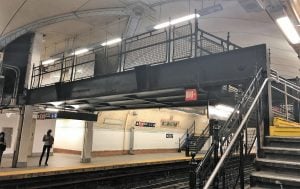
168th Street Subway Station. Photo: Brian Kachejian 2017
If you’re one of those people who has a fear of elevators, our advice to you is never get off the subway train at 168th Street in Manhattan. For passengers headed to street level, there is only one practical way out: by elevator. No matter which side of the platform you exit or which direction you’re heading, reaching Broadway means riding one of the station’s small elevators.
The Gateway To Columbia University Irving Medical Center
The station’s primary destination is Columbia University Irving Medical Center. While the medical center is regarded as one of the finest hospitals in the New York metropolitan area, getting there by automobile can often mean battling traffic on the Cross Bronx Expressway, the George Washington Bridge approaches, and the surrounding streets of Upper Manhattan. As a result, thousands of patients, employees, students, and visitors choose the subway instead.
Many first-time visitors are surprised to discover that after stepping off the train, the only practical route to the street is by elevator.
A Historic New York Subway Station
The 168th Street Subway Station first opened in 1906. Today, it is served by the A Train, the 1 Train, and, during certain service periods, the C Train.
Once the elevators reach street level, passengers emerge on both the east and west sides of Broadway, just north of Columbia University Irving Medical Center in Manhattan’s Washington Heights neighborhood. The surrounding area offers coffee shops, bagel stores, restaurants, food trucks, newsstands, and other neighborhood businesses that serve the steady stream of commuters and hospital visitors.
The Elevator Experience
The elevators are staffed by MTA employees who sit behind protective barriers inside the elevator vestibules. During the summer months, the elevators can become extremely hot, and ventilation has long been a challenge. The difficult working conditions for the employees stationed there every day are hard to ignore, especially during periods of high temperatures.
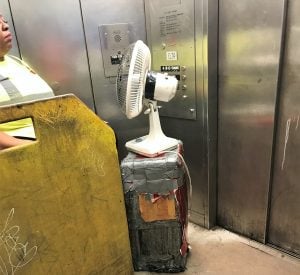
168th Street Subway Station Elevator. Photo: Brian Kachejian 2017
An Unusual Design That Raises Questions
One of the station’s most surprising characteristics is the absence of public stairway access to street level. Although stairways were originally part of the station, they have long been closed to regular public use. During rush hour, long lines can develop as commuters wait for elevators traveling between the platforms and the street.
It is understandable why some passengers feel uneasy relying solely on elevators to exit a subway station. Thoughts naturally turn to what might happen during a power outage or another emergency requiring a rapid evacuation. While the MTA maintains emergency procedures for situations like these, the station’s unusual design has left many riders wondering how efficiently thousands of passengers could exit if elevators became unavailable. For this writer, it was enough to make me think twice about using the station again.
Related Classic New York History Articles
If you enjoy learning about New York City’s transportation history, be sure to read our articles on Grand Central Terminal, the Second Avenue Subway, the history of Pennsylvania Station, and how Robert Moses shaped New York transportation.
Article updated June 28, 2026