America’s historic carousels are more than amusement park attractions. They are hand-carved works of art, pieces of family memory, and living reminders of a time when craftsmanship, music, color, and motion came together in one magical ride. Few people understand that better than William Finkenstein, whose lifelong passion for carousel art has helped preserve some of the country’s most treasured wooden carousels. His work connects generations of riders to the artists, parks, and stories that shaped this beautiful piece of American history.
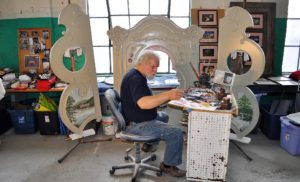
Photo: William Finkenstein restores carousel panels at his studio in Plainville, Connecticut. Credit: WRF Designs
“A carousel is a beautiful attraction. But it also is history,” said William Finkenstein.
For more than 60 years, Finkenstein has admired the history and the beauty of the world’s carousels. He considers the attractions wonderful works of art.
Finkenstein recently recalled that during his younger days, he attended a pulp show featuring countless items made from paper. One vendor featured old copies of The Saturday Evening Post.
“So, I asked if he had an issue for May 1947, that is the month and year of my birth,” said Finkenstein. “He finds the issue, and the cover has a Norman Rockwell image of an artist who is painting a carousel.”
It was meant to be.
Russian Roots
Finkenstein is one of nine children of ancestors who arrived from Prussia during the late-1800s wave of legal immigration. His grandfather, William Richard Finkinstuire, arrived in America at Castle Garden in Lower Manhattan in 1870. He had met his wife, Rosa, in Prussia, and she arrived two years later. “He was a barber,” Finkenstein recalled of his grandfather. “He did more than cut hair, though. He pulled teeth and bled people for various illnesses. He opened three shops. He moved to Pittsfield, Massachusetts, in 1875. A few years later, in 1878, he was in Cobleskill, New York, near Sharon Springs that consisted of a very large Jewish population.”
Many Jewish families from New York City spent summers at Sharon Springs, and large numbers eventually settled in nearby Schenectady and Amsterdam. Many things have changed over the years, including some members of the family’s religion. The William Finkenstein family today is Methodist on his mother’s side.
The Circus Comes To Town
While Finkenstein often recalls the surprise of finding the Rockwell magazine image, he traces his love for carousels to an earlier time when he was just six years old.
“We had a traveling circus come to town in Amsterdam. My grandparents had one of the first way stations on the Erie Canal. My grandmother ran the general store, and my grandfather, who had become an attorney, had his office nearby.
“The circus set up in nearby big fields,” added Finkenstein, “and I was told to stay on the porch, because the circus had gypsies and children sometimes disappeared when they were around. But I heard the music and smelled the popcorn. I went across the street, between a church and graveyard. I became mesmerized by the carousel. The animals were going up and down, and all the children were having fun.
“I then felt a hand on my shoulder,” continued Finkenstein, “and it was a state trooper who knew me, because my grandfather also was a judge. The trooper took me home, and I got the lecture again about the gypsies.”
Carousels continued to enter Finkenstein’s life. His father was an engineer with General Electric, and they lived in many different places. The family enjoyed its recreation time, and this included rides on many different carousels.
The Art Of Carousels
Finkenstein’s father provided the boy with telescopes and chemistry sets during his younger years, but none of it stimulated any long-term interest. The boy found his passion, though, when his mother presented him with a paint set and chalk.
“I created a number of pieces and then attended a craft show to display about 30 images,” said the artist. “Within an hour, I had only three left and made $1,800. My father told me to go home and paint more while he stayed to sell the remaining pieces.”
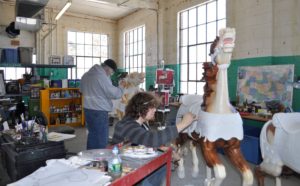
Photo: Gabe Finkenstein, foreground, and his father, William, working on carousel horses in their studio. Credit: WRF Designs
Finkenstein’s early career included sign work, drafting, and then teaching mechanical drafting. Finally, the day arrived when he would begin his work with wooden carousel horses. His company, WRF Designs in Plainville, Connecticut, focuses on the appraisal and restoration of carousels from across the country.
“Many years ago, a relative who knew I painted brought over a carousel horse for me to refurbish,” said Finkenstein. “Then, the owner of the nearby Southington Lake Compounce Amusement Park called and asked if I would restore the park’s wood carousel. From there, calls for carousels that required restoration have continued to come in.”
Finkenstein has more than 40 years of experience in carousel restoration. He and his wife, Claudia, started the New England Carousel Museum in Bristol. They invested significant time and money to gather the collection and secure the museum’s success and popularity.
Restoring America’s Carousels
Finkenstein and his son, Gabe, who works in the business with him, have restored many of the famous carousels from Binghamton, New York, the Carousel Capital of the World. The city’s minor league baseball team, the Rumble Ponies, pays homage to that history. Father and son also have restored a carousel from New Orleans that was damaged during a hurricane. Recently, they were commissioned to restore the 1915 Mangels-Carmel attraction from New York’s Rye Playland in Westchester County. The carousel was damaged by water when its roof caught fire several years ago.
Finkenstein’s passion for and artistry with carousels is featured in a new book, Freedomland U.S.A.: The Definitive History, about the early 1960s New York City American history theme park. Freedomland showcased a circa 1912 Dentzel wood carousel that it had named the King Rex Carrousel, using the French spelling for the word since the attraction was situated in the New Orleans-themed area of the park.
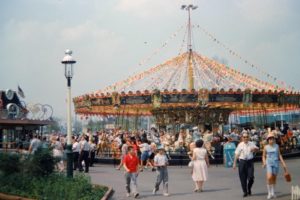
Photo: The King Rex Carrousel at Freedomland U.S.A. Credit: Michael R. Virgintino Collection
After Freedomland closed, King Rex was purchased by Storytown USA, later The Great Escape, in Lake George, New York. When Charles R. Wood, the owner of that park, decided to break up the attraction for auction in 1989, Finkenstein worked on restoring the diverse menagerie and other pieces to help attract bidders.
The many items from that Dentzel are now part of an unknown number of private collections. Two pieces, however, still can be enjoyed by the public as part of the extensive collection at the New England Carousel Museum. The remnants on display are a carved wooden upper panel depicting an Indian warrior charging on horseback, and another wooden panel with a mirror.
Thanks to Finkenstein’s lifelong passion, millions of people across generations, and for generations to come, are able to grab that brass ring as they enjoy and admire the history and artistry of America’s wood carousels.
Mike Virgintino is the author of Freedomland U.S.A.: The Definitive History, the story about America’s theme park published by Theme Park Press. It can be found on Amazon, eBay, and Goodreads.
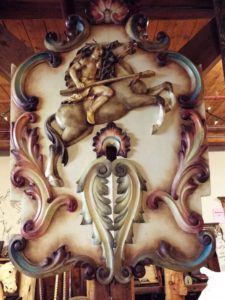
Photo: The wood inside upper panel from the Freedomland U.S.A. King Rex Carrousel. Credit: Michael R. Virgintino Collection
Related Articles
If you enjoyed this story about restoring America’s carousels, continue exploring more ClassicNewYorkHistory.com articles on New York amusement parks and historic attractions, including Do You Remember Freedomland U.S.A.?, After Eighty-Nine Years, Rye Playland Is Still Open, The History of Coney Island, The History of Luna Park in Coney Island, and The History of the Wonder Wheel at Coney Island.
Updated June 29, 2026.