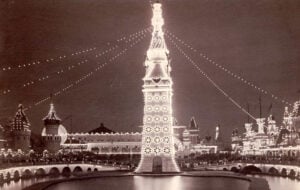
The original Luna Park illuminated at night in Coney Island, circa 1903. Detroit Publishing Co., via The New York Public Library Digital Collections.
Long before theme parks became destination resorts reached by interstate highways and commercial flights, New Yorkers found their summer thrills much closer to home. Trolley lines, ferries, elevated trains, subways, and railroads carried enormous crowds to amusement districts where roller coasters, dance halls, swimming pools, electric lights, live shows, and mechanical spectacles transformed the city and its surrounding region after dark.
Coney Island became the most famous example, but it was hardly alone. The Bronx had Freedomland and Starlight Park. Queens had Rockaways’ Playland. Upper Manhattan had Fort George. Canarsie had Golden City. Long Island families grew up with Nunley’s. Across the Hudson River in New Jersey, Palisades Amusement Park advertised directly to New Yorkers and became part of the metropolitan area’s shared amusement culture.
The ten parks below are gone, but their stories remain embedded in neighborhoods, housing developments, highways, public parks, surviving rides, and the memories of generations who spent their summers there.
1. Dreamland, Coney Island, Brooklyn
Active years: 1904–1911
Location: Coney Island, south of Surf Avenue near West 5th through West 10th Streets
Dreamland opened in 1904 as the last of Coney Island’s three great enclosed amusement parks. Former New York State Senator William H. Reynolds developed it as a more orderly and monumental rival to nearby Luna Park. Its buildings were painted largely in white, while its towers, lagoons, promenades, and electric illumination created one of the most theatrical environments ever built at Coney Island.
The park’s central Beacon Tower rose approximately 375 feet, while roughly one million electric lights helped turn Dreamland into a nighttime spectacle. Attractions included Shoot-the-Chutes, Hell Gate, live disaster spectacles, animal shows, and Dr. Martin Couney’s infant incubator exhibition. Couney’s unusual combination of medicine and public entertainment helped finance care for premature infants at a time when many hospitals offered little specialized treatment for them.
Dreamland’s life ended with extraordinary speed. In the early morning of May 27, 1911, a fire began while workers were repairing the Hell Gate attraction. The flames raced through the park’s wooden structures, and Dreamland was essentially destroyed before the day was over. It never reopened.
What is there today: The former Dreamland property was gradually redeveloped. The New York Aquarium, which opened at Coney Island in 1957, occupies a substantial part of the former Dreamland area.
2. The Original Luna Park, Coney Island, Brooklyn
Active years: 1903–1944
Location: Coney Island, north of Surf Avenue between approximately West 8th and West 12th Streets
Frederic Thompson and Elmer “Skip” Dundy opened Luna Park in 1903 on the former Sea Lion Park property. The new park became famous for an architectural fantasy of domes, minarets, towers, waterways, and electric lighting that made nighttime itself part of the attraction.
One of its signature experiences was A Trip to the Moon, a theatrical illusion that simulated a journey from Earth to the lunar surface. Luna Park also offered Shoot-the-Chutes, animal attractions, exoticized architectural environments, and an ever-changing collection of rides and shows.
The park survived for more than four decades, but a major fire on August 13, 1944, destroyed a large portion of Luna Park. The original park never recovered as a major operating attraction and disappeared from Coney Island’s landscape.
What is there today: Much of the original Luna Park property was later redeveloped as the Luna Park Houses. The amusement park operating today under the Luna Park name opened in 2010 as a new park in the Coney Island amusement district. It honors the historic name but is not the original 1903 Luna Park.
3. Steeplechase Park, Coney Island, Brooklyn
Active years: 1897–1964
Location: Coney Island, around the Boardwalk and West 15th through West 19th Streets
George C. Tilyou opened Steeplechase Park in 1897, making it the oldest of Coney Island’s three legendary enclosed amusement parks. Its namesake attraction sent riders racing beside one another on horse-shaped cars mounted to parallel tracks.
Steeplechase built its personality around participation, surprise, and embarrassment. After a devastating 1907 fire, Tilyou rebuilt around the enormous Pavilion of Fun, where attractions such as the Human Roulette Wheel, moving floors, slides, and blasts of air turned the visitors themselves into part of the show.
Unlike Dreamland and the original Luna Park, Steeplechase survived well into the postwar era. It finally closed after the 1964 season. Real estate developer Fred Trump purchased the property in 1965, and most of the remaining amusement structures were eventually demolished.
What is there today: The former Steeplechase property was redeveloped in stages. Maimonides Park, home of the Brooklyn Cyclones, occupies part of the area, while the landmarked Parachute Jump remains the great surviving visual symbol of the Steeplechase era. The Parachute Jump had originally been built for the 1939–1940 New York World’s Fair before being moved to Coney Island.
4. Freedomland U.S.A., The Bronx
Active years: 1960–1964
Location: Baychester, on land later developed as Co-op City
Freedomland U.S.A. was one of the most ambitious amusement projects ever attempted in New York City. The 85-acre park opened in 1960 with an American-history theme and a layout inspired by the geography and history of the United States.
Cornelius Vanderbilt “C.V.” Wood, who had played an important role in the development of Disneyland, conceived and built Freedomland through his Marco Engineering company. Visitors moved through themed areas that included Little Old New York, Old Chicago, the Great Plains, the Old Southwest, San Francisco, New Orleans, and the futuristic Satellite City.
Some attractions were part ride and part live theater. In Old Chicago, guests could watch a recreation of the Great Chicago Fire and help pump water. Elsewhere there were staged Western shootouts, boats, trains, performers, historical recreations, and entertainment built around an idealized trip through the United States.
Freedomland survived only five seasons. Financial problems, the realities of operating a huge seasonal park in the Northeast, and competition for leisure dollars all contributed to its collapse. More significantly, it was really just intended as a placeholder for a huge real estate deal. The park filed for bankruptcy after the 1964 season and was demolished in 1965.
What is there today: The surrounding land was rezoned for residential development, and Co-op City was built between 1966 and 1973 along with adjacent shopping areas. New York City’s Department of City Planning describes Co-op City as the largest cooperative housing development in the United States.
5. Rockaways’ Playland, Queens
Active years: 1901–1985
Location: Rockaway Beach, around Beach 98th Street and Rockaway Beach Boulevard
The roots of Rockaways’ Playland stretched back to the beginning of the twentieth century. Our CYO Day Camp in the Bronx would take us there once or twice during the summer in the late 1960s. It was always a highlight of the camp. Roller coaster pioneer LaMarcus Adna Thompson established an amusement operation in the Rockaways in 1901, and the property later became known as L.A. Thompson’s Amusement Park.
In 1928, the Geist family acquired the park and renamed it Rockaways’ Playland. It became one of Queens’ great summer destinations, combining the oceanfront setting with rides, games, concessions, and roller coasters.
The park’s best-remembered coaster was the Atom Smasher, built in 1939. The wooden coaster became nationally famous when it appeared in the 1952 widescreen film This Is Cinerama, giving movie audiences a dramatic point-of-view roller coaster experience.
Playland survived far longer than most of New York’s early amusement parks, finally closing in 1985. The Atom Smasher came down during the redevelopment that followed.
What is there today: Residential development, including condominiums and other housing, replaced much of the former amusement park property.
6. Starlight Park, The Bronx
Active era: 1920 through the 1930s, with parts of the site continuing into the 1940s
Location: Along the Bronx River near West Farms
The Starlight Park story begins with the Bronx International Exposition of Science, Arts and Industries, which occupied the site in 1918. After the exposition ended, the grounds were reorganized as an amusement destination, and Starlight Park opened in 1920.
The park offered roller coasters, swimming, athletic facilities, concessions, and entertainment along the Bronx River. A large stadium and other facilities turned the property into a combination amusement and sports complex rather than a conventional ride park alone.
By the 1930s, however, Starlight was in decline. Fire, the Great Depression, financial problems, and the deterioration of the surrounding site all contributed to the loss of the amusement park. The property passed through several later uses before major transportation construction transformed the area.
What is there today: The name survives in today’s public Starlight Park along the Bronx River. Modern park reconstruction has restored green space, paths, recreation areas, and waterfront access to a neighborhood once dominated by the old amusement grounds and later highway infrastructure.
7. Fort George Amusement Park, Upper Manhattan
Active years: approximately 1895–1914
Location: Washington Heights, around Fort George and the northern end of Highbridge Park
At the turn of the twentieth century, northern Manhattan had its own amusement district. Fort George developed around trolley access, beer gardens, dance halls, restaurants, mechanical rides, and concessions perched on the high ground above the Harlem River.
The district became widely known as “Harlem’s Coney Island.” Visitors traveled uptown for roller coasters, music, shooting galleries, food, dancing, and attractions that took advantage of the dramatic elevation and relative openness of upper Manhattan.
Fort George’s amusement era was brief. Fires damaged major parts of the district, while neighborhood opposition to noise, drinking, and crowds grew stronger. By 1914, the amusement park era was effectively ending, and much of the land was eventually incorporated into public and institutional uses.
What is there today: The former amusement district is now part of the landscape around Highbridge Park, schools, streets, and institutions in Washington Heights. The rides and midway have disappeared, but the steep terrain that made Fort George such an unusual amusement setting remains.
8. Golden City, Canarsie, Brooklyn
Active years: 1907–1939
Location: Canarsie waterfront along Jamaica Bay
Golden City opened in the summer of 1907 as Canarsie’s answer to Coney Island. Built by Warner’s Canarsie Amusement Company, the park benefited from improved rail connections that made the Jamaica Bay shoreline accessible to day-trippers from across Brooklyn and beyond.
The park offered roller coasters, carousels, arcades, a Tunnel of Love, a Ferris wheel, live performances, novelty attractions, and an elaborate midway. Brooklyn Public Library records also document spectacular shows and daredevil acts that made Golden City much more than a collection of mechanical rides.
Fire repeatedly damaged the park during its long run. By the 1930s, the surrounding waterfront was also being transformed by public works. Golden City was gone by 1939 as construction of the Belt Parkway and related shoreline changes remade the Canarsie waterfront.
One especially important piece of Golden City survived. A Stein & Goldstein carousel installed there in 1912 was moved to Baldwin, Long Island, in 1939. It became the famous Nunley’s Carousel.
What is there today: Canarsie Pier, parkland, the Belt Parkway, and surrounding public spaces occupy the waterfront area where Golden City once entertained crowds.
9. Nunley’s Amusement Park, Baldwin, Long Island
Active years: 1939–1995
Location: Sunrise Highway, Baldwin, Nassau County
Nunley’s became one of the great childhood landmarks of postwar Long Island. Generations of families came to the roadside amusement park for kiddie rides, games, miniature golf, and its beloved carousel.
The carousel had already lived a full amusement-park life before reaching Baldwin. Built by Stein & Goldstein, it had been installed at Golden City in Canarsie in 1912. In 1939, it moved to Baldwin and reopened as Nunley’s Carousel.
Nunley’s Amusement Park closed in 1995, ending more than half a century of operation in Baldwin. Unlike most of the lost parks in this article, however, its most important attraction was saved.
What is there today: Nassau County purchased and preserved the historic carousel. After restoration, it reopened in 2009 at Museum Row in Garden City. The Long Island Children’s Museum now operates Nunley’s Carousel in partnership with Nassau County, allowing a ride that once turned at two different lost amusement parks to continue operating in the twenty-first century.
10. Palisades Amusement Park, Cliffside Park and Fort Lee, New Jersey
Active years: 1898–1971
Location: The New Jersey Palisades directly across the Hudson River from Upper Manhattan
Palisades Amusement Park is the one park on this list that was not physically located in New York, but leaving it out would ignore how deeply it belonged to the New York metropolitan amusement experience. Its advertisements reached New York families for generations, and its location high above the Hudson placed it directly across from Manhattan. Additionally, this one is personal for me. Growing up in the Bronx, an older couple lived in the apartment next to ours and used to take me to Palisades all the time. For me, it was the equivalent of going to Disneyland, because that was simply out of reach. There was nothing like Palisades. I was less than 10 years old at the time, and that’s what probably made it so magical. The lights, the rides, the smell of it I will never forget what it was like escaping the Bronx for a few hours at night and seeing those amusement park lights on top of the Palisades cliffs from the George Washington Bridge as we approached Jersey.
The park began in 1898 as a trolley-company attraction intended to increase weekend ridership. It expanded from a picnic ground into a major amusement park, adding rides, entertainment, and a huge outdoor saltwater pool.
Brothers Nicholas and Joseph Schenck acquired the property in 1910. Irving and Jack Rosenthal took over in the 1930s and turned Palisades into one of the country’s best-known amusement parks. Its concert stages hosted major performers, its advertising saturated the New York market, and Freddy Cannon’s 1962 hit “Palisades Park” carried its name around the country.
Palisades finally closed on September 12, 1971, as the value of the cliffside property made residential development increasingly attractive.
What is there today: High-rise residential towers and condominiums now occupy the former amusement park property, overlooking the same Hudson River and Manhattan skyline that once formed the backdrop to the rides.
Why So Many New York Amusement Parks Disappeared
There was no single reason these parks vanished. Fire destroyed Dreamland and repeatedly damaged other amusement grounds built largely from wood. The Great Depression weakened spending. World War II brought shortages and restrictions. Rising land values made large amusement properties tempting targets for housing and commercial development. Highways and automobiles changed where families could travel for recreation, while television and new forms of entertainment competed for leisure time.
Public works also played a major role. Highways erased or divided waterfront amusement districts. Residential projects replaced large open tracts. Changing attitudes toward urban planning favored housing, roads, schools, and parks over noisy seasonal attractions.
Yet the parks rarely disappeared without leaving something behind. The Parachute Jump survives at Coney Island. Nunley’s Carousel still turns in Garden City. Co-op City rose where Freedomland once stood. Starlight Park reclaimed the name of an earlier Bronx attraction. Even when the rides vanished, the amusement landscape continued shaping what came next.
More New York Amusement Park History
Readers who remember the Bronx park can continue with our Do You Remember Freedomland U.S.A.?. For another vanished New York attraction, explore our History of New York’s Frontier Town. To compare these lost parks with a historic amusement park that survived, read After Eighty-Nine Years, Rye Playland Is Still Open. Coney Island readers can also continue with our History of Nathan’s Famous Hot Dogs at Coney Island.
Sources
New York City Department of Parks and Recreation, Coney Island Beach and Boardwalk History
New York City Department of Parks and Recreation, History of the New York Aquarium
Coney Island History Project, Dreamland History
Luna Park in Coney Island, History of the Original and Modern Luna Park
New York City Department of City Planning, Baychester Avenue Rezoning and Freedomland U.S.A. History
Queens Public Library, How the Roller Coaster Came to Queens and Rockaways’ Playland
New York City Department of Parks and Recreation, Starlight Park History
New York City Department of Parks and Recreation, Highbridge Park and Fort George History
Brooklyn Public Library, Golden City USA
Long Island Children’s Museum, Nunley’s Carousel History
Palisades Amusement Park Historical Society, A Brief History of Palisades Amusement Park
10 Lost Amusement Parks at a Glance
| # | Amusement Park | Location | Active Era | What Replaced It or Survives |
|---|---|---|---|---|
| 1 | Dreamland | Coney Island, Brooklyn | 1904–1911 | New York Aquarium and later Coney Island development occupy much of the former area |
| 2 | Original Luna Park | Coney Island, Brooklyn | 1903–1944 | Luna Park Houses occupy much of the original site; a separate modern Luna Park opened nearby in 2010 |
| 3 | Steeplechase Park | Coney Island, Brooklyn | 1897–1964 | Maimonides Park and other redevelopment; Parachute Jump survives |
| 4 | Freedomland U.S.A. | Baychester, The Bronx | 1960–1964 | Co-op City and surrounding development |
| 5 | Rockaways’ Playland | Rockaway Beach, Queens | 1901–1985 | Residential development |
| 6 | Starlight Park | West Farms, The Bronx | 1920–1930s | Modern Starlight Park and transportation infrastructure |
| 7 | Fort George Amusement Park | Washington Heights, Manhattan | c. 1895–1914 | Highbridge Park, schools, streets, and institutional development |
| 8 | Golden City | Canarsie, Brooklyn | 1907–1939 | Canarsie waterfront parkland, Canarsie Pier, and Belt Parkway area |
| 9 | Nunley’s Amusement Park | Baldwin, Long Island | 1939–1995 | Former park site redeveloped; historic carousel survives at Museum Row in Garden City |
| 10 | Palisades Amusement Park | Cliffside Park/Fort Lee, New Jersey | 1898–1971 | High-rise residential towers and condominiums |
Published August 17, 2026.
10 Lost Amusement Parks New Yorkers Once Loved article published on ClassicNewYorkHistory.com © 2026