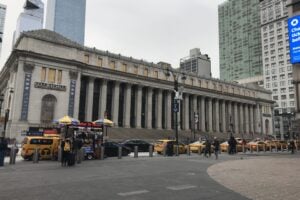

Feature Photo: bradfordschultze, Public domain, via Wikimedia Commons
The Rainbow Room has been one of the most famous restaurants in New York City since the 1930s. It is a classic example of restaurants situated on the higher floors of skyscrapers, meaning interested individuals can expect a spectacular view of the surroundings while ensconced within. Originally, the Rainbow Room was very much meant for the rich and the famous, particularly since it opened its doors during the Great Depression. Nowadays, it is quite a bit more accessible to the general public.
The Birth Of The Rainbow Room
Originally, John D. Rockefeller Jr. wanted to build a new home for the Metropolitan Opera. That plan fell through when the Great Depression made the Metropolitan Opera too broke to move. As a result, Rockefeller decided to build a business and entertainment complex on the leased land instead. Soon enough, 30 Rockefeller Plaza opened its doors in May of 1933, thus leading to questions about how to use its space.
Elevators are older than what interested individuals might expect. However, they were incorporated into buildings in the late 19th century, which not coincidentally, was around the same time when people started building the first skyscrapers. The use of elevators turned higher floors into more desirable floors. Thanks to that, there was a well-established custom of putting high-class restaurants and similar establishments on the higher floors of skyscrapers by the time 30 Rockefeller Plaza opened its doors. The Rainbow Room was one more example of this trend in those times.
Specifically, the plan called for two restaurants on the 65th floor. One was supposed to be a more casual eatery, which would become the Rainbow Grill. The other was supposed to be a more elegant restaurant, which would become the Rainbow Room. In time, a luncheon club would be established as well, which would prove to be even more exclusive in nature.
Initially, the Rainbow Room was called the Stratosphere Room. The first part of the name referred to its high-up location, while the second part of the name prevented it from seeming too much like a normal restaurant. Later, the Stratosphere Room was renamed the Rainbow Room because of a special organ that synchronized the color of its lights with the sound of its music. Supposedly, the organ wasn’t very popular, which would explain why it was removed decades and decades ago.
The Rainbow Room Under the Rockefellers
The Rainbow Room didn’t just acquire its desired clientele right away. Still, it was backed by one of the richest men in the country, so it was just a matter of time. Throughout the 1930s, the Rainbow Room was a popular place to visit for the rich and the famous, as shown by how its clientele ranged from American magnates to European royalty. On top of that, its success meant that it was often packed.
In 1942, the Rainbow Room closed because of the focus on the Second World War. It still saw use for various purposes throughout the 1940s, but it wouldn’t reopen as a restaurant until 1950. Subsequently, the Rainbow Room continued to host the rich and the famous, though it became less exclusive as well because of its increased availability to the general public. There were a couple of major renovations in this period. The first happened in 1965, while the second happened in 1985. Both were meant to rejuvenate the Rainbow Room, though their chosen methods weren’t quite the same.
The Rainbow Room Under the Ciprianis
Soon enough, the Rockefellers turned the operation of the Rainbow Room over to the Ciprianis of Cipriani S.A. fame. It wasn’t too long before the new operators became embroiled in controversy. After all, the Ciprianis started by firing 250 union employees, thus causing a strike. Furthermore, they ruffled a lot of feathers by greatly reducing the general public’s access to the Rainbow Room, which didn’t win them any favors in the PR battle. This more-or-less set the tone for what would prove to be a troubled period.
For example, a mob turncoat named Michael DiLeonardo testified in 2003 that the Ciprianis paid the Gambino crime family $120,000 to make their union problem go away. The claim was never proven, but it nonetheless impacted their reputation. Similarly, the Ciprianis sued the landlord Tishman Speyer in 2004 over the latter’s decision to install metal detectors at the entrance to the Rainbow Room’s elevator bank. They said it would cause unreasonable wait times for their clientele, while the landlord said the metal detectors were necessary because of post-9/11 security measures. Eventually, the relationship between the two parties deteriorated so much that Tishman Speyer moved to evict the Ciprianis over unpaid rent. Something that was resolved by the Ciprianis agreeing to give up the Rainbow Room, which closed in 2009.
The Rainbow Room Under Tishman Speyer
Since then, Tishman Speyer has decided to operate the Rainbow Room itself. The restaurant received landmark status on October 13 of 2012. Subsequently, Tishman Speyer reopened the Rainbow Room on October 5 of 2014 following extensive renovations. So far, the restaurant hasn’t seen much drama. The most notable occurrence is that the Rainbow Room closed during the COVID-19 crisis, though that says very little because that wasn’t exactly limited to just the Rainbow Room.
What Customers Can Expect From the Rainbow Room?
Nowadays, the Rainbow Room serves New American cuisine. Unsurprisingly, its prices remain high, though whether those prices are worth it is very much a matter of personal opinion. Interested individuals can also book it for weddings provided they are prepared to pay a few hundred dollars per person for a few hours.
References:
https://rockarch.org/resources/about-the-rockefellers/john-d-rockefeller-jr/
https://www.cnn.com/style/article/short-history-of-the-elevator/index.html
http://www.nycago.org/organs/nyc/html/rainbowroom.html
https://www.rockefellercenter.com/attractions/rainbow-room/
https://www.nytimes.com/1999/05/16/nyregion/restaurant-empire-under-siege-battle-over-union-jobs-only-one-cipriani-family-s.html
https://nymag.com/news/intelligencer/topic/62708/
https://www.nytimes.com/2004/05/14/nyregion/metal-detector-before-the-maitre-d-at-the-rainbow-room.html
https://www.nytimes.com/2012/08/15/nyregion/rainbow-room-shut-by-feud-has-fading-wish.html
https://www.marthastewart.com/7931619/nyc-rainbow-room-wedding-venue
History Of New York’s Rainbow Room ClassicNewYorkHistory.com ©2022
ClassicNewYorkHistory.com claims ownership of all its original content and Intellectual property under United States Copyright laws and those of all other foreign countries. No one person, business or any organizations is allowed to republish any of our original content anywhere on the web or in print without our permission.