The St. James Long Island Rail Road station is one of the oldest surviving railroad stations on Long Island. Opened in 1873, the beautifully preserved Victorian depot stands as a reminder of the Long Island Rail Road’s nineteenth-century expansion eastward and continues to serve commuters on the Port Jefferson Branch more than 150 years after welcoming its first passengers.
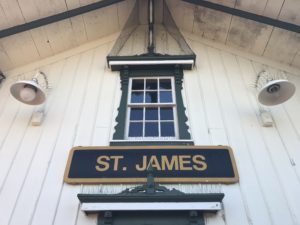
Photo: Brian Kachejian 2017
While most Long Island Rail Road stations feature modern structures built in the past fifty to seventy-five years, a few still retain the original buildings built at the birth of the Long Island Rail Road in the nineteenth century. The Long Island Rail Road was originally constructed in the early 1830s. However, it took almost forty years for the line to reach the hamlet of St. James in the 1870s.
The St. James station opened in 1873. The original building still stands on Lake Avenue. The building was constructed in the Steamboat Gothic style. A local carpenter named Calvin L’Hommedieu was responsible for constructing the station building. At the time, the St. James Train Station became a gleaming showcase for the Long Island Rail Road’s expansion to Port Jefferson.
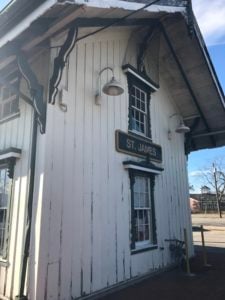
Photo: Brian Kachejian 2017
The St. James Train Station also housed a freight station just west of the building. However, the freight station no longer exists and is simply a memory of a different time. Since many original Long Island Rail Road stations were built in the nineteenth century, numerous depots were torn down during the 1960s due to operating costs and deteriorating conditions. Passengers also began purchasing tickets on trains rather than inside station buildings. The days of the manned ticket booth would eventually give way to ticket vending machines, making many of the buildings even more obsolete.
While the ticket booths inside the St. James Train Station have not been manned for years, the building still stands as a tribute to the past. During the 1990s, the building was restored to preserve its historic connection to the community.
Today, the St. James station serves as the third-to-last stop on the Long Island Rail Road’s Port Jefferson Branch. Stony Brook and Port Jefferson are the final two stations on the line. The area surrounding the station is a well-kept community within the Town of Smithtown. Directly north of the station is St. James Elementary School. To the south is a King Kullen supermarket. Across Lake Avenue from the tracks stands Garguilo’s Bakery, easily one of Long Island’s finest bakeries. Within about a half-mile walk from the station is the St. James General Store. The St. James General Store is the oldest continuously operating general store in the United States.
The St. James Train Station is a single-platform station. There are no bus stops at the station. There is a parking lot, but it is rather small when compared to most Long Island Rail Road station parking lots. The station seems to serve mostly business travelers and is usually quiet on weekends, although many families use the train for weekend trips into New York City.

Photo: By Gryffindor (Own work) [CC BY-SA 3.0], via Wikimedia Commons

Photo: Brian Kachejian
Related Long Island History Articles
If you enjoyed this article, be sure to explore more Long Island history on ClassicNewYorkHistory.com, including features on the St. James General Store, Long Island Expressway, and other historic places that have helped shape Long Island’s past.
Article updated on June 26, 2026