
The Industrial Backbone of the Empire State
When people think of New York State, they picture the soaring skyscrapers of Manhattan. Beyond the five boroughs, however, lies a vast network of historic industrial centers, canal cities, manufacturing hubs, and river communities stretching from the lower Hudson Valley to the shores of Lake Erie.
These are the cities that milled the nation’s flour, forged its steel, built its locomotives, produced its cameras, manufactured its textiles, and helped electrify the modern world. Many of them were transformed by the Hudson River, the Erie Canal, and the railroads that tied the state together.
One point of confusion needs to be cleared up before the countdown begins. New York State law distinguishes incorporated cities from towns and villages. That is why the Town of Hempstead on Long Island does not appear on this list even though its population is larger than that of Buffalo, Yonkers, Rochester, and Syracuse combined. Hempstead is legally a town, not a city.
This ranking covers New York State’s ten largest incorporated cities using the U.S. Census Bureau’s Vintage 2025 population estimates for July 1, 2025. Annual population estimates are revised when each new vintage is released, but these are the most recent completed and consistent figures available.
10. Utica (Population: 62,978)
Utica sits in the heart of the Mohawk Valley in Oneida County, on a strategically important crossing of the Mohawk River once known as Old Fort Schuyler. The community was incorporated as a village in 1798 and became a city in 1832.
The arrival of the Erie Canal in the early nineteenth century transformed Utica into a major transportation and commercial center. The city’s industrial golden age belonged to textiles. By the beginning of the twentieth century, Utica had become known as the knit goods capital of the world, with mills that supplied clothing to customers across the country.
When textile manufacturing moved away during the twentieth century, Utica endured decades of economic hardship. The city nevertheless retained several treasured institutions, including the F.X. Matt Brewing Company, founded in 1888 and known for Utica Club and Saranac, and the Stanley Theatre, the grand 1928 movie palace that remains one of the city’s architectural landmarks.
In more recent decades, refugee resettlement has brought new residents, businesses, restaurants, and traditions to the old mill city. That renewal continues the immigrant story that helped build Utica in the first place.
9. Schenectady (Population: 69,471)
Schenectady earned one of the great civic slogans in American history: “The City That Lights and Hauls the World.” It was no idle boast.
Thomas Edison moved the Edison Machine Works to Schenectady in 1886. In 1892, Edison General Electric merged with the Thomson-Houston Electric Company to form General Electric, establishing Schenectady as one of the most important centers of electrical research and manufacturing in the world.
The city’s other industrial giant grew from the Schenectady Locomotive Works, which became a principal part of the American Locomotive Company in 1901. ALCO built steam and diesel locomotives, along with military equipment during wartime. Electricity and locomotives gave Schenectady the two halves of its famous slogan.
Today the Stockade District preserves streets and homes tied to the city’s Dutch colonial past and later development. Proctors Theatre anchors downtown, while the Mohawk River still rolls past a city whose factories once helped illuminate and move the nation.
8. Mount Vernon (Population: 72,304)
Mount Vernon sits directly against New York City’s northern border in Westchester County, so close that its streets flow almost seamlessly into the Bronx. In 1850, an association of New Yorkers purchased land in the area to establish an affordable residential community outside the crowded city. Mount Vernon was incorporated as a village in 1852 and became a city forty years later.
Rail service made the plan work. Mount Vernon developed into one of the region’s earliest commuter suburbs, a community whose residents could live outside New York City while remaining economically connected to it.
The city’s greatest historic treasure is Saint Paul’s Church National Historic Site. The adjoining village green was the setting of the Great Election of 1733, a fiercely contested colonial election reported in the first issue of John Peter Zenger’s New York Weekly Journal.
Zenger’s later arrest and 1735 trial took place in Manhattan, not at Saint Paul’s. Historians caution against claiming that the election directly created freedom of the press. The election and its newspaper coverage nevertheless remain important parts of the larger history of religious liberty, contested voting rights, independent journalism, and the freedoms later protected by the Bill of Rights.
7. New Rochelle (Population: 85,864)
New Rochelle carries one of the most moving origin stories in New York. French Huguenots fleeing religious persecution purchased land here in 1688 and named their new community after La Rochelle, the French port city associated with their former home.
Situated along Long Island Sound in Westchester County, New Rochelle developed from a colonial coastal settlement into a nineteenth-century commercial community and later a residential destination for people drawn to its shoreline, rail connections, and proximity to New York City.
By the middle of the twentieth century, New Rochelle had become a nationally recognizable image of suburban life. The Dick Van Dyke Show placed the fictional home of Rob and Laura Petrie in New Rochelle, bringing the city into American living rooms every week.
Glen Island Park and the Long Island Sound shoreline preserve the city’s waterfront identity, while extensive residential construction has continued to reshape its downtown. The old Huguenot settlement remains one of the largest and most diverse cities in the Hudson Valley.
6. Albany (Population: 101,698)
Albany is one of the oldest continuously settled European communities in the United States. The Dutch established Fort Orange in 1624 near the head of navigation on the Hudson River, creating an important center for the fur trade with the region’s Native peoples.
The city’s political destiny was secured in 1797, when Albany became the permanent capital of New York State. In 1807, Robert Fulton’s North River Steamboat established commercially successful service between New York City and Albany, strengthening the economic connection between the state capital and the nation’s largest port.
Albany’s skyline is dominated by the Empire State Plaza and the New York State Capitol, whose construction stretched from 1867 to 1899. The Capitol’s elaborate stonework and monumental staircases make it one of the most remarkable government buildings in the country.
Washington Park gives the city its green heart, while the Hudson River, state government, universities, hospitals, and surrounding Capital Region continue to define Albany’s modern economy. It is a city where more than four centuries of New York history remain visible in the street plan, architecture, and institutions.
5. Syracuse (Population: 144,896)
Syracuse rose on salt. The brine springs surrounding Onondaga Lake supported an industry so important that the city became known as the Salt City. Salt duties also contributed revenue to the fund used to build the Erie Canal, while the completed canal carried Syracuse salt to distant markets.
The city turned its canal and railroad advantages into manufacturing strength. The Franklin Automobile Company built luxury cars in Syracuse, and in 1937 the Carrier Corporation consolidated its manufacturing, engineering, and administrative operations in the former Franklin factory complex. Air conditioning became one of the industries most closely associated with the city.
Syracuse University rises above downtown, with the 42,784-seat JMA Wireless Dome serving as one of the region’s best-known landmarks. The Erie Canal Museum occupies the 1850 Syracuse Weighlock Building, the only surviving canal weighlock building in the United States.
Onondaga Lake carries a history far older than the modern city. The lake is sacred to the Onondaga Nation and is remembered as the place where the original nations of the Haudenosaunee Confederacy came together under the Great Law of Peace.
4. Rochester (Population: 206,108)
Rochester has reinvented itself repeatedly. It first became known as the Flour City, as the falls of the Genesee River powered mills that processed enormous quantities of grain. As commercial nurseries and horticulture grew, the nickname evolved into the Flower City, a tradition still celebrated by the annual Lilac Festival.
Then came the industries that changed how the world recorded and reproduced information. George Eastman built Eastman Kodak in Rochester, Bausch and Lomb became a leader in optical manufacturing, and the Haloid Company developed into Xerox. Together, those companies made Rochester one of the most important centers of imaging, photography, optics, and copying technology in the world.
Rochester’s civic history matched its industrial creativity. Frederick Douglass published The North Star in the city, and Susan B. Anthony organized for women’s suffrage from her home on Madison Street. Both figures are buried at Mount Hope Cemetery.
The George Eastman Museum preserves one of the world’s great collections devoted to photography and motion pictures, while High Falls remains a dramatic reminder of the natural power that created the original Flour City.
3. Yonkers (Population: 212,603)
Yonkers ranks third under the Census Bureau’s July 1, 2025 estimates, leading Rochester by 6,495 residents. The two cities were separated by only 241 people in the 2020 Census, but the latest estimate places a more substantial distance between them.
Stretching along the Hudson River immediately north of the Bronx, Yonkers occupies land associated with Adriaen van der Donck, the seventeenth-century Dutch landowner known by the title Jonkheer, meaning young lord or young gentleman. That title gradually became the name Yonkers.
Elisha Otis established his elevator business in Yonkers in 1853, one year before publicly demonstrating his safety brake at the New York Crystal Palace. The invention made safe passenger elevators practical and helped clear the way for the modern skyscraper.
The Alexander Smith and Sons Carpet Company later turned Yonkers into one of the world’s great carpet-manufacturing centers. Today the city is known for Untermyer Gardens, its Hudson River views, and the daylighted sections of the Saw Mill River that have restored a long-buried waterway to the downtown landscape.
2. Buffalo (Population: 274,613)
Buffalo is the second-largest city in New York State, and during the nineteenth century it became one of the most important transportation and commercial centers in North America. When the Erie Canal opened in 1825, Buffalo served as its western terminus, linking Great Lakes shipping to canal boats bound for Albany and New York City.
The grain trade transformed the waterfront. In 1842, Joseph Dart and engineer Robert Dunbar developed the first steam-powered grain elevator in Buffalo, dramatically accelerating the transfer of grain from lake vessels to canal boats. By the end of the nineteenth century, enormous elevators lined the Buffalo River.
Heavy industry followed. Steelmaking grew throughout the Buffalo region, including the vast Lackawanna works just south of the city, while hydroelectric power from Niagara Falls supported factories across Western New York.
Buffalo’s prosperity produced an extraordinary architectural inheritance. Frederick Law Olmsted and Calvert Vaux created the nation’s first coordinated system of parks and parkways there. Frank Lloyd Wright’s Darwin D. Martin House remains one of the architect’s great residential masterpieces.
The Anchor Bar is generally credited with introducing the Buffalo-style chicken wing in 1964. After decades of industrial decline, renewed investment along Canalside and the Buffalo River has brought people back to a waterfront that first made the city rich. The City of Good Neighbors has endured because its civic identity has always been larger than any single industry.
1. New York City (Population: 8,584,629)
There was never any suspense about the top position. New York City is not only the largest city in New York State, but also the largest city in the United States. Its estimated 8,584,629 residents represent nearly 43 percent of the state’s entire population.
The city’s story is the state’s story written on the largest possible scale. New Amsterdam began as a Dutch commercial settlement at the mouth of one of the world’s great natural harbors. The Erie Canal later connected that harbor to the interior of the continent, helping New York become the nation’s dominant port and commercial center.
Wall Street turned trade into capital, while generations of immigrants supplied the labor, entrepreneurship, culture, and energy that built the city. Manhattan, Brooklyn, Queens, the Bronx, and Staten Island were consolidated into a single municipal government in 1898, creating the five-borough city recognized today.
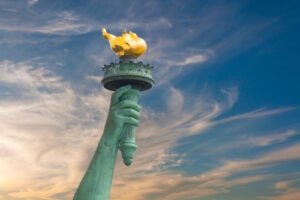
The Brooklyn Bridge, Central Park, the Empire State Building, the Statue of Liberty, Broadway, Wall Street, and the subway system became symbols recognized throughout the world. Yet New York City’s importance cannot be separated from the rest of the state.
Buffalo’s grain, Rochester’s manufactured goods, Syracuse’s salt, Schenectady’s electrical equipment, and Utica’s textiles all moved through transportation and financial networks connected to New York Harbor. The ten largest cities in New York State are not ten isolated stories. Together, they form the history of the Empire State.
What Is the Second-Largest City in New York State?
Buffalo is the second-largest incorporated city in New York State, with an estimated population of 274,613 on July 1, 2025. It remains far smaller than New York City but substantially larger than Yonkers, Rochester, and Syracuse.
Why Does Yonkers Rank Ahead of Rochester?
The 2020 Census counted 211,569 residents in Yonkers and 211,328 in Rochester, a difference of only 241 people. The Census Bureau’s July 1, 2025 estimates place Yonkers at 212,603 and Rochester at 206,108, widening the difference to 6,495 residents. Future annual estimates may revise those figures, but Yonkers currently holds third place.
What Is the Smallest Incorporated City in New York State?
Sherrill in Oneida County is the smallest incorporated city in New York State. The Census Bureau’s July 1, 2025 estimate placed its population at 2,973. Despite its size, Sherrill is legally one of New York State’s 62 cities.
Why Are Hempstead and Brookhaven Not on the List?
Hempstead and Brookhaven are legally classified as towns under New York State municipal law, not incorporated cities. The Town of Hempstead had an estimated population of 795,734 in 2025, while the Town of Brookhaven had an estimated population of 496,410. Their large populations do not change their municipal classification.
| Rank | City | County or Counties | Region | July 1, 2025 Population Estimate |
|---|---|---|---|---|
| 1 | New York City | Bronx, Kings, New York, Queens, and Richmond | Downstate | 8,584,629 |
| 2 | Buffalo | Erie | Western New York | 274,613 |
| 3 | Yonkers | Westchester | Lower Hudson Valley | 212,603 |
| 4 | Rochester | Monroe | Finger Lakes | 206,108 |
| 5 | Syracuse | Onondaga | Central New York | 144,896 |
| 6 | Albany | Albany | Capital Region | 101,698 |
| 7 | New Rochelle | Westchester | Lower Hudson Valley | 85,864 |
| 8 | Mount Vernon | Westchester | Lower Hudson Valley | 72,304 |
| 9 | Schenectady | Schenectady | Capital Region | 69,471 |
| 10 | Utica | Oneida | Mohawk Valley | 62,978 |
More New York State History
Readers interested in the transportation systems and communities that shaped the Empire State can continue with our History of the Erie Canal, History of New York’s Empire State Express Train, History of the Great New York State Fair, and History of Yonkers Raceway.
The 10 Largest Cities in New York State by Population article published on ClassicNewYorkHistory.com © 2026