Feature Photo: Wangkun Jia / Shutterstock.com
Long before anyone ever uttered the words “shopping mall,” New Yorkers had something better. If you needed a winter coat, a toaster, a First Communion dress, school shoes for the kids, or curtains for the living room, you went to the department store. It was all under one roof, and in New York City, those roofs sometimes covered entire city blocks.
Going to the department store was an event. Families dressed up for the trip. Mothers dragged their kids through the aisles in September for school clothes and brought them back in December to see the holiday windows. You knew which store fit your budget and which one you only walked through to look. Alexander’s was famous for low prices and endless variety; Bergdorf Goodman sat at the other end of the universe entirely.
These multistory cathedrals of consumption offered everything from fine couture and European imports to rooftop tea rooms, indoor fountains, white-glove elevator operators, and elaborate animated holiday displays. Beginning in the late 19th century along lower Manhattan’s Ladies’ Mile and eventually migrating uptown along Fifth and Sixth Avenues, New York’s grand retail palaces transformed shopping from a routine chore into a cultural experience.
Suburban malls, corporate mergers, changing neighborhoods, and eventually online shopping claimed several of these legendary institutions. Others continue to anchor Midtown Manhattan. Here are 10 of the most famous department stores in New York City history, how they began, and what happened to them.
1. Macy’s Herald Square
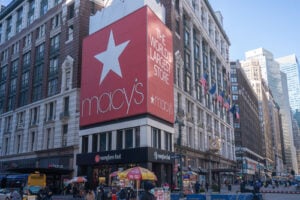
Location: 151 West 34th Street, Herald Square
Founded: 1858 by Rowland Hussey Macy; Herald Square flagship opened in 1902
Status: Open
Claim to Fame: The historic Herald Square flagship and the Macy’s Thanksgiving Day Parade
Former whaler Rowland Hussey Macy opened R. H. Macy & Co. as a dry goods store near 14th Street and Sixth Avenue in 1858. Macy’s moved uptown to Herald Square in 1902 and expanded the store in stages until the building reached nearly 2.2 million gross square feet. Following a major addition, Macy’s Herald Square became the world’s largest store in 1924.
Macy’s helped normalize fixed prices, money-back guarantees, and large-scale newspaper advertising at a time when retail customs were changing rapidly. Its greatest contribution to New York culture may have arrived in 1924, when employees organized the first Macy’s Christmas Parade, later known as the Macy’s Thanksgiving Day Parade. The store’s holiday windows became another annual attraction on 34th Street.
Hollywood cemented the store’s legend in 1947, when Miracle on 34th Street placed Macy’s and its Santa Claus at the center of one of the most beloved holiday films ever made. Generations later, Santaland remains a seasonal fixture inside the flagship.
Nostalgia Note: Several of Macy’s historic wooden escalators remain in operation on the upper floors, a rare surviving piece of early department-store engineering.
For a deeper look at the store’s extraordinary rise, read our complete history of Macy’s Herald Square.
2. Bloomingdale’s
Location: 1000 Third Avenue at 59th Street
Founded: 1872 by Joseph and Lyman Bloomingdale
Status: Open
Claim to Fame: Fashion, theatrical promotions, and the famous brown shopping bags
Brothers Joseph and Lyman Bloomingdale opened Bloomingdale Brothers on East 56th Street and Third Avenue in 1872. Their father had operated a dry goods business downtown, but the brothers placed their new store in a neighborhood that was still developing. Their gamble was that elevated trains, streetcars, and future rapid transit would bring customers uptown. One early slogan captured the strategy perfectly: “All Cars Transfer to Bloomingdale’s.”
By the mid-20th century, Bloomingdale’s had transformed from a traditional department store into an adventurous fashion and design showcase. It staged elaborate international promotions, created model rooms that became destinations in their own right, and offered important exposure to rising American designers. The store became as closely associated with New York popular culture as it was with retail.
In 1973, designer Massimo Vignelli created Bloomingdale’s Big Brown Bag for the linen department. The Little Brown Bag followed a year later, with the Medium Brown Bag arriving afterward. The plain paper bags became international status symbols, and shoppers often carried them long after the original purchase was gone.
Explore the full story behind the famous brown bags, fashion promotions, and Third Avenue flagship in our history of Bloomingdale’s in New York City.
3. Saks Fifth Avenue
Location: 611 Fifth Avenue, between 49th and 50th Streets
Founded: Saks & Co. traced its beginnings to 1867; the Fifth Avenue flagship opened in 1924
Status: Open
Claim to Fame: Luxury retail opposite Rockefeller Center
The Saks story began with Andrew Saks, whose business eventually became part of the Herald Square shopping district. After his death, his son Horace Saks joined forces with Bernard Gimbel, a member of the family behind the rival Gimbels chain. Together, they planned a new luxury store farther uptown.
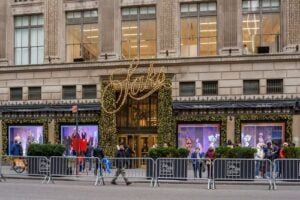
The Fifth Avenue flagship opened on September 15, 1924, and the crowds were so large that office employees reportedly had to help serve customers. Its location near St. Patrick’s Cathedral became even more valuable when Rockefeller Center rose directly across Fifth Avenue during the 1930s.
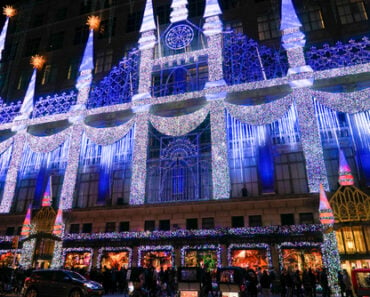
Saks Fifth Avenue became synonymous with European couture, personal shopping, cosmetics, and holiday spectacle. Its projected holiday light show paused in 2024 and returned in 2025. The flagship remained open through its parent company’s 2026 Chapter 11 reorganization and continues to operate as one of Fifth Avenue’s best-known luxury stores.
4. Bergdorf Goodman
Location: 754 Fifth Avenue at 58th Street
Founded: 1899 by Herman Bergdorf and Edwin Goodman
Status: Open
Claim to Fame: High-society luxury on the former Vanderbilt mansion site
Alsatian immigrant Herman Bergdorf opened a tailor shop in 1899 and soon began working with Edwin Goodman, who eventually bought out his mentor. Goodman moved the business steadily uptown as its reputation grew among New York’s wealthiest customers.
The current Fifth Avenue building opened in 1928 on the former site of the Cornelius Vanderbilt II mansion, once the largest private home in New York City. Bergdorf Goodman became the building’s defining tenant and eventually occupied the entire property. The Goodman family also maintained a private penthouse apartment above the store, turning the retail palace into a home as well as a business.
Bergdorf Goodman became known for couture, exclusive designers, society weddings, and highly personal service. Its artistic holiday windows are planned months in advance and remain among the most elaborate displays in the city. The Fifth Avenue women’s store and the men’s store across the street continue to operate.
5. Lord & Taylor
Location: 424 Fifth Avenue, between 38th and 39th Streets
Founded: 1826; Fifth Avenue flagship opened in 1914
Status: Closed
Claim to Fame: One of America’s oldest department stores and a holiday-window innovator
English immigrants Samuel Lord and George Washington Taylor founded their dry goods business on Catherine Street in 1826. Lord & Taylor grew alongside New York, moving from the Lower East Side to Broadway, then to Ladies’ Mile, and finally to Fifth Avenue.
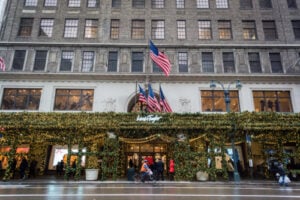
Its Italian Renaissance Revival flagship opened in 1914. The store became celebrated for animated holiday displays and dated its annual Christmas-window tradition to 1938. Lord & Taylor also made retail history in 1945 when Dorothy Shaver became its president, the first woman to hold that position at a prominent American retail store.
The Fifth Avenue flagship closed in January 2019. Amazon purchased the landmark building in 2020, renovated it, and opened offices there in 2023. The copper cornice, limestone base, grand entrance, and historic exterior remain, but the holiday windows that once drew crowds now belong to New York retail history.
Our complete history of Lord & Taylor looks back at the Fifth Avenue flagship, its celebrated holiday windows, and the end of the legendary store.
6. Gimbels
Location: 100 West 33rd Street at Greeley Square
New York Era: 1910 to 1986
Status: Closed
Claim to Fame: Macy’s fiercest Herald Square rival
When the Gimbel family brought its successful retail operation to New York in 1910, it opened a massive store at 33rd Street and Broadway, only one block from Macy’s. The rivalry became so famous that New Yorkers turned it into an expression: “Does Macy’s tell Gimbels?” It was the city’s way of saying that competitors did not share their secrets.
Gimbels competed through bargain pricing, a busy basement, showmanship, and direct transportation access. In 1926, the company erected an ornate three-story skybridge over 32nd Street to connect the main store with its offices and annex. The copper-clad bridge survives, although it has long been sealed and unused.
The rivalry became part of the story in Miracle on 34th Street, when Macy’s Santa surprised executives by directing shoppers to Gimbels. The chain closed in 1986. The former flagship later became A&S Plaza and then Manhattan Mall, but the mall itself is no longer operating. Much of the building now serves as office space, with the former mall concourse functioning largely as an entrance and lobby.
Read more about the rivalry, the bargain basement, and the famous Herald Square building in our deep history of Gimbels in New York City.
7. B. Altman & Co.
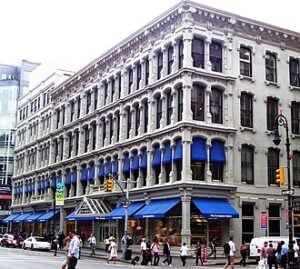
Photo: Beyond My Ken, CC BY-SA 4.0 <https://creativecommons.org/licenses/by-sa/4.0>, via Wikimedia Commons
Location: 355–371 Fifth Avenue at 34th Street
Active Years: 1865 to 1990
Status: Closed
Claim to Fame: The dignified Italian Renaissance palace that helped move shopping uptown
Benjamin Altman founded B. Altman & Co. in 1865. In 1906, he became the first major department-store owner to move from Ladies’ Mile to the stretch of Fifth Avenue above 34th Street, which was still lined with mansions. Designed by Trowbridge & Livingston, his Italian Renaissance-style building deliberately resembled a private palace more than a commercial store.
Altman was known for unusually progressive employee policies. His will created the Altman Foundation, in part to promote the welfare of the company’s workers, and he left his extraordinary collection of Rembrandts, Old Masters, and decorative art to the Metropolitan Museum of Art.
The store was remembered for quiet service, carpeted salons, elegant elevators, and the Charleston Garden restaurant, which included the facade of a Southern mansion. Bankruptcy and liquidation ended the company’s run, with the final stores closing by early 1990.
The Fifth Avenue side of the landmark building is now home to the CUNY Graduate Center. The New York Public Library’s former Science, Industry and Business Library on the Madison Avenue side closed in 2020, and other portions of the building have changed ownership or been prepared for new uses.
Nostalgia Note: For years, the Fifth Avenue facade carried no large store sign. The message was unmistakable: anyone who belonged there already knew the address.
Discover the remarkable story of Benjamin Altman and his Fifth Avenue retail palace in our complete history of B. Altman & Co.
8. Loehmann’s
Location: Founded in Brooklyn; famous New York locations included the Bronx and Chelsea
Active Years: 1921 to 2014 as a full department-store chain
Status: Closed as a full chain; later revived through limited pop-up sales
Claim to Fame: Off-price designer shopping and the legendary Back Room
Frieda Loehmann, a former department-store buyer, opened her first shop in Brooklyn in 1921. She purchased designer overstock and samples directly from manufacturers, then sold them at steep discounts. The formula helped create the modern off-price fashion business.
Loehmann’s became a New York institution through stores in the Bronx and later Chelsea. Shoppers accepted communal dressing rooms and crowded racks as part of the hunt. The greatest prizes waited inside the Back Room, where designer evening wear and couture pieces could be found at a fraction of Fifth Avenue prices.
The chain liquidated its stores in 2014 after repeated bankruptcies. Century 21 later acquired the Loehmann’s name and began reviving it through limited warehouse and pop-up sales, beginning on Long Island in 2025. The brand has returned in a limited form, but the great New York Loehmann’s department stores remain closed.
For more on Frieda Loehmann, the communal fitting rooms, and the legendary Back Room, visit our history of Loehmann’s department store.
9. Henri Bendel
Feature Photo: Wangkun Jia / Shutterstock.com
Location: 712 Fifth Avenue, between 55th and 56th Streets
Active Years: 1895 to 2019
Status: Closed
Claim to Fame: Designer discovery, brown-and-white stripes, and downtown style on Fifth Avenue
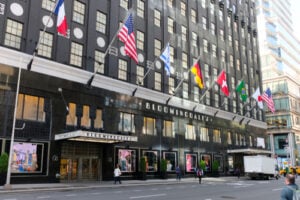
Louisiana-born milliner Henri Bendel opened his New York shop in 1895 and built a reputation among fashionable women. The store became known for introducing new European styles to American customers and was widely credited with bringing Coco Chanel’s designs to the United States. Its brown-and-white striped packaging became one of the most recognizable luxury signatures in New York.
Under president Geraldine Stutz, Bendel’s promoted emerging designers, developed the store-within-a-store boutique concept, and held open buying sessions where unknown creators could present their work directly to the store. A young Andy Warhol also worked for Bendel’s as a commercial illustrator.
Henri Bendel moved into 712 Fifth Avenue in 1990. The famous René Lalique glass windows on the facade belonged to the historic Coty Building and predated Bendel’s arrival, but they became inseparable from the store’s final era. L Brands closed Henri Bendel in January 2019 after 123 years. Jeweler Harry Winston later leased the former flagship space, while the landmark Lalique windows survived.
Our history of Henri Bendel explores the designers, personalities, and Fifth Avenue setting that made the store a New York institution.
10. Alexander’s
Location: 58th Street and Lexington Avenue in Manhattan; Fordham Road and the Grand Concourse in the Bronx
Active Years: 1928 to 1992
Status: Closed
Claim to Fame: High-volume value shopping for New York families
George Farkas founded Alexander’s in 1928 with a store on Third Avenue in the Bronx. The business grew into one of the region’s most powerful discount department-store chains. Its formula was simple: enormous selection, constant turnover, and prices that working families could afford.
The Manhattan flagship at 58th Street and Lexington Avenue stood directly across from Bloomingdale’s, placing high-end fashion and high-volume value on the same corner. For many Bronx families, however, the Alexander’s that mattered was the huge store at Fordham Road and the Grand Concourse. It anchored one of the busiest shopping districts in the borough, and its rooftop sign could be seen from blocks away.
I can speak to that store personally. When I lived on Bainbridge Avenue and 206th Street, Alexander’s on Fordham Road was only a few bus stops away, and I went there all the time. It did not matter that it was not around the corner. There was simply no other department store that big in the Bronx, and if you needed something, anything, that was where you went.
Alexander’s closed all its stores in 1992 after years of financial trouble. The Manhattan flagship was demolished and replaced by 731 Lexington Avenue, home to Bloomberg L.P.’s global headquarters and retail space. Remarkably, Alexander’s, Inc. survived the collapse of its stores and continues as a real estate investment trust.
Alexander’s played such an important role in New York retail history that we also published a complete history of Alexander’s department stores, including its unforgettable Bronx locations.
The Department Stores New York Never Forgot
New York’s department stores were never only places to buy things. They reflected neighborhoods, family budgets, social ambitions, and the city’s constant movement uptown. The surviving flagships still draw shoppers and tourists, while former retail palaces have become offices, schools, libraries, and modern commercial complexes. The stores may have changed or disappeared, but names including Gimbels, B. Altman, Lord & Taylor, Loehmann’s, and Alexander’s still unlock memories for generations of New Yorkers.
10 Famous NYC Department Stores at a Glance
| Rank | Store | Founded or NYC Era | Status Today |
|---|---|---|---|
| 1 | Macy’s Herald Square | 1858 to present | Operating |
| 2 | Bloomingdale’s | 1872 to present | Operating |
| 3 | Saks Fifth Avenue | 1867 to present | Operating |
| 4 | Bergdorf Goodman | 1899 to present | Operating |
| 5 | Lord & Taylor | 1826; Fifth Avenue flagship closed in 2019 | Closed; building reused as Amazon offices |
| 6 | Gimbels | New York flagship, 1910 to 1986 | Closed; building reused for offices and retail |
| 7 | B. Altman & Co. | 1865 to 1990 | Closed; building reused by CUNY and other occupants |
| 8 | Loehmann’s | 1921 to 2014 as a full store chain | Chain closed; brand revived through limited pop-up sales |
| 9 | Henri Bendel | 1895 to 2019 | Closed |
| 10 | Alexander’s | 1928 to 1992 | Closed; company survives as a real estate trust |
More New York City Shopping History
Continue exploring New York’s retail past with our articles on the history of History of New York’s John’s Bargain Stores, History of TSS Stores, Times Square Stores in NY, History of Sears, Roebuck and Co, and The History of Woolworth’s
10 Most Famous Department Stores in NYC History article published on ClassicNewYorkHistory.com © 2026