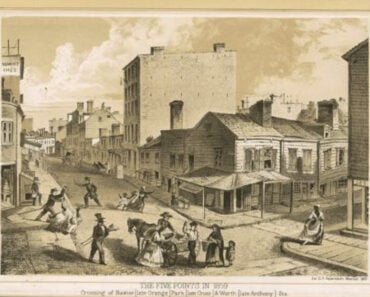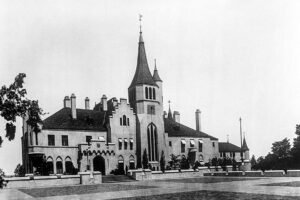
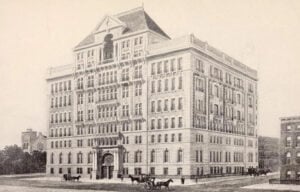
1899 architectural rendering of the Society of the Lying-In Hospital building at 305 Second Avenue. The building later became Manhattan General Hospital, where I was born in 1964. Source: Society of the Lying-In Hospital of the City of New York Annual Report, 1899. Public Domain.
New York City hospitals have stood on the front lines of epidemics, immigration, war, childbirth, public health crises, and some of the most important changes in American medicine. Yet the city has never been sentimental about buildings. Hospitals that once treated generations of New Yorkers have closed, merged, been demolished, or found entirely new uses.
Some of these institutions disappeared almost completely. Others survive in converted buildings where their original purpose still shows in the architecture. Together, these 10 lost and transformed New York City hospitals tell a larger story about medicine, neighborhoods, and the city’s constant reinvention.
1. St. Vincent’s Hospital
Active Years: 1849–2010
Location: Greenwich Village, centered around Seventh Avenue and West 11th Street
Founded by the Sisters of Charity in 1849 during a cholera epidemic, St. Vincent’s became Manhattan’s first Catholic hospital and one of Greenwich Village’s most important institutions. For more than 160 years, its history repeatedly intersected with moments of tragedy and crisis in New York.
St. Vincent’s treated victims of the 1911 Triangle Shirtwaist Factory fire and survivors of the RMS Titanic in 1912. Decades later, it became one of the hospitals most closely identified with the HIV/AIDS epidemic. In 1984, the hospital opened what became the first and largest dedicated AIDS ward on the East Coast. On September 11, 2001, St. Vincent’s also became an important downtown triage and treatment center after the attacks on the World Trade Center.
What Happened: St. Vincent’s declared bankruptcy and closed in 2010. Much of the hospital complex was subsequently redeveloped, although several structures were preserved and adapted.
What’s There Today: The Greenwich Lane residential development occupies much of the former hospital campus. Across the street stands the New York City AIDS Memorial, while the former O’Toole Building became Lenox Health Greenwich Village.
2. The Original New York Hospital
Original Downtown Site: 1791–1870
Location: Broadway between Duane and Worth Streets, Lower Manhattan
The Society of the New York Hospital received its royal charter from King George III in 1771, making it the oldest hospital organization in New York City and the second oldest hospital in the United States. Construction of its first building was delayed by a devastating fire and the Revolutionary War. British and Hessian troops used the unfinished and rebuilt structure as barracks and for medical purposes during the occupation of New York.
The hospital finally opened to civilian patients in 1791. The site was also connected to the infamous Doctors’ Riot of 1788, when public anger over grave robbing and anatomical dissection erupted into violence in Lower Manhattan.
What Happened: As Lower Manhattan became increasingly commercial, the hospital closed its original Broadway location in February 1870. A new hospital opened between West 15th and West 16th Streets near Fifth Avenue in 1877, and the institution later moved again to its present East 68th Street medical center.
What’s There Today: Commercial and civic buildings occupy the block where the original hospital once stood.
3. Sydenham Hospital
Active Years: 1892–1980
Location: 565 Manhattan Avenue, between West 123rd and West 124th Streets, Harlem
Sydenham Hospital became one of the most important institutions in the history of Black medical care in New York. Founded in 1892, it eventually moved to 565 Manhattan Avenue in Harlem and served a predominantly Black community at a time when discrimination restricted opportunities for Black physicians and nurses throughout American medicine.
In the 1940s, Sydenham adopted a fully integrated interracial staffing policy and became the first fully desegregated hospital in the United States. It employed Black physicians, nurses, and trustees with responsibilities and privileges that many other institutions still denied them.
What Happened: New York City took over Sydenham in 1949. During the fiscal crisis of the late 1970s, Mayor Ed Koch’s administration selected the hospital for closure. Harlem residents, doctors, nurses, and activists fought intensely to save it, but Sydenham closed in 1980.
What’s There Today: The former hospital complex was converted to residential use, while neighborhood health services continued under the Sydenham name.
4. Doctors Hospital
Active Years: 1930–2004
Location: 170 East End Avenue, between East 87th and East 88th Streets
Doctors Hospital was created by a group of prominent physicians and investors who wanted to provide affluent private patients with a level of privacy and comfort not commonly available in traditional hospital wards. The cornerstone was laid in 1929, and the hospital opened to patients in February 1930 overlooking Carl Schurz Park and Gracie Mansion.
For decades, Doctors Hospital became associated with wealthy New Yorkers, celebrities, public figures, and private patients who valued discretion and individual rooms. Beth Israel Medical Center acquired the institution in 1987, and it was later known as Beth Israel North and the Singer Division.
What Happened: Beth Israel closed the hospital in 2004. The building was demolished the following year.
What’s There Today: A luxury residential condominium development at 170 East End Avenue occupies the former hospital site.
5. Manhattan General Hospital
Active Years: 1920s–1964
Location: 305 Second Avenue at East 17th Street, Stuyvesant Square
Manhattan General Hospital eventually occupied one of the most distinctive medical buildings around Stuyvesant Square. The structure had originally been built in 1902 for the New York Lying-In Hospital, a maternity institution whose history reached back to the end of the 18th century. After the Lying-In Hospital moved uptown in 1932, the building became home to Manhattan General, a private proprietary hospital.
Manhattan General has a little extra special meaning to me personally. I was born there in 1961, when my mother was living in a tenement building at 29th Street and Second Avenue. That places my own family’s story inside the final year of Manhattan General’s life as an independent hospital, just before Beth Israel took over the institution.
What Happened: Beth Israel acquired Manhattan General in 1964. The following year, the former hospital building became the Morris J. Bernstein Institute, an important inpatient center for the treatment of alcoholism and drug addiction.
What’s There Today: Unlike many hospitals on this list, the building itself survives. Beth Israel sold it in the 1980s, and the former hospital was converted into the Rutherford Place residential complex at 305 Second Avenue. Its original medical history remains visible in architectural details on the facade, including sculpted infants dating from its years as the Lying-In Hospital.
6. French Hospital
Active Years: 1881–1977
Later Location: 330 West 30th Street, Chelsea
The Société Française de Bienfaisance, or French Benevolent Society, established French Hospital to serve French residents of New York as well as the broader population. The institution moved several times before settling into a large new hospital complex on West 30th Street in the late 1920s.
The Chelsea Hospital served an area filled with working-class residents, immigrants, railroad workers, and families living near Penn Station and the West Side. Its French identity remained part of the institution even as its patient population expanded well beyond the city’s French-speaking community.
What Happened: French Hospital closed in 1977 after years of financial difficulties.
What’s There Today: The hospital buildings survive as the French Apartments, an affordable housing complex at 330 West 30th Street and 329 West 29th Street.
7. Triboro Hospital for Tuberculosis
Opened: 1941
Location: Parsons Boulevard, Jamaica, Queens
Triboro Hospital for Tuberculosis was one of the great public-health projects of Mayor Fiorello La Guardia’s era. Architect John Russell Pope began the design, which was completed by Eggers & Higgins after his death. The Art Moderne hospital opened in January 1941 with more than 500 beds.
The building was designed around the medical thinking of the tuberculosis era. Large windows, sunrooms, terraces, and balconies maximized access to sunlight and fresh air for patients receiving long-term treatment.
What Happened: As effective drug therapies transformed tuberculosis treatment, the need for enormous dedicated sanitariums declined. Triboro was eventually incorporated into Queens Hospital Center and used for other medical purposes.
What’s There Today: The landmark building survived. After an extensive adaptive-reuse project, the former tuberculosis hospital reopened as the T Building, containing 200 affordable and supportive apartments, including housing for people who had experienced homelessness.
8. St. Mary’s Hospital of Brooklyn
Active Years: Late 19th century–2005
Location: 170 Buffalo Avenue, Crown Heights, Brooklyn
St. Mary’s Hospital served Brooklyn for more than a century and became a major Catholic medical institution for the surrounding Crown Heights community. Generations of Brooklyn families used the hospital for emergency care, surgery, maternity services, and other forms of inpatient treatment.
What Happened: St. Mary’s became part of the Saint Vincent Catholic Medical Centers network and closed in 2005 amid severe financial problems within the system.
What’s There Today: The large former hospital building at 170 Buffalo Avenue survived years of vacancy. It was later renovated and converted into the Brooklyn Center for Rehabilitation and Residential Health Care, preserving the massive hospital structure while giving it a new health-care use.
9. New York Infirmary for Women and Children
Founded: 1857
Original Location: Bleecker Street; later centered at 321 East 15th Street
Dr. Elizabeth Blackwell, the first woman in the United States to receive a medical degree, founded the New York Infirmary for Indigent Women and Children in 1857 with her sister Dr. Emily Blackwell and Dr. Marie Zakrzewska. The institution provided medical care to poor women and children while creating something that established hospitals had denied female physicians: a place to practice, teach, and gain clinical experience.
The infirmary became a landmark in the history of women in American medicine. It also established the Woman’s Medical College of the New York Infirmary in 1868, helping train generations of women physicians.
What Happened: The New York Infirmary merged with Beekman Downtown Hospital in 1979. Hospital operations were consolidated downtown in 1981, and the combined institution eventually evolved into what is now NewYork-Presbyterian Lower Manhattan Hospital.
What’s There Today: The institution no longer operates as the New York Infirmary, but its legacy continues through NewYork-Presbyterian Lower Manhattan Hospital. Buildings associated with its later Stuyvesant Square campus have been adapted for other institutional and residential uses.
10. Willard Parker Hospital
Active Years: 1885–1955
Location: East 16th Street near the East River
Willard Parker Hospital was a municipal communicable-disease hospital created to isolate and treat New Yorkers suffering from dangerous infectious illnesses. Its wards received patients with diseases including scarlet fever, diphtheria, and other contagious conditions at a time when effective vaccines and antibiotics either did not exist or remained in their infancy.
The hospital also became part of one of New York’s most important public-health achievements. Dr. William H. Park and his colleagues helped advance bacteriological diagnosis and diphtheria treatment, and New York City first used diphtheria antitoxin at Willard Parker Hospital in 1895.
What Happened: Medical advances dramatically reduced the need for a large specialized infectious-disease hospital. Willard Parker closed in 1955, and its buildings were demolished.
What’s There Today: The East Side landscape around the former hospital site was transformed by postwar residential development and later waterfront changes. Stuyvesant Town-Peter Cooper Village and the modern Stuyvesant Cove area now define this section of Manhattan.
Sources
NYC LGBT Historic Sites Project: St. Vincent’s Hospital Manhattan
Weill Cornell Medicine Archives: History of New York Hospital
Schomburg Center, New York Public Library: Sydenham Hospital Protest Collection
New York City Municipal Archives: The Closing of Sydenham Hospital
Icahn School of Medicine at Mount Sinai Archives: Doctors Hospital
Mount Sinai Archives: New York Lying-In Hospital and Manhattan General Hospital
Mount Sinai Archives: Beth Israel Medical Center Records
Related Companies: French Apartments and the Former French Hospital
New York City Mayor’s Office: The Former Triboro Hospital T Building
New York City Department of City Planning: Former St. Mary’s Hospital at 170 Buffalo Avenue
NewYork-Presbyterian: Dr. Elizabeth Blackwell and the New York Infirmary
New York City Municipal Archives: Willard Parker Hospital Records
New York City Department of Health: Public Health Historical Chronology
More New York Medical and Institutional History
New York’s hospital history connects to a much larger story of how the state cared for people through changing ideas about medicine and institutional treatment. For more, read our histories of Rockland State Psychiatric Center, Pilgrim Psychiatric Center, Harlem Valley Psychiatric Center, and my firsthand story of performing at Kings Park Psychiatric Center.
Updated August 20, 2026.