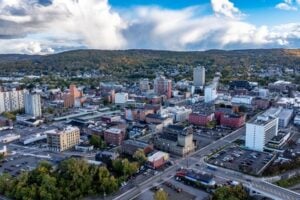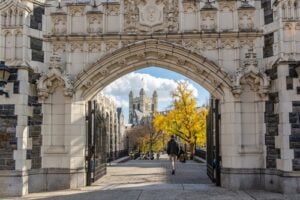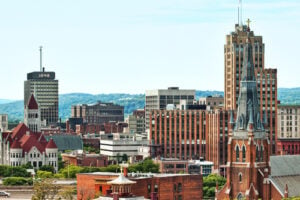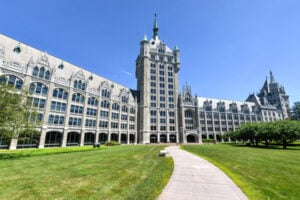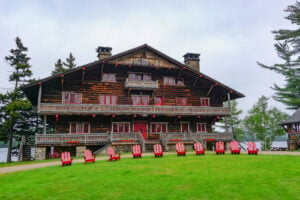

My son Cole on the SUNY Plattsburgh campus in Upstate New York. Photo by Brian Kachejian.
The first college I ever attended was Sullivan County Community College. It was not really far upstate, about a three-hour drive from Long Island, but it was far enough to offer a very different experience from suburban life. It was almost like I had moved to another state. The isolation you experience in a small town like Loch Sheldrake, away from city and suburban attractions and distractions, created a real sense of community among the students I met and befriended. It would prove to be one of the most enjoyable times of my life. Years later, I watched my son go to college upstate in Plattsburgh, and I saw him experience much of the same thing. So while many of the reasons below offer logical explanations for why students choose to attend college in Upstate New York, the experience you hopefully find through the people you meet and the opportunities you engage in may ultimately outweigh every other reason on this list.
Choosing a college is deeply personal, but Upstate New York gives students an unusually wide range of options within one region. There are major research universities, small liberal arts colleges, specialized technology schools, music conservatories, and a large network of public SUNY campuses spread across the Hudson Valley, Capital District, Mohawk Valley, Central New York, the Southern Tier, the Finger Lakes, Western New York, and the North Country.
The attraction is not one single thing. Some students come for academics or price. Others want a traditional residential campus, a strong college town, outdoor recreation, Division I sports, or access to research and internships. Taken together, these are ten of the strongest reasons students consider attending college in Upstate New York.
1. An Exceptional Range of Academic Choices
Upstate New York is home to institutions with very different academic identities. Cornell University in Ithaca includes colleges devoted to agriculture and life sciences, engineering, architecture, computing, human ecology, veterinary medicine, business, public policy, and the liberal arts. Rensselaer Polytechnic Institute in Troy, founded in 1824, describes itself as the first technological research university in the United States. The University of Rochester is especially well known for its Institute of Optics, founded in 1929 as the nation’s first optics education program, while its Eastman School of Music has been part of the university since 1921.
Students who prefer a smaller liberal arts environment can look to schools such as Hamilton College, Colgate University, and Skidmore College. Syracuse University, Clarkson University, Union College, Ithaca College, Hobart and William Smith Colleges, and many other institutions add still more choices. The strength of the region is not that every school offers the same experience, but that students can choose among very different academic models without leaving New York State.
2. The Value of the SUNY System
For New York residents, the State University of New York system can make the financial side of college especially attractive. SUNY lists 2026–27 undergraduate tuition at $7,070 for New York residents attending state-operated campuses in bachelor’s degree programs, before student fees, housing, food, books, transportation, and other expenses are added.
Major upstate SUNY institutions include the University at Buffalo, Binghamton University, and the University at Albany, while campuses such as SUNY Geneseo, SUNY New Paltz, SUNY Cortland, SUNY Oneonta, SUNY Oswego, SUNY Plattsburgh, SUNY Potsdam, SUNY Fredonia, and SUNY Polytechnic Institute give students additional choices in size, setting, and academic focus. Undergraduate research is not limited to the largest universities; campuses including Binghamton and SUNY New Paltz maintain formal programs that connect students with faculty research, scholarship, and creative work.
3. Traditional College Campuses With Memorable Settings
Students who imagine college as a place with quads, lawns, towers, historic buildings, and long walks between classes can find plenty of that Upstate. Cornell’s campus is cut by Fall Creek Gorge and Cascadilla Gorge, giving students access to waterfalls, trails, and exposed rock formations directly around the university. Colgate rises above the village of Hamilton, while Hamilton College occupies College Hill outside Clinton and SUNY Geneseo overlooks the broad Genesee Valley.
The architecture varies from nineteenth-century stone and brick to modern research facilities, but many Upstate campuses have enough space for gardens, athletic fields, wooded areas, and large residential complexes. For students who want the campus itself to feel like a distinct place rather than a collection of buildings scattered through a major city, that can be a significant attraction.
4. Four-Season Outdoor Recreation
Geography is part of the college experience in Upstate New York. Depending on the school, students may be close to the Adirondacks, Catskills, Finger Lakes, Hudson Valley, Great Lakes, or St. Lawrence River. Ithaca students have gorges and waterfalls woven directly into the local landscape. New Paltz sits beneath the Shawangunk Ridge. North Country colleges provide access to the Adirondacks, while Finger Lakes schools are surrounded by lakes, state parks, and hiking country.
The seasons change the experience throughout the academic year. Fall brings foliage and hiking, winter brings skiing, snowboarding, skating, and snowshoeing, and spring brings students back onto trails, lakes, and campus greens. The long winter is not for everyone, but students who enjoy four distinct seasons often see it as part of the appeal rather than a drawback.
5. Real College Towns With Their Own Identity
Some of New York’s strongest college communities are places where the school and town are closely connected. Ithaca combines Cornell University and Ithaca College with downtown Ithaca, the Commons, Collegetown, restaurants, shops, music, and an unusually strong local culture. Saratoga Springs gives Skidmore students access to a walkable downtown, arts venues, parks, restaurants, and the city’s long-established cultural life.
Geneseo, New Paltz, Oneonta, Potsdam, Canton, and Hamilton provide smaller versions of the same idea. Students can leave campus and still feel as though they are part of a community shaped in part by college life. For many students, that relationship between campus and town becomes almost as important as the campus itself.
6. Residential Campus Life Can Be More Immersive
Many Upstate colleges place a strong emphasis on residential life. Students may live in residence halls, eat in campus dining facilities, join clubs, attend performances and lectures, participate in intramural or varsity sports, and spend much of their social time within walking distance of where they take classes.
That kind of setting appeals to students who want college to be more than a daily commute to lectures. It can make it easier to participate in student organizations, meet people outside a major, attend campus events, and develop a stronger sense of connection to the institution. The experience varies greatly by school, but Upstate New York offers many campuses built specifically around this residential model.
7. College Sports Can Become a Major Part of Campus Culture
For students who enjoy college athletics, Upstate New York has several distinctive sports traditions. Syracuse University’s JMA Wireless Dome seats 42,774 for football and lacrosse and 30,286 for basketball, making Orange games major campus and regional events. College hockey is equally important at many schools.
ECAC Hockey includes New York programs such as Cornell, Colgate, RPI, Clarkson, St. Lawrence, and Union. Cornell’s Lynah Rink holds more than 4,200 fans and is famous for the “Lynah Faithful,” while RPI’s Houston Field House seats more than 4,800. Even for students who never compete on a varsity team, game nights can become a major part of the social rhythm of the academic year.
8. Research, Technology, Government, and Internship Opportunities
Upstate New York’s economy gives students access to opportunities that go well beyond traditional campus jobs. In Albany, the University at Albany’s College of Nanotechnology, Science, and Engineering works at the NY Creates Albany NanoTech Complex, a major semiconductor research and development center. NY Creates also operates student training and internship programs connected to semiconductor fabrication.
The broader technology corridor continues to expand. Wolfspeed operates a silicon carbide fabrication facility in Marcy in the Mohawk Valley, GlobalFoundries operates its large semiconductor manufacturing site in Malta, and Micron is developing its major semiconductor project in Clay near Syracuse. In Albany, students interested in government and public policy also have direct access to New York State agencies and legislative internships; UAlbany administers programs that place students in the State Senate and Assembly.
9. Living Costs Can Be More Manageable in Some College Markets
Cost is never uniform across Upstate New York. Ithaca, Saratoga Springs, and other highly desirable college communities can be expensive, and students should never assume that moving off campus will automatically save money. Binghamton University specifically advises students to compare rent, utilities, food, insurance, transportation, and other expenses before deciding whether off-campus living is cheaper.
Still, the region gives students a wide range of housing markets to compare, from larger cities such as Buffalo, Rochester, Syracuse, Albany, and Binghamton to smaller communities such as Cortland, Oneonta, Potsdam, and Plattsburgh. For families trying to control the total cost of a four-year degree, that variety can matter almost as much as tuition.
10. A Different Environment for Building Independence
For students coming from New York City, Long Island, or other densely populated areas, going to college upstate can provide enough distance from home to build independence without necessarily leaving New York State. A smaller city or college town can feel easier to navigate while still offering academic programs, internships, cultural events, athletics, restaurants, and social life.
That setting will not suit everyone, and some students will always prefer a major urban campus. But for students looking for a place where the campus, town, landscape, and academic community are closely connected, Upstate New York offers a college experience that can feel distinctly different from attending school in New York City or another large metropolitan center.
For more on college life across the region, see The 10 Best College Towns in Upstate New York, Ranked by Character, Walkability, and Quality of Life and The 10 Most Visually Stunning and Scenic College Campuses in Upstate New York. You can also explore 25 Famous People You Didn’t Know Went to College in Upstate New York.